
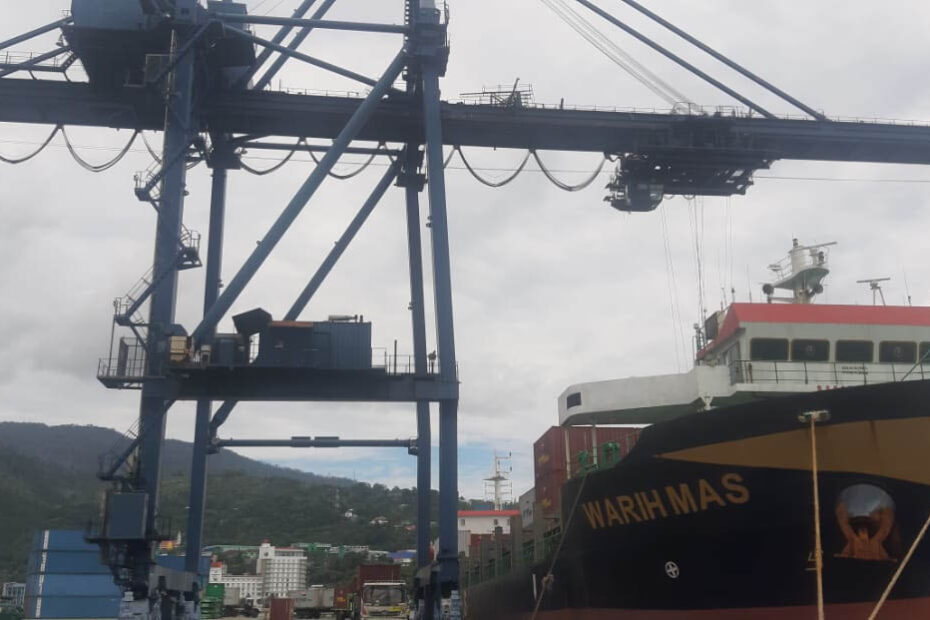
Jayapura port has been getting improvement since the operator, PT Pelindo (Pelindo Terminal Petikemas Sub-holding/SPTP) did digitalization and planning control – based operation. But, this does not automatically help the province exit from complicated problems in distribution of cargoes within the provinces. This province calls for land access improvement, connecting the port (Jayapura Port) with hinterland, other distribution centres (airports), and end users.
Papua is known as the region in the country with the highest logistics cost for a very long time, making the price of goods, the industrial products in particular, as the most expensive. Acute problems of poor infrastructure and poor performance of transportation facilities have long paralyzed the province, and not to mention its topographical condition which is, for some instance, impossible to be accessed by land transportation mode.
As one of the transportation infrastructure and facility for the province, Jayapura Port, has also been labelled as one of the ports within the country with low performance, though it still played as a centre of distribution for the province. Longer port stay and cargo stay and lower productivity were blamed as the causes why cargoes were late to be delivered to end users.
However, there are evidences to say in the last two years, the port has gradually got improvement. PT Pelindo’s transformation programs through digitalization and planning control-based operation have helped to fasten the process of cargo (container) stevedoring at the berth, loading/unloading at the CY (container yard), and the process of delivery and receiving to/from the terminal as well.
Supported by its facilities of 2 QC (Quay crane), 4 RTGs (Rubber Tired Gantry), 3 Reach Stakers, 2 Forklifts, 4 head trucks, 4 trontons, 1 CY crane, 1 pilot boat, and 1 tug boat, its port stay and cargo stay have shortened significantly, while its moves both during the stevedoring process (BSH – box/ship/hour) has increased significantly.
According to SPTP data, the Jayapura port stay has shortened from 36 to only 17 hours. The BSH has increased from 18 to 52.
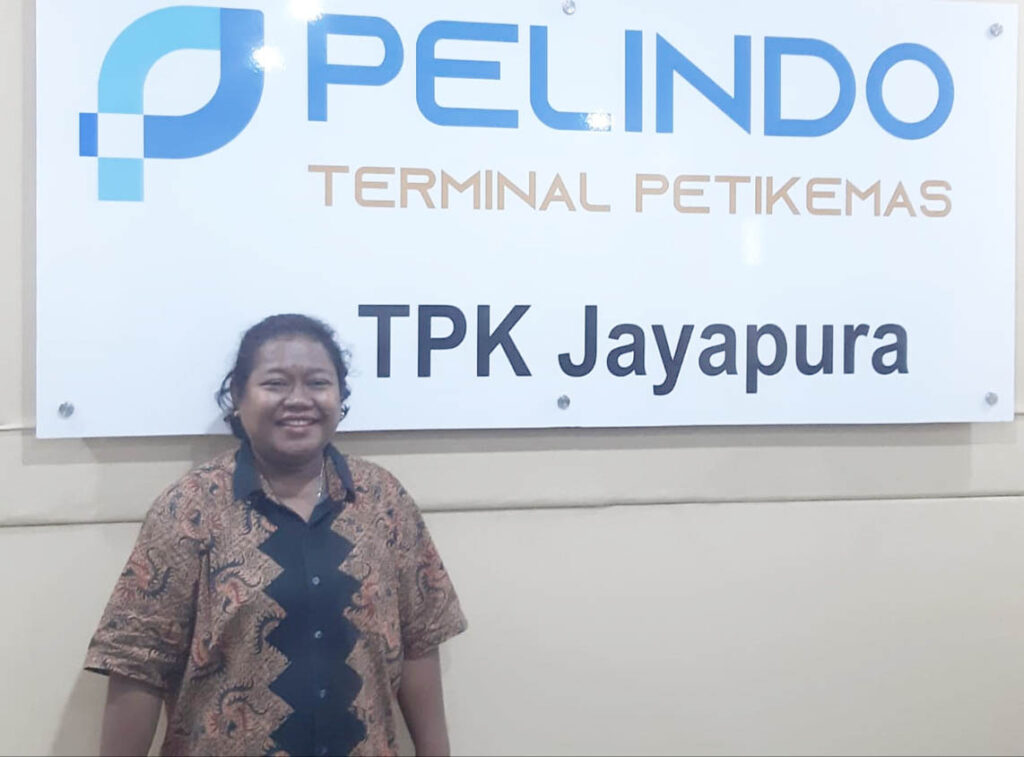
Terminal Head TPK Jayapura Welta Selfie explained that such achievement was reached through appropriate transformation without investment for facilities and equipment. “No additional equipment of QC, nor RTG and reach stakers, except that we do planning control-based operation to optimize their (equipment) productivity, in addition to add our work day on Sunday. And, of course, we improve our human resources capability in line with our transformation steps in operation,” she said.
In 2022, she said, our BSH was only 13. Then it increased to 36 at early this year and continue to increase in the months after.
However, Selfie affirmed that this productivity increase was not in parallel with the throughput growth. “But, good to know that the throughput growth mostly hangs on the trade volume. Whenever the demand of cargo from this province down, it impacts on the terminal throughput.”
According to data, until August 2023, TPK Jayapura throughput reached 51,713 TEUs, down from 62,007 TEUs in the same period last year (January-August 2022). However, Selfie is optimistic to reach yearly target of 2023 which is contracted to 98,294 TEUs.
Echoing the view TPK Jayapura Operation Manager Jems Yeffry Fonataba explained that the throughput drop was mostly due to the drop of demand on consumer goods from the province. Consumers goods remain the inbound dominant commodities to the province.
“The lower purchasing power of the community in this province has significantly impacted on the drop of demand to consumer goods and building material as well, the two dominant commodities we handled at this terminal,” he said.
Shipping, Forwarders Operating Cost Down 30%
Contacted sources from shipping lines and forwarding companies affirmed the transformation at this terminal has fastened their operation. The transformation, they said, have made their TRV (turn round voyage) in shipping and cycle time in logistics distribution become shorter. In addition, the improvement of port service has cut their operating cost by more than 30%.
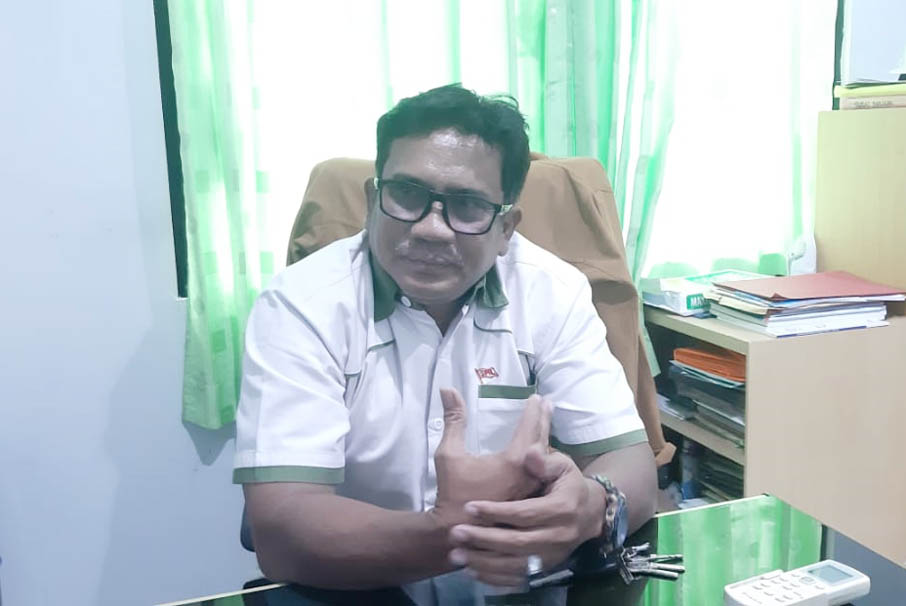
Jayapura Branch Head of PT Salam Pacific Indonesia Lines (SPIL) Slamet Sampurno, who is also Chairman of Jayapura Indonesian National Shipowner’s Association (INSA Jayapura) amended it, saying the combination of the port (Pelindo) programs of digitalization, planning control, and Sunday work day, have created a lot of benefits to shipping business.
SPIL is the dominant player of shipping business to/from the port, with market share reaching 60%, while 40% of the market goes to Tanto and Temas.
“It is true that the BSH has increased significantly, thanks to the Pelindo transformation in operation and application of digitalization that supports an easier process of document and billing,” said Slamet.
“In addition, this higher BSH is also a result of additional work day of Sunday,” he said. As reported earlier, any related parties, including government, social and religion institutions, and dockers have agreed to make Sunday as a work day.
“By adjusting working times, loading and unloading can be completed more quickly and the ship can sail straight to its next destination,” he said. One of the SPIL ships even completed loading and unloading of 650 containers in only 11 hours.
The increase of BSH, according to Slamet, has make port stay become shorter. , and finally will make TRV (turn round voyage) become shorter.
“Of course we will save much cost from the charge for berthing at the terminal and surely our (shipping operating cost),” he said. Slamet explained that this has cut shipping operating cost by more than 30%.
Like shipping lines, forwarders also admitted the operation transformation and digitalization has helped fastening the process of document and container delivery from the terminal, thanks to the adoption of IBS (Integrated Billing System).

Ernest Montolalu, owner of forwarding Serakoy Raya, explained that the IBS has helped the forwarders in document process, while the planning control-based operation at the terminal has cut down the TRT (truck round time) for delivering a container from terminal.
“No need to queue at the counter to process documents, but by online via IBS. The billing process is also faster via this IBS,” Ernest explained.
“The TRT is also become shorter and shorter. A truck only spends more than 15 minutes to load a container from a terminal,” he said.
Land Site Improvement for Better Logistic Distribution
Since Jayapura Port plays as a central for distribution to the province, improvement of the access at the land site connecting the port with hinterland and end users are very urgent.
Jayapura Port is the centre of cargo distribution to 14 regencies within the province, including City of Jayapura, Jayapura Regency, Keerom, Sarmi, Mamberamo Raya, Mamberamo Tengah, Jayawijaya, Lanny Jaya, Pegunungan Bintang, Puncak, Puncak Jaya, Tolikara, Yahukimo, Nduga and Yalimo.
“We call for road access improvement from the port to some end users in Jayapura and surroundings, and to the Sentani airport, thus it can be easily delivered by air modes to certain regencies that cannot be accessed by land transport,” said Ernest.
For information, some cargoes in the provinces have to be delivered with air mode (airplanes) due to unavailable land access. “We have to build synergy with air forwarders to deliver the cargoes by air mode. So, we expect the port access to be improved,” Ernest said further.

In responding this, Jayapura Major Frans Pekey explained that the government will continue to coordinate with relating parties, including Pelindo, on how to overcome the problem of access connecting the port with hinterlands and end users or with the airport. Frans admitted that the road access to the port remained a problem for smooth delivery of cargo from the port.
“We admitted that narrow road access as a problem from smooth delivery. We actually try to find some solution, including the option to widen the road. But, it will cost much, including cost for relocation those impacted.”
But, Frans appreciate any efforts the Pelindo has taken to support smooth cargo flow at the port. Frans affirmed that the faster process of container loading/unloading at the port has helped the process of logistics distribution at the province, especially the distribution of basic needs, thus keeping the price stability and the province inflation rate.
According to Bank Indonesia (BI) Papua data, Papua inflation year to date is 2.36%, lower than last year and much lower than the high record in 2021.