
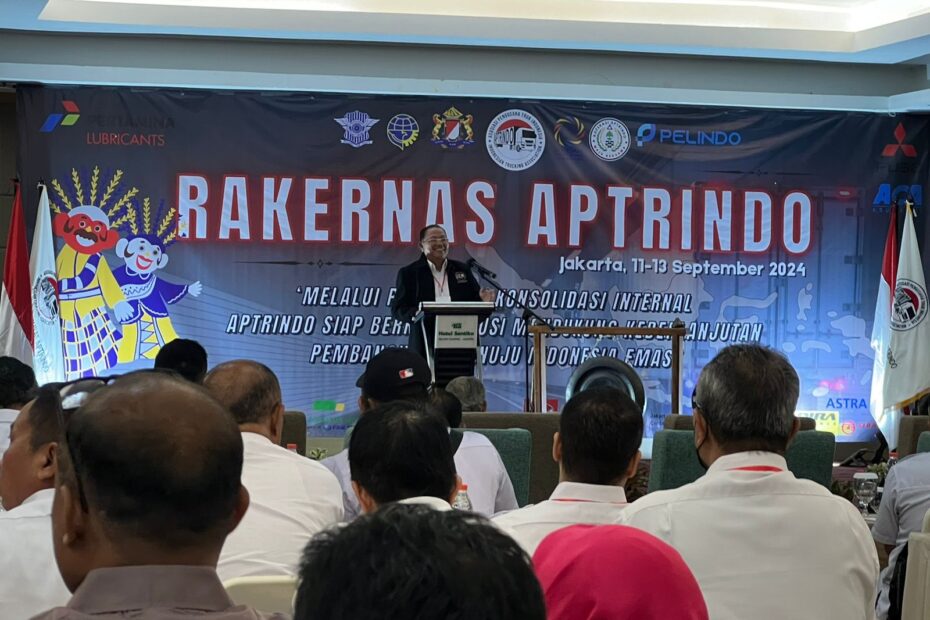
Indonesia Trucking Companies’ Association APTRINDO’s National Meeting (Rakernas) 2024 recommends three key points to government, the related ministers. The three point relate to the government programs of ODOL (over dimension over load), subsidized fuel (diesel), and halal trucking.
Aptrindo had just conducted national meeting on September 11-13, 2024.
Aptrindo Chairman Gemilang Tarigan explained that after going through a long discussion and debate during the Rakernas, members of Aptrindo then conveyed official stance on the issues.
First, the trucking companies call for stopping the program of over dimension over load (ODOL) as the actions taken by the relevant agencies so far have not been comprehensive or selective.
Gemilang said that until now Aptrindo considers that the problem of eradicating ODOL practices tends to be unsuccessful and on the other hand trucking companies do not have a strong bargaining position in facing the cargo owners.
“Therefore, Aptrindo considers that the ODOL eradication program has not been successful, and is actually very detrimental to trucking operators. That’ is why we currently state that we reject the continuation of the program,” Gemilang said today, Friday, September 13.
Second, stop the program of subsidized fuel (diesel BBM) program for the fleet of trucks transporting cargoes throughout Indonesia.
The reason is, with the existence of subsidized fuel (diesel) for goods transportation, there is uncertainty about the availability and adequate supply of this type of fuel for goods transportation.
“As a result, there are many complaints from our member trucks in areas that have difficulty obtaining this type of fuel so that the truck fleet cannot operate and many lose transportation orders. The impact is that logistics are actually hampered and costs have soared,” he said.
According to Gemilang, from the beginning, Aptrindo proposed to eliminate subsidized fuel for goods transportation so that there is operational clarity and certainty in the trucking business climate that supports the smooth running of national logistics.
“For us (trucking), the main thing is that there must be certainty that fuel for goods transportation is always ready when needed. If there is no fuel, how can trucks operate?” explained Gemilang.
Third, reject the mandatory ‘Halal Logistics’ certification program for trucking companies or fleets, because this regulation actually increases the licensing bureaucracy and burdens the trucking business.
Gemilang emphasized that in principle (in terms of business) logistics trucks should not need to comply with ‘halal logistics’ certification, because trucking never knows the detailed information classification of the goods it loads, because trucking only accepts truck loading services.
“In other words, we (trucking) do not distribute goods but only transport goods. So regarding whether it is halal or not, the regulation is carried out by the owner of the goods or is free on the truck,” Gemilang argued.
Until now, the issue of ‘halal logistics’ certification for trucks transporting food and beverage products has become a polemic ahead of its implementation on October 17, 2024.
Previously, the Halal Product Guarantee Agency (BPJH) stated that the category of storage service activities (cold storage), packaging to distribution of food and beverage products, had not been optimal in complying with the obligation of ‘halal logistics’ certification.
This category includes storage services or Cold Storage and Warehousing, Product Packaging Services for food and beverages (not repackaging products) for Food and Beverage Products. As for distribution services, they include containers for food and beverage products, forwarders for food and beverage commodities, transporters (trucking), shipping, air cargo, train cargo, and courier/delivery services for food and beverage products.