
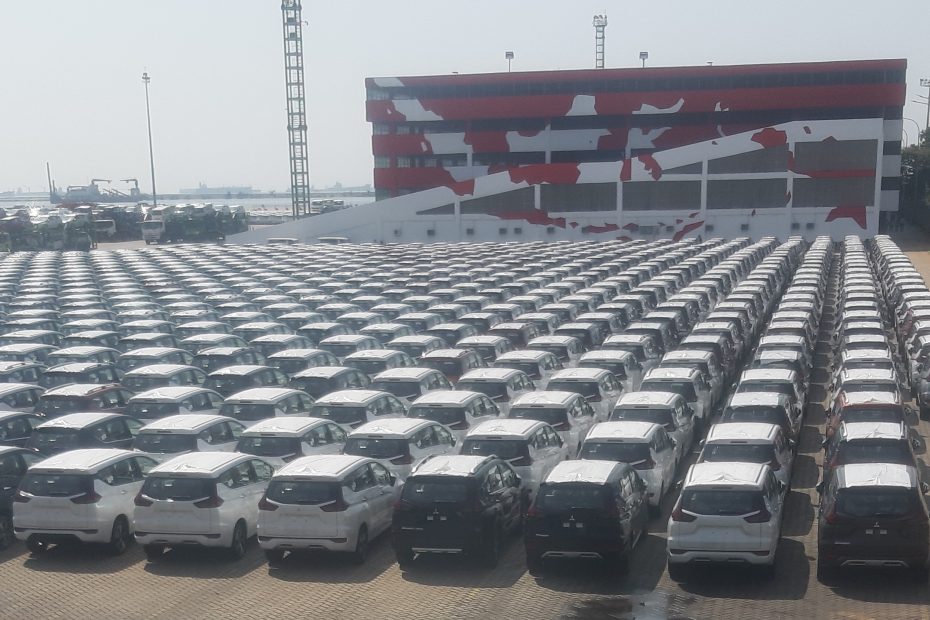
Photo: IKT/IPCC Car Terminal Tanjung Priok, the Indonesia’s main gateway for automotive export/import
Between January and October 2024, Indonesia’s automotive industry saw impressive growth, with key production, sales, and export figures reflecting the sector’s ongoing expansion. The Ministry of Industry reported that a total of 996,000 four-wheeled vehicles were produced during this period. Of these, 710,000 units were sold domestically, 390,000 were exported as Completely Built Units (CBUs), and 80,000 were imported as CBUs.
“This marks a 6.7% increase compared to 2023,” said Faisol Riza, Deputy Minister of Industry, in an official statement on Sunday, December 1st.
As part of its commitment to global sustainability goals, particularly the Net Zero Emissions (NZE) target, Indonesia is aiming for a 43.2% reduction in emissions by 2030. In response, the government is rolling out a series of measures designed to boost the adoption of electric vehicles (EVs). These incentives include the elimination of the Luxury Goods Sales Tax (PPnBM) on EVs, 0% import duties, and Government Borne Value Added Tax (PPN DTP) for electric vehicles.
“This regulation is intended to drive investment and accelerate the transition to clean energy. To support this transition, the Ministry of Industry is implementing a multi-pathway strategy to achieve the emission reduction targets,” said Faisol.
In line with these goals, the Ministry of Industry has introduced Regulation No. 36 of 2021, which provides tax incentives for vehicles with low carbon emissions. The regulation also emphasizes the importance of utilizing local components in the manufacturing process, offering both fiscal and non-fiscal incentives to companies that meet the Domestic Component Level (TKDN) requirements.
“Many local components are already being produced here in Indonesia. While some components are still imported, the local content is increasing—some vehicles already have close to 40% local components. The Ministry of Industry is working to further boost this number,” Faisol added.
To further enhance the development of the domestic electric vehicle ecosystem, the Indonesian government has revised its TKDN targets. The previous requirement of 40% TKDN until 2023 will now be gradually raised: 40% until 2026, 60% by 2029, and 80% by 2030.
“This shift is aimed at strengthening Indonesia’s domestic automotive industry, which is critical to our national economy. We want automotive manufacturers to set up factories in Indonesia because it creates jobs and drives economic growth,” Faisol emphasized.
He also highlighted the importance of protecting large automotive factories and their supply chains, especially the small and medium-sized industries that support them. “If these industries aren’t protected, it will lead to long-term challenges, especially considering the significant number of workers involved and the complexity of the industry,” Faisol said.
Looking to the future, the Deputy Minister predicted that electric vehicles would dominate Indonesia’s automotive market within the next five years. “We must start planning a transition from fossil fuel-powered vehicles to electric vehicles—or a combination of both. As regulators, it’s essential that we ensure the industry does not face contraction,” he added.
Echoing this sentiment, Rachmat Kaimuddin, Head of the National Energy Transition Task Force, noted that other Southeast Asian countries, such as Thailand, are also preparing for a shift toward EVs. “The global decline in conventional vehicle sales since 2017 underscores the need for us to embrace the transition. It’s not a matter of ‘if’ but ‘when’ the market will be dominated by electric vehicles,” Rachmat explained.
From a consumer perspective, Rachmat expressed confidence in the quality of electric vehicles entering the Indonesian market. However, he stressed the importance of the government ensuring that only high-quality EVs are available to consumers. “It is crucial that we maintain high standards so that Indonesian buyers receive reliable, top-notch products,” he concluded. As Indonesia navigates this critical transition, the combination of governmental incentives, strategic investments, and domestic innovation could shape the future of its automotive industry, positioning the nation as a leader in the global move toward sustainable transportation.