

The ongoing transformation of PT Pelabuhan Indonesia (Pelindo) following the merger and the down streaming of Southeast Sulawesi’s nickel industry has led to a significant increase in shipping activity at Kendari Port, particularly at the container terminal Kendari New Port (KNP). As a result, several shipping lines have added more calls to the port, driving higher throughput and reflecting a growing trend in port activity.
Three of the seven shipping lines currently calling at KNP—Meratus, Tanto, and SPIL—have reported increased calls over the past years, helping boost port throughput. These three shipping lines operate weekly calls to Kendari Port, and all have added extra sailings in response to rising demand.
Klemens Kenny, Head of the Meratus Kendari Branch, highlighted the growth, saying: “We now have seven calls a month, up from just four. We’ve added three new calls.”

Klemens Kenny
Meratus, the leading carrier at KNP, commands nearly 50% of the terminal’s total throughput. The company also operates larger vessels, with capacities ranging from 400-800 TEUs. Kenny noted that Meratus has seen an annual growth rate of 8-10%.
Similarly, Usman Bada, Branch Manager of SPIL Kendari, reported two additional calls this year, bringing the company’s total to six monthly calls, up from four. Like Meratus, SPIL has also experienced a 10% growth in volume handled.
Although Tanto has not added new calls, the shipping line has responded to the growing demand by increasing the size of the vessels it operates. Ramadhan Akbar, Head of the Tanto Kendari Branch, explained: “While we haven’t added new calls, we have upgraded our fleet capacity. The demand for cargo has been consistently growing over the past few years.”

Photo: Usman Bada
Currently, Tanto maintains four monthly calls at KNP.
The increase in shipping activity at Kendari New Port can be attributed to two key factors. First, Nickel Industry Downstreaming. The downstreaming of the nickel industry in Southeast Sulawesi has played a crucial role in driving cargo demand. As the region develops smelting facilities to process nickel into semi-finished goods, there is a growing need for raw materials and equipment to support the smelter operations.
Although most of the processed nickel products are still being shipped in bulk (not yet in containers), the rise of finished products like lithium in the future is expected to drive containerized cargo volumes higher.
Another important factor is the continued expansion of Southeast Sulawesi’s fisheries and agriculture sectors. This growth has contributed to a higher volume of return cargo from the province. The return load from Kendari is averaging about 30%, which is relatively high compared to the 10% return rate seen in other parts of Eastern Indonesia.
Second, port performance and Pelindo’s transformation. In addition to these sectoral shifts, the improved performance of Kendari Port since the launch of the Kendari New Port (KNP) has been instrumental in boosting shipping calls. The ongoing transformation led by Pelindo post-merger has been pivotal in enhancing port operations, encouraging more frequent visits from shipping lines.
Klemens Kenny pointed to significant improvements in operational efficiency:
“The loading and unloading speed at the port has increased dramatically. The average port stay is now just one day, down from two days previously. This is a major improvement from several years ago, when the average port stay was over three days.”
These operational enhancements have made Kendari Port more attractive to shipping companies, contributing to the growing number of calls.

Photo: Ramadhan Akbar
Currently, seven shipping lines operate at Kendari New Port, including Meratus, SPIL, Tanto, Temas, SRIL, Mentari, and SAMAS. Together, these lines make a total of 35 calls per month, demonstrating the continued growth and importance of Kendari Port as a key logistics hub in Southeast Sulawesi.
BSH Increases Significantly, Port Stay Reduced to Less Than a Day
According to data from TPK Kendari, which operates the KNP Port, the performance of Kendari Port has been steadily improving since the new KNP Port became operational in 2019. The KNP container terminal, with a capacity of 250,000 TEUs, has seen continuous growth in operational performance. Additionally, the significant transformation undertaken after the merger has further boosted operational efficiency.
“The increase in operational performance can be attributed to two key phases. The first phase occurred after the transfer of container operations from the Bungkutoko Conventional Terminal to KNP in 2019. The second phase followed the merger in 2021,” said Herryanto, Terminal Head of TPK Kendari.
Herryanto, who also serves as the General Manager (GM) of Kendari Port, highlighted that Kendari Port now operates four terminals: KNP, Bungkutoko Conventional Terminal, Nusantara Terminal, and Kendari City Boat Base Terminal.
Prior to the container transfer to KNP, ships often experienced long waiting times, sometimes extending for several days. “However, after the transfer in 2019, coupled with the systems transformation implemented post-merger in 2021, ship queues have almost disappeared,” Herryanto explained.
Operational data from TPK Kendari shows significant improvements. The average waiting time at KNP is now just 30 minutes, down from 1 hour in 2020 (before the merger). Compared to 2018—before KNP was operational, when waiting times could stretch for days—this represents a major improvement. The effective berthing time (ET/BT) has also risen from 68.75% in 2020 to 76.09% in 2024, well above the Directorate of Sea Transportation’s standard of 70%.
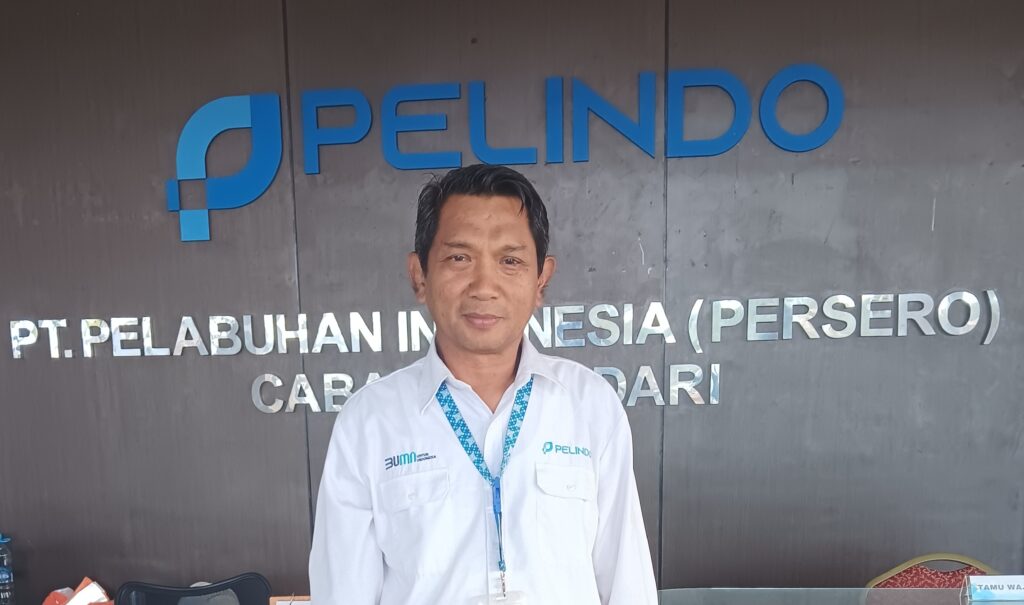
Photo: Herryanto
Freight services have also seen impressive growth. The Box/Ship/Hour (B/S/H) rate has increased from 11.05 in 2020 to 21.46 in 2024, while Box/Crane/Hour (B/C/H) has risen from 14.70 to 25.19 in 2024.
“In fact, B/S/H can reach 40 when two quay container cranes (QCCs) are used simultaneously to serve a single vessel,” said Klemens Kenny, confirming the significant operational improvements.
These advancements have had a major impact on port stay times. The average port stay for ships at KNP is now under a day, with ships carrying 800 TEUs staying for about 17 hours on average. “For smaller ships, the port stay is even shorter, often less than a day,” Kenny added.
Throughput Increases by 10%, Operational Availability at 93%
As of October 2024, KNP’s throughput has reached 112,112 TEUs, reflecting a 10% increase compared to the same period in 2023. Herryanto is confident that the port will meet its target of 130,000 TEUs by the end of the year.
Over the past three years, following the merger, KNP’s throughput has shown steady growth: from 95,835 TEUs in 2020 to 106,888 TEUs in 2021, 120,721 TEUs in 2022, and 128,456 TEUs in 2023.
This growth aligns with an increase in ship calls, which rose from 339 in 2021 to 363 in 2022 and 388 in 2023. As of October 2024, the number of ship calls has reached 322.
Despite the higher throughput and growing number of ship visits, key operational ratios such as Yard Occupancy Ratio (YOR) and Berth Occupancy Ratio (BOR) remain well within acceptable limits, far below the density standard. Currently, YOR is at 25.90% and BOR is at 39.40%, both well below the 70% threshold. This indicates that operational availability is still very high—around 93%.
“This shows that both the dock and the stacking yard are still more than adequate,” explained Herryanto. “With our current annual throughput of approximately 130,000 TEUs, and our terminal capacity of 250,000 TEUs, we are well within operational limits.”
The time spent by trucks delivering or picking up goods at the port has also been significantly reduced. The Truck Round Time (TRT) for deliveries is currently just 18 minutes, while receiving takes only 15 minutes. “This improvement is a direct result of the system transformation we implemented through better planning and control systems,” Herryanto added.
