

Photo: Capt Medi Kusuma
There are evidences to say that the massive adoption of digitalization system post-merger at Pelindo ports have helped to fasten service, create efficiency, and cut logistics cost. In addition, the digitalization, as the National Strategy for Corruption Prevention (Stranas-PK) has called, is meant to support transparency overall the government institutions, including the state-owned companies and its subsidiaries.
“In responding to those spirits and programs, the adoption of digitalization at Teluk Bayur will soon go live,” General Manager of Pelindo Regional 2 Teluk Bayur Capt Medi Kusuma disclosed in a recent discussion with Indonesia Shipping Gazette on March 28, 2024.
“If all run as planned, digitalization will go live by the end of April this year,” he said, adding that the digitalization will be applied to any kind of port services, from vessel calls at sea side until cargo receiving and delivery at the land side.
Medi names some digitalization programs that will soon go live, including the Single Truck Identity Document (STID), Terminal Operating Systemor TOS Nusantara (TONUS) for container terminal, and Pelindo Terminal Operating System Multipurpose (PTOS-M) for non-container terminal.
STID is a system that digitizes trucking services with only one card/document. The STID can control logistics trucks that are not suitable for operation because later they will also be connected with related agencies such as the Transportation Agency.
TONUS – a container terminal operating system that runs under a planning control-based operation and that will integrate all container terminals of state port operator PT Pelindo national wide – is built by internal Pelindo to replace its existing systems of I-TOS (a system for domestic container trade) and OPUS (international trade).
TONUS is a system based on the latest technology that supports end-to-end services at container terminals with planning and control-based operating patterns, starting from vessel planning, berth planning, yard planning, control tower.
The system comes with several advantages such as implementing solutions on several sites in one system (multi-tenant), ease of tracing and tracking cargo in the terminal (cargo-visibility), optimizing terminal business process operations in providing cargo/container services (terminal optimizer), low investment costs with volume-based pricing and cloud-based infrastructure (low investment) as well as easy integration of data and surrounding systems (open for integration).
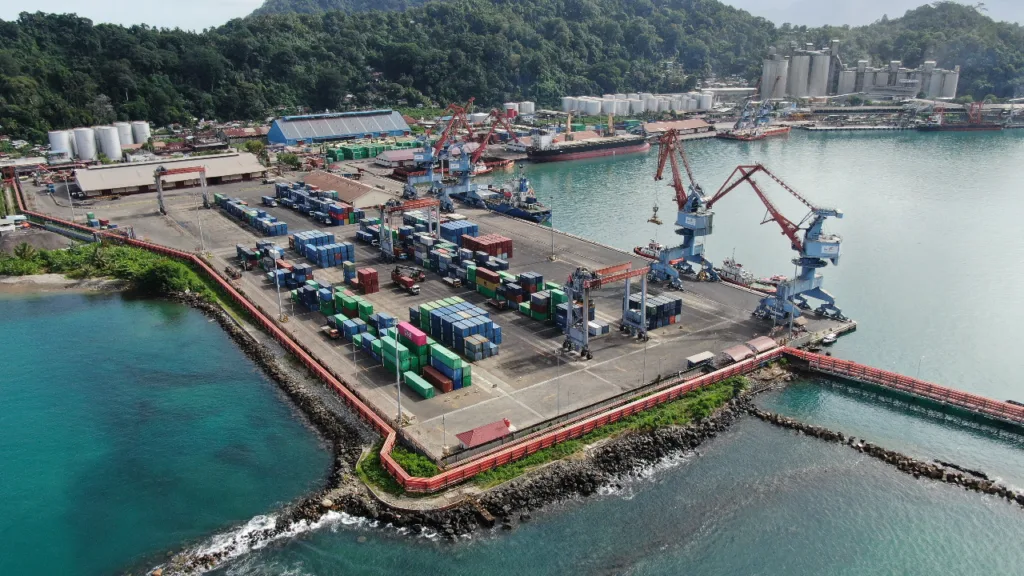
This system will provide various benefits, from terminal itself until customers. The terminal operating planning preparation times are more optimal with advanced ship planning and core functionality that supports port operational services. It provides benefits to customer as the system can be integrated with customer’ systems.
As reported earlier, in addition to STID and TONUS, Pelindo has also launched an integrated multi-terminal port operating system PTOS-M (Pelindo Terminal Operating System Multipurpose). This system is a single platform application supporting operations for port services for non-container cargo based on planning and controlling.
PTOSM has been gradually applied overall Pelindo ports nationwide since the end of 2022. PTOSM is integrated with other systems such as customer portals, ship service systems, and financial service systems. Apart from being integrated with several systems, PTOSM has features that provide easy services such as online booking requests, operation planning, inventory storage, and control & monitoring.
“In brief, in line with the Pelindo programs to go digital and for transparency as called by Stranas-PK, we will soon make those systems go live,” Medi explained.
Medi expects support from all port users, including shipping lines, cargo owners, truckers, and any port stakeholders to support this system application.
Hence, he expect the executive boards of the associations to witness the even in April, including chairmen of ALFI, INSA, APBMI, Aptrindo, GPEI, Organda and other related associations.
Non-container Terminal Expansion Urgent
In addition to digitalization program, Teluk Bayur Port also plans to expand its non-container (bulk) terminal expansion, in responding to the increasing volume of liquid bulk cargoes, the crude palm oil (CPO) commodities in particular.
“We will soon expand the terminal (berth) of break bulk as the CPO continue to grow,” explained Medi, adding that currently, in case of high calls, some of the CPO tankers, have to berth at container terminal.
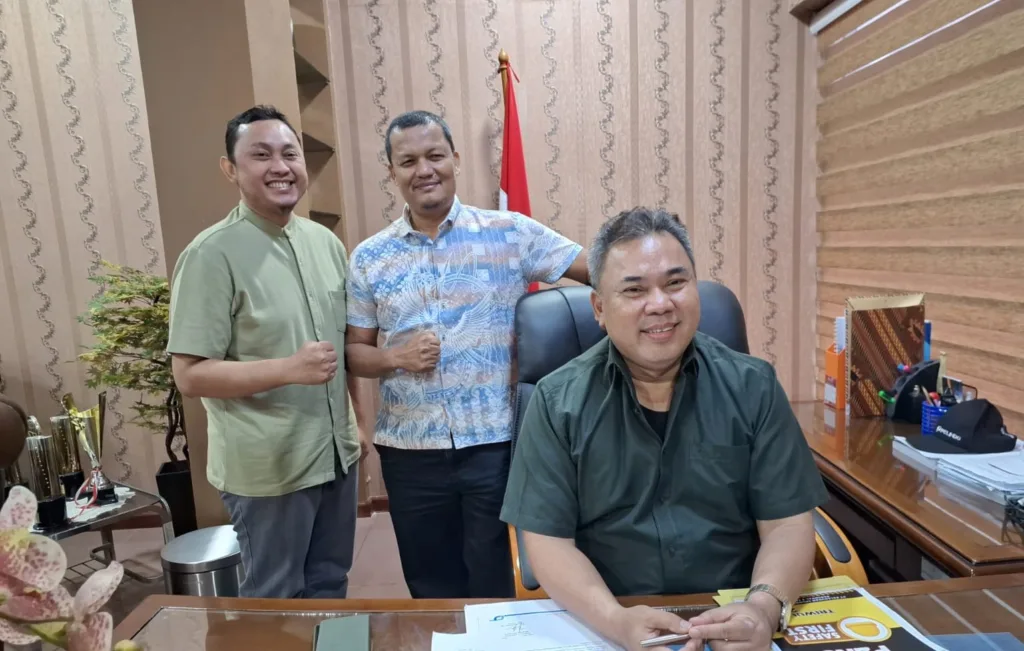
Photo: Hendri Adolf (center)
Deputy General Manager of Pelindo Regional 2 Teluk Bayur for Commercial Hendri Adolf explained that the CPO volume continued to increase in the last years. “Now, volume of CPO at this port has exceeded 3.5 million tons per annum, increasing from average 3 million tons in earlier years,” said Adolf.
“This will continue to increase in the next years. Our digitalization programs are expected to attract more and more tanker calls, while on the same time the production of CPO at the hinterlands are predictably to increase,” explained Adolf.
Therefore, according to Medi, expansion of non-container terminal is urgent. “Moreover, we will no longer use the container terminal for break bulk, as the trend of containerized cargo is also increasing,” Medi noted.
According to data, approaching to end of the first quarter of 2024 (January-March), TPK Teluk Bayur throughput has reached 24,183 TEUs (21,823 boxes), exceeding the total Q1 in 2023 that reached 23,886 TEUs (22,139 boxes).
The February throughput contributed the highest, reaching 9,351 TEUs (8,444 boxes), then followed by January of 7,744 TEUs (7,019 boxes), and March of 7,088 TEUs (6,360 boxes).
The achievement of container flows during the first three months of 2024 has increased compared to the realization for the same period in 2023 of 23,886 TEUs or the equivalent of 22,139 boxes.
TPK Teluk Bayur targets to handle 25,000 TEUs in Q1, while for the whole year of 2024, it targets to handled 98,286 TEUs.