
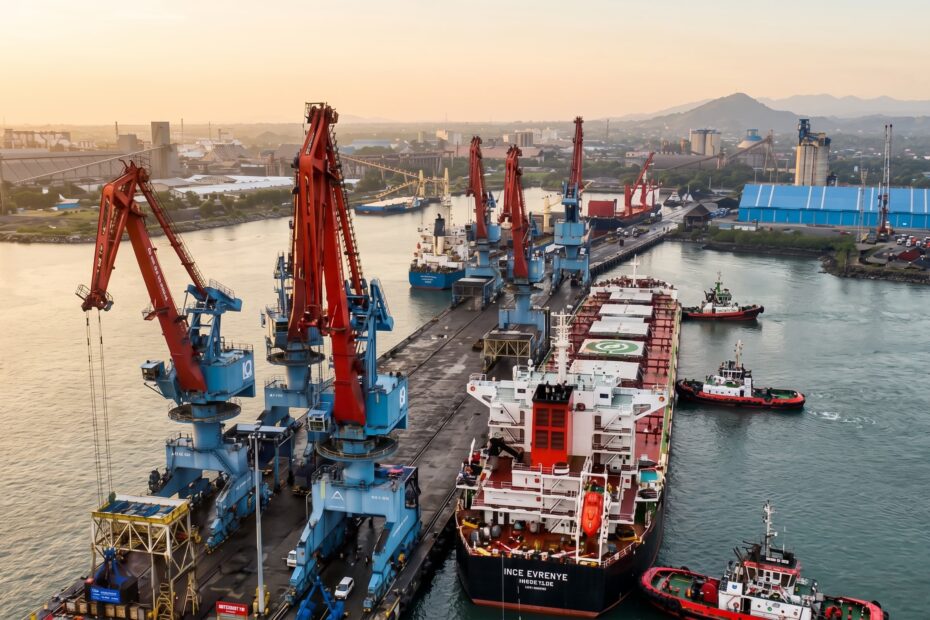
PT Pelabuhan Tanjung Priok (PTP Nonpetikemas) said it is strengthening the implementation of its green port strategy by focusing on environmental sustainability, worker health protection, and long-term social impact across its operational areas.
The company said the initiative forms part of its broader operational transformation aimed at supporting cleaner, safer, and more sustainable port activities.
PTP Nonpetikemas President Director Indra Hidayat Sani said the green port concept extends beyond environmental protection and includes maintaining the health and safety of workers operating in port areas.
“A green port is not only about protecting the environment, but also about ensuring the continuity of healthy and safe operations for workers,” Indra said in a statement.
The company has implemented an environmental management system based on ISO 14001 standards and the PROPER environmental assessment framework, while also adopting emission control measures, energy efficiency programs, waste management initiatives based on the 3R principles, and environmentally friendly cargo handling operations.
As part of its operational transition, PTP Nonpetikemas has introduced LED lighting, expanded the use of overhead cranes to reduce dependence on fossil fuel-powered equipment, and accelerated the electrification of loading and unloading machinery to support lower-emission port operations.
The company said its Environmental, Social, and Governance (ESG) programs align with the Green Port and Green & Smart Port initiatives promoted by Indonesia’s Coordinating Ministry for Maritime Affairs and Investment.
In liquid bulk operations, pollution prevention measures include the deployment of oil booms before cargo handling activities and preparedness training under the International Maritime Organization’s Oil Pollution Preparedness, Response and Cooperation (OPRC) framework.
PTP Nonpetikemas also said worker health remains a central focus, particularly in dry bulk operations where exposure to dust and other environmental factors poses occupational health risks.
“Green ports are a necessity, not an option. The port industry must move towards cleaner and more sustainable operations because human health and safety remain the top priority,” Senior Manager of Corporate Secretary Fiona Sari Utami said.
The company said it applies Hazard Identification, Risk Assessment and Determining Control (HIRADC) and Health Risk Assessment (HRA) systems across its 11 operational branches to identify and mitigate workplace risks.
Occupational health programs, including medical check-ups, fit-to-work assessments, and workplace environmental quality monitoring, are conducted regularly to ensure compliance with safety and health standards, it added.
To reduce pollution exposure, the company has implemented routine spraying at docks and stockpile areas, installed dust suppression systems, deployed dust monitoring equipment, and optimized operations to reduce heavy equipment idle time.
PTP Nonpetikemas said it conducted more than 1.27 million safety patrols and over 14,000 safety briefings throughout 2025 as part of efforts to strengthen workplace safety culture. The company also uses a digital HSSE Dashboard to monitor operational risks in real time.
Beyond operational sustainability, the company said it continues to expand its Social and Environmental Responsibility (TJSL) programs, focusing on education, environmental conservation, support for micro, small and medium enterprises (MSMEs), and community development.
Among its Creating Shared Value (CSV) initiatives are the PTP Peduli K3 occupational safety program conducted in collaboration with Indonesia’s Ministry of Manpower, professional certification programs for daily workers at Kijing Terminal, and EduPort, a program aimed at improving student capabilities and encouraging innovation in the port sector.
The company also participated in the planting of 11,000 mangrove seedlings as part of Pelindo Group’s environmental sustainability efforts. PTP Nonpetikemas said business performance should be measured not only by operational achievements but also by contributions to worker welfare, environmental sustainability, and surrounding communities.