
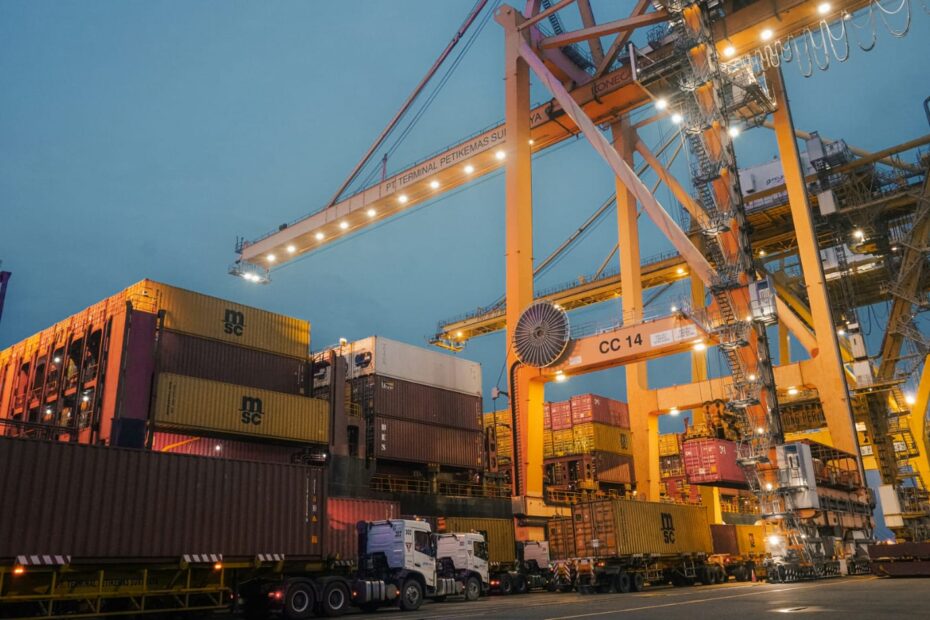
PT Terminal Petikemas Surabaya (TPS), one of Indonesia’s key port operators, reported a significant increase in container traffic in May 2025, driven by a surge in international trade flows and improved port efficiency.
The terminal, located at Tanjung Perak Port in East Java, handled 133,841 twenty-foot equivalent units (TEUs) in May, up 13% from 118,237 TEUs in April, according to data released by the company.
The growth was largely supported by international shipments, which reached 127,873 TEUs in May, marking an 11% increase from the previous month. Domestic container volume also rebounded sharply, rising 82% month-on-month to 5,968 TEUs, from 3,282 TEUs in April.
Year-to-date container traffic from January to May 2025 stood at 632,567 TEUs, up 0.7% from the 628,068 TEUs recorded in the same period last year. While international throughput climbed to 603,880 TEUs, domestic flows slipped to 28,687 TEUs, down from 34,533 TEUs a year earlier.
“We recorded progressive growth in May, reflecting the increasing trust of exporters and importers in the reliability of our services,” said Erika Asih Palupi, TPS Corporate Secretary, in a statement on Tuesday.
Export Momentum Drives Surplus
Exports saw a strong rebound in May, with containerized export volume rising 20.6% month-on-month to 64,642 TEUs, compared to 53,603 TEUs in April. Import volumes also edged higher, increasing 3.1% to 63,231 TEUs.
The export-import split in May marked a trade surplus in container movement, with exports accounting for 51% of international throughput and imports 49%. That was a reversal from April, when imports led with 54%, while exports accounted for 46%.
The number of vessel calls at TPS also rose in May, with 105 ships docking, up from 96 in April, a 9.4% increase.
Operational efficiency also improved. TPS reported an average loading and unloading productivity of 51 boxes per ship per hour, exceeding the 48 boxes/hour standard set by Indonesia’s Ministry of Transportation.
“Our performance is above the national benchmark, and that gives us confidence as we continue to serve as a leading gateway for international trade,” said Palupi.
TPS operates terminal facilities comprising a 1,000-meter international berth and a 450-meter domestic pier, supported by 12 container cranes. The terminal plays a strategic role in facilitating both export and import activities in eastern Indonesia.
TPS also retained its dominance in international cargo handling at Tanjung Perak Port, commanding an 83% market share in May.
With consistent improvements in operational metrics and digital integration efforts underway, TPS is positioning itself as a critical logistics hub as Indonesia seeks to enhance its global trade competitiveness.