

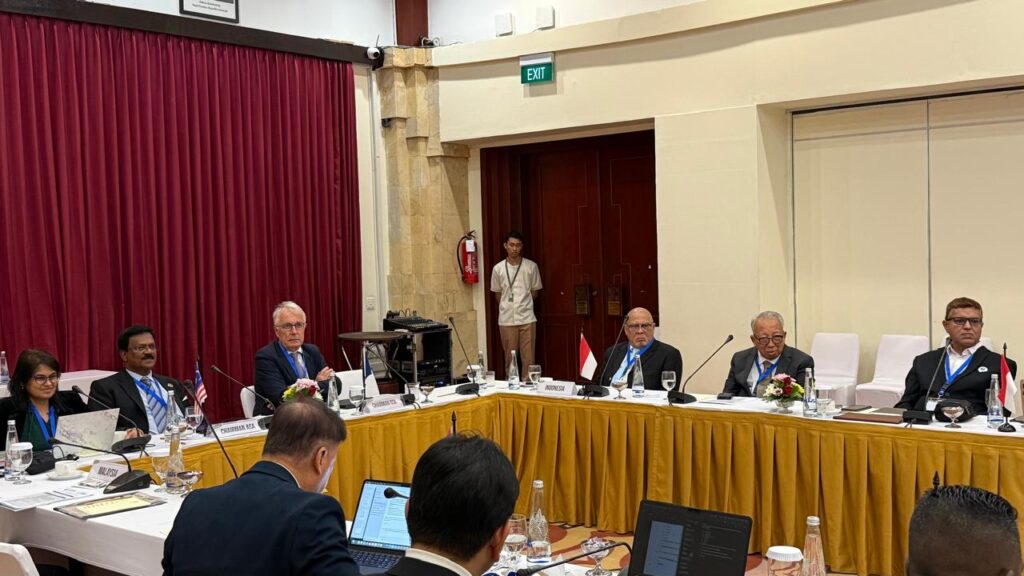
The Indonesian National Shippers’ Council (INSC), also known Depalindo, hosted the 2025 Annual Meeting of the Global Shippers’ Alliance (GSA) and Asian Shippers’ Alliance (ASA) in Bali last week, gathering industry leaders to address key challenges in trade, shipping, and logistics competitiveness.
The hybrid meeting, held on November 6, brought together cargo owners and trade representatives from across Asia, Europe, Australia, and the United States.
Indonesia’s Coordinating Minister for Food Affairs, Zulkifli Hasan, delivered remarks at the opening session, while Iqbal Shoffan Shofwan, Director General of Domestic Trade at the Ministry of Trade, officially inaugurated the event on behalf of the trade minister.
Delegates included representatives from the American Association of Exporters and Importers (AAEI), Australian Peak Shippers’ Association (APSA), European Shippers’ Council (ESC), and Shippers’ Council of Bangladesh (SCB), alongside national shipper councils from Hong Kong, Indonesia, Korea, Malaysia, Sri Lanka, and Thailand.
“The main agenda was to push for the urgent improvement of minimum service standards in maritime and port transportation to deliver more cost-efficient logistics,” said Toto Dirgantoro, Chairman of INSC, in a statement on Monday.
Toto said shippers across member countries face persistent challenges stemming from logistics service inefficiencies and regulatory hurdles, which continue to drive up trade costs. Participants agreed to consult with their respective governments to resolve issues related to port tariffs, container depot fees, and trade flow bottlenecks.
Logistics Challenge
In his opening remarks, Iqbal Shoffan Shofwan underscored the government’s commitment to cutting Indonesia’s high logistics costs, a long-standing drag on competitiveness.
“Logistics is not just about moving goods. It is the lifeblood of trade that connects producers, consumers, and global markets,” he said.

According to Shofwan, logistics costs currently account for around 14% of Indonesia’s GDP, down from 24% a decade ago, but still higher than the 8–9% typical in developed economies. The government aims to lower the ratio to 8% by 2045, he added.
Efforts to achieve this include strengthening domestic distribution networks and interregional trade to stabilize prices and support household purchasing power. “The Ministry of Trade’s strategy focuses on securing domestic markets, expanding exports, and empowering MSMEs to enter global supply chains,” Shofwan said.
Joint Statement for Common Concern
In a joint statement, the GSA and ASA raised concerns over several regulatory and operational constraints, including the lack of legal recognition for electronic documents such as e-Bills of Lading, restrictions during peak traffic hours, empty container parking fees, and freight rate regulations affecting container cargo trucks.
The alliances committed to coordinating with national governments and engaging international organizations to address these systemic issues.
“This collective effort reflects the need for a unified global voice for shippers to ensure fairer, more efficient logistics services,” Toto said.
The meeting also discussed broader geopolitical and sustainability developments affecting global supply chains. Delegates expressed concern over volatility in U.S. trade policy, which they said was adding uncertainty and cost pressures worldwide.
Participants reviewed recent Environmental, Social, and Governance (ESG) measures in the European Union, including the EU Deforestation Regulation, Carbon Border Adjustment Mechanism (CBAM), and Corporate Sustainability directives. These regulations, the forum noted, will require exporters to adapt to stricter sustainability standards, with far-reaching impacts on international trade and logistics.
New ASA Executive Boards Elected
The forum concluded with the election of the Thai National Shippers’ Council (TNSC) as Chair of the ASA for the 2026–2027 term. The Australian Peak Shippers’ Association (APSA), Hong Kong Shippers’ Council (HKSC), and Shippers’ Council of Bangladesh (SCB) were appointed as Vice Chairs.
The new leadership is expected to strengthen advocacy for Asian exporters and promote greater collaboration across the shipping industry to boost efficiency and resilience.