
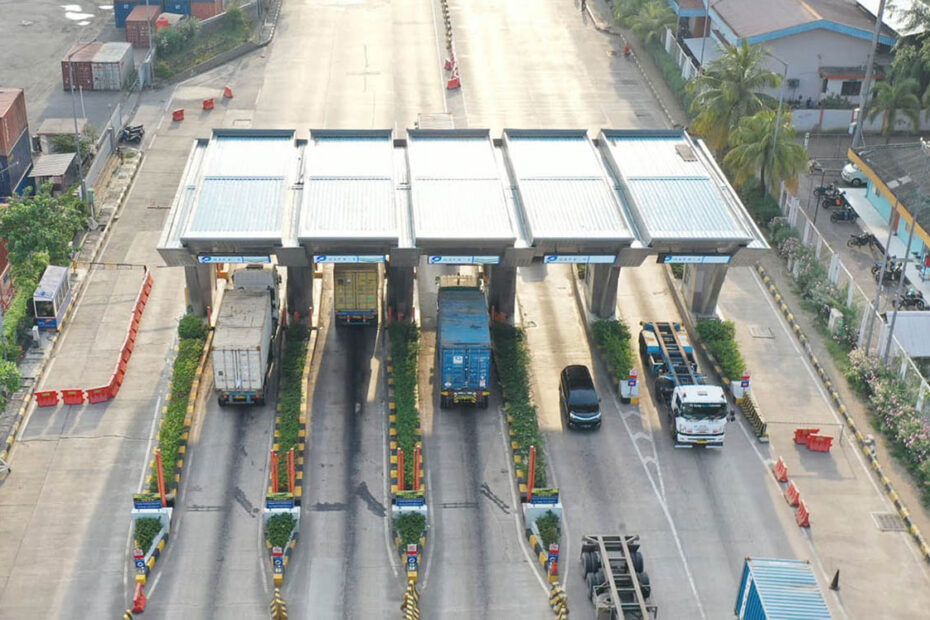
Indonesia’s Tanjung Priok Port, the country’s busiest maritime hub, has tightened gate pass controls to ease congestion and streamline logistics following the Eid al-Fitr holiday.
Operators and regulators at the port are coordinating the new measures to manage surging cargo volumes, rather than restrict the movement of goods, authorities said.
The Tanjung Priok Harbormaster and Port Authority Office (KSOP) described the policy as a calibrated effort to align vehicle inflows with port capacity, helping prevent bottlenecks that could disrupt cargo handling.
Capt Heru Susanto, M.M, head of KSOP, said the regulation is designed to match traffic with operational capacity.
“This is not about limiting cargo movement, but aligning traffic with operational capacity to avoid bottlenecks that could disrupt logistics flows,” he said.
Under the system, truck entry is adjusted dynamically based on real-time conditions inside terminals and surrounding roads. Terminal operators can increase gate pass issuance when capacity allows, provided measures are in place to prevent congestion.
Pelindo, the state-owned port operator, said it is coordinating closely with regulators to ensure smooth operations.
“Gate pass controls are necessary to balance incoming traffic with terminal capacity, ensuring that loading, unloading, and cargo distribution continue without disruption,” said Yandri Trisaputra, Executive General Manager of Pelindo Regional 2 Tanjung Priok.
Authorities said they are maintaining communication with shipping lines, logistics providers, and port users, and will adjust policies as needed. Both KSOP and Pelindo said the measures will be reviewed periodically to respond to evolving cargo volumes.
“The policy is carried out through close coordination among regulators, including port authorities, local governments, police, BMKG and SAR agencies and port operators, with involvement from industry associations such as GINSI, GPEI, ALFI, ILFA, INSA JAYA, APBMI, APTRINDO, ANGSUSPEL, KLUB LOGINDO, ISAA, ASDEKI, and APTESINDO.”
Pelindo issued a circular on March 29 outlining a congestion-control plan at Tanjung Priok Terminals following the holiday. The plan caps daily gate pass quotas at 50% of normal levels during the first two weeks after Eid, from March 30 to April 12, rises to 75% in the third week, and returns to full capacity from April 20.
Ship arrivals will also be restricted, with berthing capacity limited to 50% during the first three weeks and a minimum six-hour interval enforced between dockings. Full berthing operations are set to resume in the fourth week.
A command center will operate at the Nusantara Pura Passenger Terminal from March 30 to April 19 to monitor traffic and operational conditions in real time. Terminal operators have been instructed to comply with the restrictions, assign representatives to the command center, and intensify communication with service users.
Tanjung Priok, Indonesia’s main gateway for container traffic, typically experiences a surge in logistics activity after major holidays, increasing the risk of congestion. Authorities said the measures may be adjusted depending on on-the-ground conditions.