
Patimban Port’s first scheduled international container service signals ambition to strengthen supply chain resilience, expand industrial connectivity and position the port as a regional logistics gateway
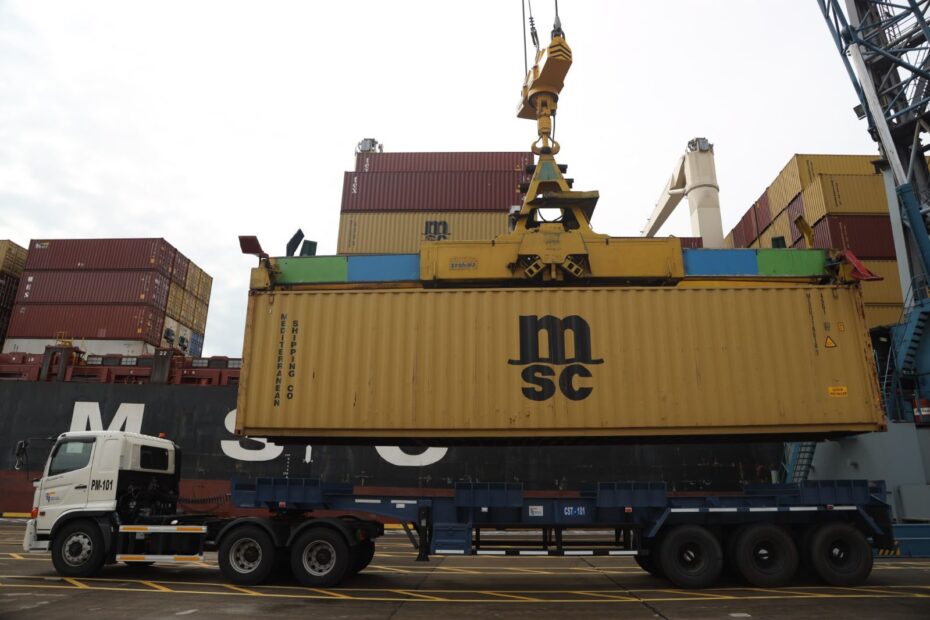
The arrival of the MSC Aria III at Patimban Port in Subang, West Java, marks the beginning of scheduled international container services at Indonesia’s newest deep-sea port, a milestone officials and industry leaders say could strengthen the country’s logistics network and support its ambition to become a regional manufacturing and trade hub.
The vessel, operated by Mediterranean Shipping Company (MSC), is the first to provide a regular international container service from Patimban. The route connects the port with Singapore, Thailand’s Laem Chabang Port, and three major Chinese ports—Shekou, Ningbo and Shanghai—linking Indonesia more directly with key manufacturing and trading centers in Asia.
The launch comes as multinational manufacturers continue to diversify production bases and supply chains in response to geopolitical tensions, changing trade patterns and efforts to reduce dependence on single-country sourcing. Industry observers say efficient ports and integrated logistics infrastructure have become increasingly important factors in attracting investment and supporting export-oriented industries.
According to the United Nations Conference on Trade and Development (UNCTAD), around 80% of global merchandise trade by volume is transported by sea, making port efficiency a critical component of national competitiveness.
Yukki Nugrahawan Hanafi, Senior Vice President of the International Federation of Freight Forwarders Associations (FIATA) and commissioner of PT Patimban Port International (PPI), said the introduction of MSC’s scheduled service represented more than the addition of a new shipping route.
“The arrival of MSC’s regular service marks the beginning of a new logistics ecosystem,” Yukki said. “As the world’s largest archipelagic nation, Indonesia needs not only large ports but an integrated port network capable of serving international trade efficiently while strengthening supply chain resilience amid geopolitical uncertainty and global disruptions.”
He said the new service could encourage other international shipping lines to establish regular calls at Patimban, expanding connections beyond Asia to the Middle East, Europe and the United States.
“More international services would create a broader shipping network, increase competition and provide exporters and importers with more routing options,” he said.
Patimban’s container terminal currently occupies about 10 hectares and has an annual handling capacity of 250,000 twenty-foot equivalent units (TEUs). Operator PT Patimban Global Gateway Terminal (PGT) is expanding the facility in phases to increase annual capacity to 1.65 million TEUs.
Under the government’s long-term master plan, the container terminal is expected to eventually handle up to 7.5 million TEUs annually. The adjoining automotive terminal is designed to accommodate up to 600,000 vehicles a year, positioning Patimban among Indonesia’s largest integrated maritime logistics developments.
Capacity expansion is being supported by additional cargo-handling equipment.
The terminal began operations in January 2026 with one Mobile Harbor Crane (MHC). Two additional MHC units entered service in April.
Later this year, PGT plans to install three Ship-to-Shore (STS) cranes and nine Electric Rubber-Tyred Gantry (E-RTG) cranes, alongside nine Rubber-Tyred Gantry (RTG) cranes, four reach stackers and 16 terminal trucks.
Once the equipment is fully operational, annual container handling capacity is projected to increase from about 250,000 TEUs to approximately 800,000 TEUs.
Yukki said the investment would improve operational efficiency in addition to increasing capacity. “New equipment will increase loading and unloading productivity, shorten vessel turnaround times and improve shipping schedule reliability,” he said.
Beyond container operations, Patimban has also expanded its automotive logistics business.
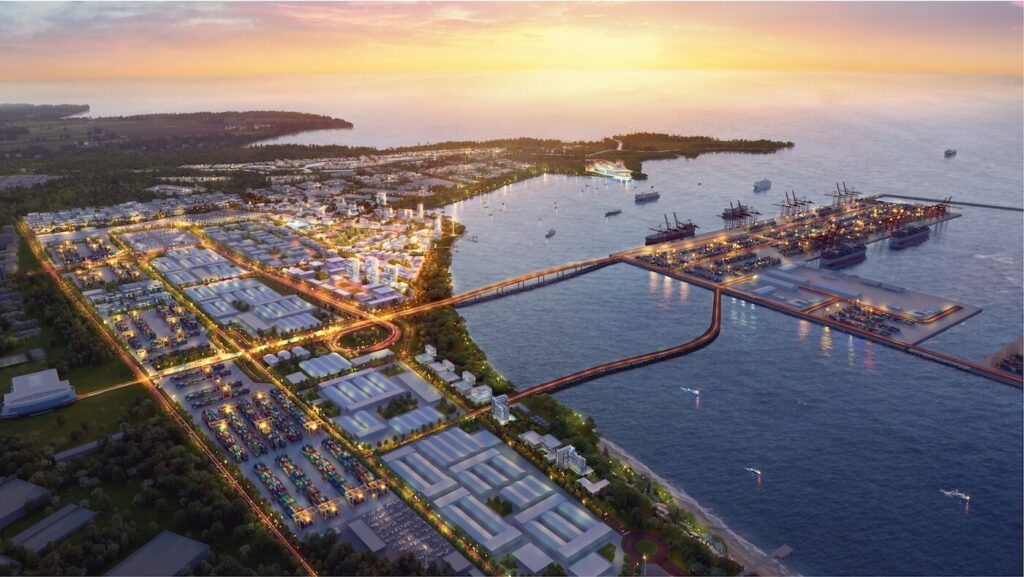
The port’s vehicle terminal, operating since 2022 on a 22.4-hectare site, has an annual capacity of 218,000 completely built-up (CBU) vehicles for export and import.
According to PT Patimban International Car Terminal (PICT), the facility handled 204,774 vehicles in 2025. Most were exports, while 13,381 units were imported and 65,688 vehicles were distributed to the domestic market.
During the first half of 2026, the terminal exported 63,086 vehicles and imported 7,262 units. Domestic shipments through Patimban also exceeded combined volumes handled via Belawan and Batam ports, reaching 37,110 vehicles.
The port has also increased its capability to accommodate larger car carriers.
Following dredging works, the berth depth has reached minus 14 meters at low water spring, allowing vessels carrying between 5,000 and 6,000 vehicles to berth, compared with a previous capacity of around 4,000 vehicles.
Land Connectivity Remains Another Priority.
Construction of the 37-kilometer toll road linking Patimban with the Cikopo–Palimanan Toll Road is progressing in stages. Once completed, the road is expected to reduce travel time between the industrial estates of Karawang and northern West Java and the port from up to two hours to around 30 to 40 minutes.
Industry players believe improved road access will strengthen Patimban’s competitiveness by lowering logistics costs and making the port more attractive for manufacturers located across West Java, one of Indonesia’s largest industrial regions.
Yukki said the development of Patimban should be viewed as part of Indonesia’s broader strategy to improve trade competitiveness rather than simply expanding port infrastructure.
He outlined what he called the “Patimban Vision 2036,” which consists of three phases: establishing international shipping services, expanding world-class infrastructure and equipment, and building sustainable cargo volumes supported by a wider global shipping network.
“When these three phases develop together, Patimban will be increasingly ready to become Indonesia’s integrated gateway for containers and automotive exports while strengthening the resilience of the national supply chain,” he said.
He added that achieving the vision would require collaboration among government agencies, port operators, shipping lines, freight forwarders, manufacturers, customs authorities, investors, logistics associations and academic institutions.
“With strong collaboration across stakeholders, Patimban has the potential to become one of Asia’s strategic ports and support Indonesia’s long-term economic development,” Yukki said.