
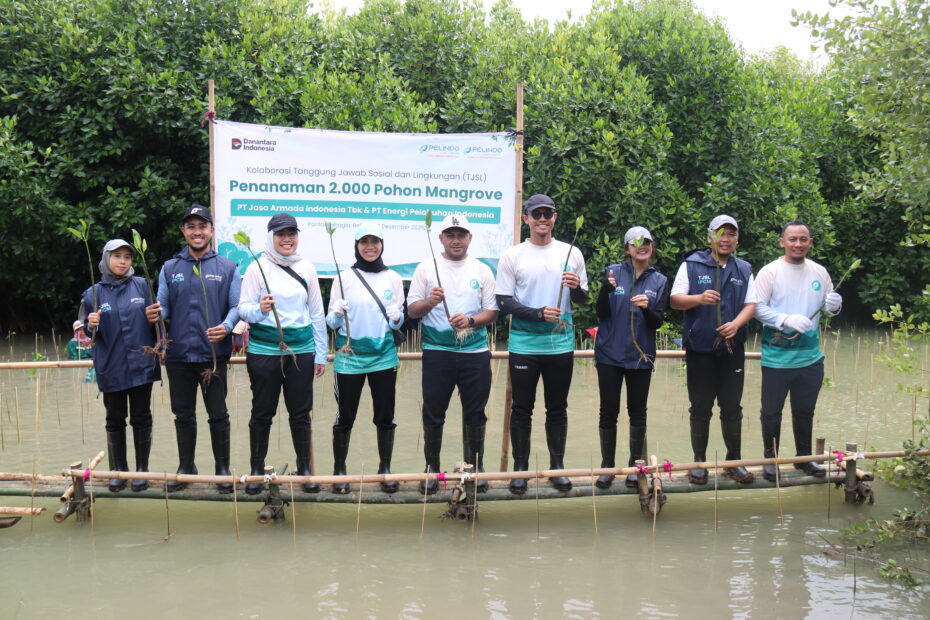
Pelindo Group subsidiaries PT Jasa Armada Indonesia Tbk (IPCM) and PT Energi Pelabuhan Indonesia (EPI) planted 2,000 mangrove trees along the coast of Bahagia Beach in Bekasi Regency as part of a joint effort to support environmental sustainability and strengthen coastal resilience.
The mangrove planting forms part of the companies’ Social and Environmental Responsibility (TJSL) programme and reflects their commitment to building a sustainable port ecosystem, the companies said.
The initiative involves planting 2,000 Rhizophora mucronata mangrove seedlings, a species known for its dense root system that helps reduce coastal erosion by acting as a natural barrier against waves. Mangroves also play a key role in preserving coastal biodiversity while delivering ecological, social and economic benefits to nearby communities.
The activity began with a symbolic handover of mangrove seedlings by IPCM, represented by Ridwan Budiman, Deputy Vice President of Corporate Communications, GCG and CSR, followed by EPI Corporate Secretary Indrianisari. Employees from both companies then took part in the planting, alongside representatives of the Employee Social Responsibility (ESR) programme.
“Maintaining the balance and sustainability of marine ecosystems is an essential part of supporting the company’s business activities,” Budiman said. “This collaborative mangrove planting reflects the positive synergy among Pelindo Group subsidiaries to create a tangible environmental impact for coastal communities, while also supporting the Net Zero Emission target and the long-term sustainability of port operations.”
Indrianisari said the TJSL programme underscored EPI’s commitment to environmental conservation and sustainable development, particularly under the environmental pillar.
“As a company involved in providing and managing energy in port areas, EPI views the sustainability of coastal environments as inseparable from the resilience of the maritime ecosystem and national port operations,” she said.
The joint programme aligns with Pelindo Group’s environmental, social and governance (ESG) framework. Environmentally, mangrove restoration contributes to climate change mitigation by absorbing carbon and protecting coastal ecosystems. Socially, the initiative encourages the involvement of coastal communities through education and empowerment. From a governance perspective, collaboration among Pelindo Group subsidiaries is aimed at delivering measurable and sustainable outcomes.
The programme also supports several United Nations Sustainable Development Goals, including SDG 8 on decent work and economic growth, SDG 13 on climate action, SDG 14 on life below water, SDG 15 on life on land and SDG 17 on partnerships.