
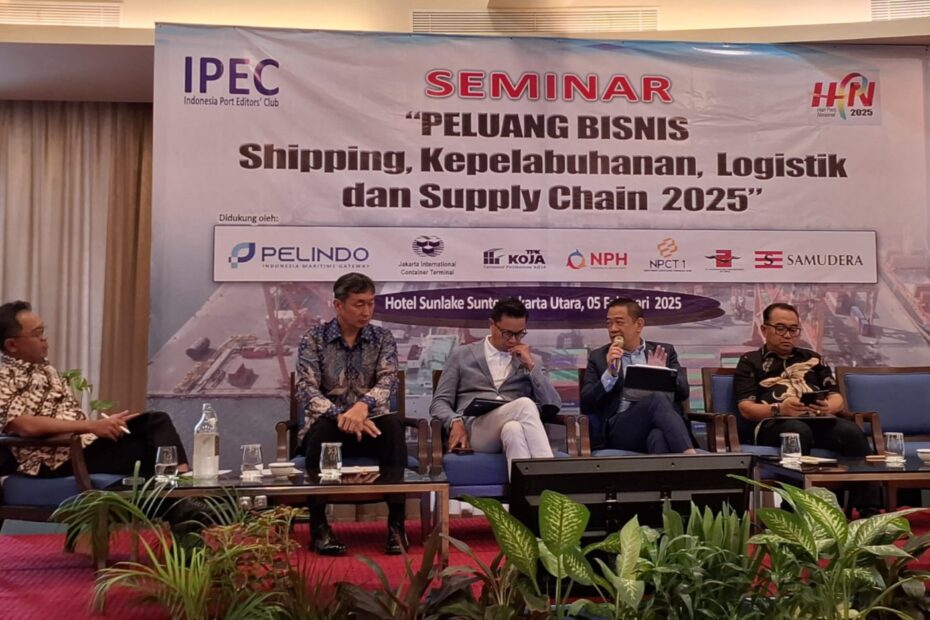
Industry leaders in the port, shipping, and logistics sectors remain optimistic about business growth despite facing local and global challenges over the next two years. Speakers representing those sectors said it in a recent seminar titled “Business Opportunities in Shipping, Ports, Logistics, and Supply Chain for 2025” organized by the Indonesia Port Editor’s Club (IPEC) in Jakarta on February 5, 2025.
Speakers, including Yan Prastomo Ardi, Head of the Sub-Directorate for Port Development Planning and Arrangement at the Ministry of Transportation, Adi Sugiri, Executive General Manager of Pelindo Regional 2 Tanjung Priok, Akbar Djohan, Chairman of the Indonesian Logistics and Forwarding Association (ALFI), Danny Novianto, Managing Director of Tisco Logistics (Representative of Emirates Shipping Line in Indonesia), and Keishin Watanabe, President Director of Ocean Network Express (ONE) Indonesia, addressed some key issues relating the business challenges and told some key recommended steps to make the business grow up.
They agree that Indonesia’s logistics and shipping industry face numerous challenges, from high logistics costs and inefficient infrastructure to geopolitical disruptions and cargo imbalances. However, with strategic initiatives like digital transformation, policy reforms, and enhanced collaboration, the sector is well-positioned for sustained growth.
By integrating logistics systems, reducing inefficiencies, and fostering global partnerships, Indonesia can strengthen its position as a competitive player in the global shipping and logistics industry.
Speaking on behalf of the Directorate General of Sea Transportation Yan Prastomo Ardi, explained that efficient connectivity is crucial for equitable economic growth, seamless goods distribution, and enhanced national competitiveness.
Yan highlighted several key issues affecting logistics efficiency, including: High logistics costs, which contribute to economic disparities between western and eastern Indonesia; Infrastructure imbalances, leading to uneven goods distribution; Cargo imbalances, reducing port operational efficiency and slowing down supply chains; and long cargo stay at major ports, averaging 4 to 7 days.
To address these issues, the government has implemented various reforms, including improvements in Indonesia’s Trading Across Borders ranking (Doing Business 2020) and a positive trend in reducing dwelling time. However, digital integration remains a challenge due to repetitive and duplicated processes that cause inefficiencies and increase operational costs.
Govt Efforts for a More Efficient Logistics
Digital transformation and national logistics system integration are critical to strengthening Indonesia’s global competitiveness. Yan emphasized that the concentration of container traffic at four main ports, which still perform below international standards, requires urgent improvements.
Furthermore, shipping networks remain suboptimal, with 77% of routes operating on a port-to-port basis and only 23% forming a loop network. This results in higher hinterland transportation costs, which can make up 50% of total logistics expenses. Additionally, 96% of domestic shipments still rely on land transportation, increasing inefficiencies and costs.
To tackle these challenges, the National Port Master Plan has been established to enhance logistics connectivity through a network of 636 ports, including 28 main ports, as well as feeder and collector ports.
This policy aims to encourage investment and competition; create safe, efficient, and sustainable port operations, and ensure integrated planning and maritime environmental protection.
Yan stressed that collaboration between the government, port operators, land transport companies, shipping lines, exporters/importers, freight forwarders, associations, and financial institutions is essential to creating a fully integrated and efficient logistics system. He emphasized that digital transformation in ports is the key to enhancing national logistics competitiveness.
Echoing the view, state port operator PT Pelabuhan Indonesia (Pelindo) underlined that the corporate transformation steps and efforts post-merger have significantly improved logsitcs efficiency. Pelindo, Adi Sugiri, has successfully cut port stay, cargo stay, and dwelling time as well.
He said this had positively impacted on port productivity. He underscored the importance of continued collaboration among stakeholders to achieve further efficiency.
Recommended Steps to Reach Optimum Growth
Despite existing challenges, the shipping and logistics sector in Indonesia has strong growth potential, provided it aligns with global industry trends, according to shipping lines.
Danny Novianto, Managing Director of Tisco Logistics (Representative of Emirates Shipping Line in Indonesia), highlighted digitalization and infrastructure development as essential factors in driving industry growth. He also emphasized the need for collaboration with global players.
“For example, we encourage Indonesian ports to digitalize their equipment to improve efficiency and competitiveness,” he noted.
Keishin Watanabe, President Director of Ocean Network Express (ONE) Shipping, echoed similar concerns. He pointed out that geopolitical tensions and trade wars have significantly influenced the shipping industry since 2024.
For example, the conflict in the Red Sea has forced ships to reroute through the Cape of Good Hope, increasing travel times and the demand for more vessels. This disruption is expected to persist until at least the third quarter of 2025.
Another major concern is the imbalance between supply and demand, with supply expected to grow by over 5%, while demand increases by only 2.8%.
However, Watanabe noted that Indonesia’s Main Liner Operator (MLO) market remains promising. He predicted that the ocean-going shipping market in Indonesia will experience 5-10% growth this year.
Akbar Djohan, Chairman of the Indonesian Logistics and Forwarding Association (ALFI), meanwhile, proposed four key recommendations to enhance the national logistics system, thus supporting the industry growth this year and in the future.
First, Integration of Government Institutions – Establish a National Logistics Agency to oversee supply chain regulations and policies.
Second, Improved Logistics Education – Enhance the quality and availability of logistics education at all levels, starting from secondary schools.
Third, Optimization of Incoterms – Encourage state-owned enterprises and institutions abroad to adopt incoterms like Ex-Work and FCA/FOB to strengthen the role of national private logistics players in import and export transactions.
Fourth, Support for National Business Players – Implement policies that foster competition, reduce monopolies, and limit foreign dominance in logistics. Additionally, introduce financial and taxation reforms to help local businesses become globally competitive.