
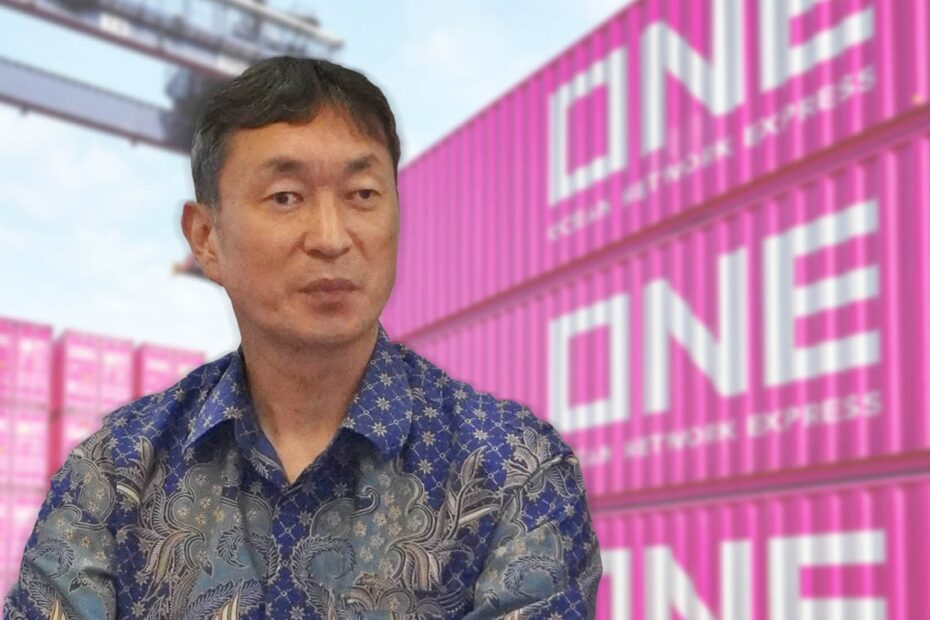
Ocean Network Express (ONE), an international shipping company currently ranked sixth in terms of global container capacity, views Indonesia as a highly promising market for future growth.
Formed in 2017 and headquartered in Singapore with offices worldwide, ONE is committed to expanding its presence in Indonesia. The company plans to enhance services, increase ship capacity, and expand its route offerings through both new calls and increased capacity on existing services.
This commitment was shared by Keishin Watanabe, President Director of PT Ocean Network Express Indonesia and Country Head of Indonesia for Ocean Network Express Global, during a discussion with Indonesia Shipping Gazette earlier last month.
Watanabe highlighted that since ONE’s formation over seven years ago, the Company has seen continued growth. Just one year after its establishment, in 2018, ONE expanded its global presence by opening representative offices in key trade centers such as Hong Kong, Singapore, the UK, the USA, and Brazil. Most recently, the company opened an office in Dubai in 2024 to further develop its presence in the Middle East market.
“ONE continues to expand into new regions through organic growth and in collaboration with other companies. We are a member of the Premiere Alliance, and we also work with companies outside of alliances to strengthen our networks globally including the Asia-Europe trade,” Watanabe explained.
Thanks to ongoing investments, expansions, and strategic partnerships, ONE is now the world’s sixth-largest container shipping company, operating a fleet of more than 240 vessels with a total capacity of approximately 1.8 million TEUs. With 165 weekly service routes and operations in more than 244 ports across 120 countries, ONE has demonstrated strong, positive growth.

In 2024, ONE achieved total revenue of US$10.75 billion, with an estimated net profit of US$2.7 billion. Watanabe noted that this year’s performance has been equally impressive, with growing volumes and favorable shipping rates.
GEOPOLITICAL IMPACT AND EVOLVING SHIPPING ALLIANCES
Watanabe acknowledged that the global shipping industry, including in Indonesia, is significantly influenced by geopolitical tensions and trade conflicts, in addition to internal factors such as market competition and shipping alliances.
In 2024, the global shipping industry faced challenges driven by political unrest in the Red Sea. This geopolitical situation has forced changes in shipping routes, requiring vessels to bypass the Suez Canal and navigate around the Cape of Good Hope in Africa, resulting in longer travel times and the need for more vessels.
“At the start of 2024, we predicted there would be an oversupply of new ships, but this did not occur. Instead, shipping rates surged, which positively impacted our company’s revenue,” Watanabe explained.
In addition to navigating global challenges, ONE is heavily investing in the future by developing a fleet of environmentally friendly vessels equipped with the latest technology to drive down emissions. This investment is part of the company’s broader commitment to decarbonizing the shipping industry and supporting sustainability efforts.
INDONESIA’S CONTRIBUTION TO ONE’S SUCESS
Watanabe acknowledged that the Indonesian market plays a key role in the positive performance of ONE, the shipping company known for its uniquely colored vessels.
“Intra-Asia trade is one of our primary focuses, and the trend in trade between Indonesia and the intra-Asia region is looking very promising,” Watanabe said.

Keishin Watanabe: “The trend in trade between Indonesia and the intra-Asia region is looking very promising”
“We are still conducting a significant amount of transshipment through Singapore. From there, cargo is distributed to various destinations, including Europe, America, and other intra-Asia markets.”
Watanabe confirmed that ONE is open to establishing direct services in the future if demand warrants it.
“In 2024, we handled around 400,000 TEUs of exports from Indonesia,” he continued. “Imports were roughly the same, though slightly lower than exports. This success is driven by our robust fleet and extensive global network, which allows us to meet the needs of Indonesian customers with destinations worldwide.”
Watanabe also highlighted the significant contribution of ONE’s services in Indonesia to the company’s overall performance. While he declined to provide exact figures, he estimated that ONE’s volume growth in Indonesia for 2024 was between 5-10%.
MAINTAINING SERVICE EXCELLENCE AT ALL TERMINALS, ESPECIALLY TPK KOJA
Watanabe noted that ONE’s operations in Indonesia are still heavily concentrated at Tanjung Priok Port, with 60% of the company’s volume—approximately 240,000 TEUs annually— coming from three key terminals: TPK Koja, JICT, and NPCT1.
With this strong presence, ONE has become one of the leading shipping companies at Tanjung Priok. At TPK Koja alone, ONE handled 83,900 TEUs from 49 calls in 2024, ranking the company sixth in terms of shipping volume at the terminal.
“We maintain weekly calls at all three terminals, using vessels with capacities of 4,000-5,000 TEUs,” Watanabe explained. “These ships serve direct intra-Asia routes and feeder services to Singapore. Each terminal contributes similarly to our overall volume.”
“TPK Koja has been a reliable partner in Tanjung Priok Port for a long time, consistently providing excellent service and maintaining strong operational capabilities. We look forward to continuing our strong collaboration,” he said.
Looking ahead, ONE remains committed to preserving its service at all three terminals. “We’ll continue to enhance our service offerings and maintain the high quality that our customers expect. Each terminal has its own distinct service profile, with some focusing on intra-Asia routes and others on feeder services to Singapore,” Watanabe said.
ONE also plans to expand its capacity by adding new services or increasing the size of existing vessels. “We can’t confirm exactly when these changes will occur, but with Indonesia’s rapid economic growth, we’re prepared to add new calls or expand the capacity of our current fleet,” he added.
APPRECIATION AND HOPE FOR IMPROVED EFFICIENCY
Watanabe expressed his appreciation for the substantial progress in operational efficiency and facilities at Indonesian container terminals, especially TPK Koja, following the Pelindo merger.
The improvements have had a positive impact on the efficiency of Indonesia’s logistics sector. However, he stressed the importance of continuing to enhance operational efficiency and investing in technological advancements. “More efficient port operations directly lead to more efficient shipping services for our customers,” Watanabe noted.
He also emphasized the role of technology in optimizing operations, particularly through the digitalization of services. “A faster exchange of information and data will significantly improve supply chain efficiency,” he said. “We’re grateful for the strong cooperation with TPK Koja thus far, and we hope to see even more progress in operational efficiency moving forward.”
By taking these strategic steps, Watanabe believes TPK Koja will continue to grow into one of the most efficient and trusted container terminals, helping to strengthen the overall logistics landscape in Indonesia.
Relating the port business in Indonesia, Watanabe believes that Indonesia has great potential because of its strategic location and growing economy. “We are also encouraged by the continuous efforts of the Indonesian government to improve port operations through initiatives like the National Strategic Project, which focuses on modernizing facilities and logistics systems.”
These initiatives, coupled with investments in digital technology, he said, have the potential to significantly enhance the efficiency and service quality of our ports in the future.
In responding Watanabe’s expectation and other customers, TPK KOJA is implementing a significant upgrade to its loading and unloading equipment in 2025.
“This year, we will replace the existing two QCC Panamax cranes at the quay with three Super Post Panamax twin-lift QCC. As a result, TPK KOJA will have a total of eight QCCs. Additionally, we are adding four eco-friendly RTG units to support our Go Green initiative, along with one RS unit and six trucking units,” said Ali Mulyono, TPK Koja General Manager.
“Through these enhancements, we aim to foster growth and development alongside our valued customers. We look forward to a future of continued success and collaboration with all our partners,” he said further.