
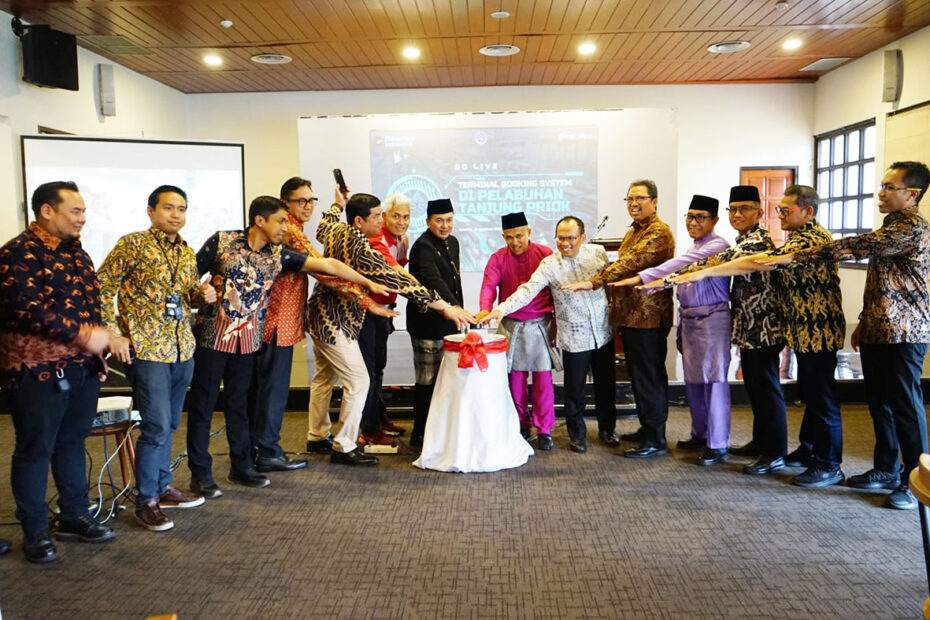
Indonesia’s busiest port, Tanjung Priok, officially launched its Terminal Booking System (TBS) right on the Independence Day this week, aiming to streamline truck traffic and improve efficiency at the sprawling maritime hub in North Jakarta. Port users welcome it, but warned that without adequate buffer zones, the system could falter.
The system, which went live on August 17, coinciding with the country’s 80th Independence Day, will regulate truck arrivals using a hybrid platform of online and offline booking tools. Authorities say it marks a milestone in the port’s digital transformation, aligning with broader national goals for innovation and operational synergy.
“This launch, in line with our Independence Day, symbolizes that real independence and progress come through innovation and collaboration,” said Capt. Heru Susanto, Head of the Tanjung Priok Port Authority (KSOP).
Yandri Trisaputra, Executive General Manager at Pelindo Regional 2 Tanjung Priok, said the system allows transporters to schedule arrivals in accordance with terminal service capacity, helping to prevent truck congestion. He noted that the rollout will be followed by close monitoring and evaluation.
Users Call for Buffer Areas
While industry groups broadly welcomed the initiative, several logistics stakeholders warned that without adequate buffer zones, designated parking areas where trucks can wait before entering terminals, the system could falter.
“Without sufficient truck buffer areas, implementing TBS effectively is almost impossible,” said Toto Dirgantoro, Chairman of the Indonesian Port Council (Depalindo) as quoted by logistiknews.id.
He cited frequent traffic bottlenecks and a lack of coordination with off-port depots as major risks to the system’s success.
Tanjung Priok Port is home to five major container terminals: Jakarta International Container Terminal (JICT), Koja Container Terminal (TPK), New Priok Container Terminal One (NPCT-1), Terminal IPC TPK, and Mustika Alam Lestari Terminal (MAL/NPH).
Exporters have echoed these concerns. Irwandy M.A. Rajabasa, Chairman of Indonesian Exporters Association (GPEI) Chapter Jakarta emphasized that unpredictable traffic congestion outside the port continues to disrupt operations.
“To make TBS work, there needs to be an external truck buffer zone, a parking facility with reliable travel-time predictability,” Irwandy said.
“Trucks should wait in these zones before being synchronized with the TBS system.”
No Penalty Yet
Heru Satrio, Head of the TBS Working Group and Pelindo’s IT Group Head, said the TBS rollout will be phased in. In the initial stage, truck operators will be educated on how to use the booking system. No penalties will be imposed during this phase for early or late arrivals.
“A dashboard will track arrivals, categorizing them as early, on-time, or late,” Heru said. “This data will be essential for refining the system in Phase 2.”
The second phase will integrate a unified application portal across all container terminals.
Authorities hope the system will ultimately boost port productivity, lower operational costs, and reduce truck emissions by minimizing idle time and congestion inside the port.