
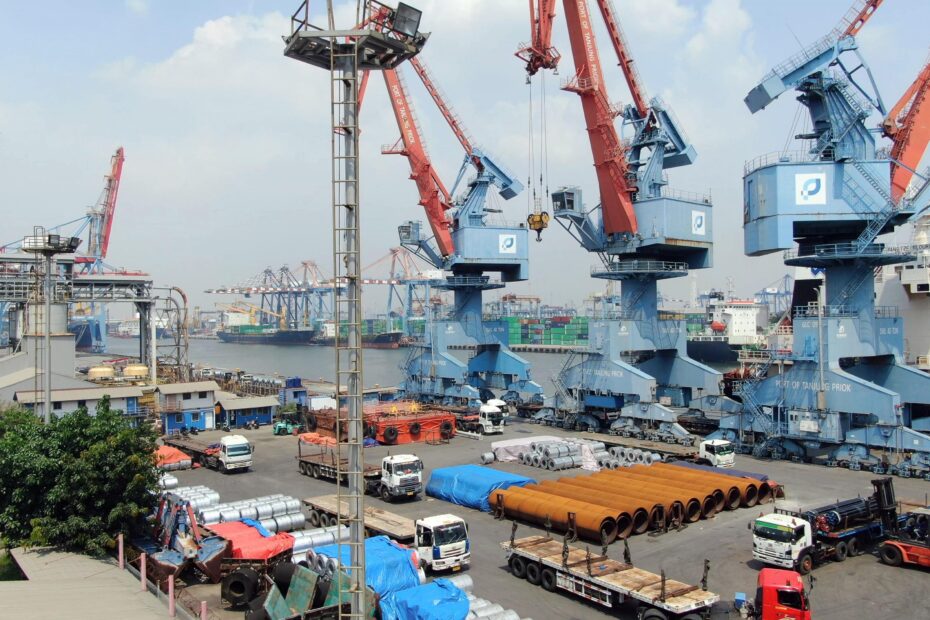
In the heart of Indonesia’s busiest seaport, a quiet yet critical engine is propelling the country’s logistics performance forward. The Tanjung Priok Branch of PT Pelabuhan Tanjung Priok (PTP Nonpetikemas), a terminal operator focusing on non-containerized cargoes, has emerged as a national force behind the multipurpose terminal sector, one that’s gaining momentum with every ton of cargo handled.
As of the first half of 2025, the branch has outpaced its performance targets by a notable margin. Handling 7.53 million tons/m³ of cargo, the branch exceeded its operational plan by 110% and marked a 14% increase from the same period last year, driven largely by surging volumes in dry bulk and general cargo.
“This achievement is more than just a number,” said Budi Utoyo, Branch Manager of PTP Nonpetikemas Tanjung Priok. “It’s a sign that we’re evolving in the right direction, efficiently, strategically, and in sync with national logistics needs.”
PTP Nonpetikemas, a subsidiary of the state-owned port operator Pelindo, is targeting a total throughput of 53.5 million tons/m³ by year-end. Tanjung Priok, as the country’s flagship port, is leading that charge.
The company is modernizing terminals, expanding digital integration through its proprietary Pelindo Terminal Operating System Multipurpose (PTOS-M), and strengthening collaborations with cargo owners and shipping lines.
Cornerstone of National Ambition
“We see Tanjung Priok as more than just a branch. It’s a cornerstone of our national logistics ambitions,” said Indra Hidayat Sani, President Director of PTP Nonpetikemas.
“We are positioning ourselves as an adaptive and competitive terminal operator, ready to respond to shifting global supply chain demands.”
Among the priority projects underway is the enhancement of liquid bulk handling in Region 2 of Tanjung Priok, including ship-to-ship transfers and support for offshore logistics. Additionally, PTP is expanding cooperation in the operation of private docks (Tersus/TUKS) and offering new services for LNG, condensate, and fuel.
Nationally, the company reported strong performance throughout 2024. It contributed 39% to the total throughput of the SPMT Group, PTP’s parent company, with overall cargo reaching over 47 million tons/m³. Notably, the Tanjung Priok Branch ranked first among all regional branches for general cargo throughput.
Even productivity metrics are on an upward curve. As of June 2025, the branch’s terminal service density (TSD) reached 3,320.75—the highest in the general cargo segment within the SPMT network.
The branch also led in total traffic realization for general cargo and bagged goods, recording 4.7 million tons/m³—an increase of nearly 15% from 2024. It’s a testament to Tanjung Priok’s strategic importance as a diversified distribution hub.
From dry bulk commodities like sugar, salt, cement, and sulfur to high-value cargo including vehicles, heavy machinery, and steel products, the terminal handles an array of materials critical to the Indonesian economy. Liquid bulk such as crude palm oil (CPO) and processed vegetable oils round out its portfolio.
Backing up this scale is world-class infrastructure. The branch operates a 3.4-kilometer wharf, a 2-hectare warehouse, 15 hectares of yard space, and nearly 240,000 square meters of stacking area. It’s powered by a fleet of specialized equipment, 11 gantry cranes, 12 overhead cranes, multiple grab and hopper cranes, and nine weighbridges.
What sets PTP Non-Container apart, however, goes beyond hardware. With over a decade of experience, its workforce is trained to uphold efficiency, safety, and timeliness, elements crucial to national economic resilience.
“Logistics is the lifeblood of development, and ports are its heart,” Indra emphasized. “Our mission is to ensure that Indonesia’s economic arteries remain open, strong, and future-ready.”
As Indonesia positions itself as a regional maritime powerhouse, the Tanjung Priok Branch of PTP Nonpetikemas is proving to be one of its most valuable, and perhaps most underappreciated, assets.