
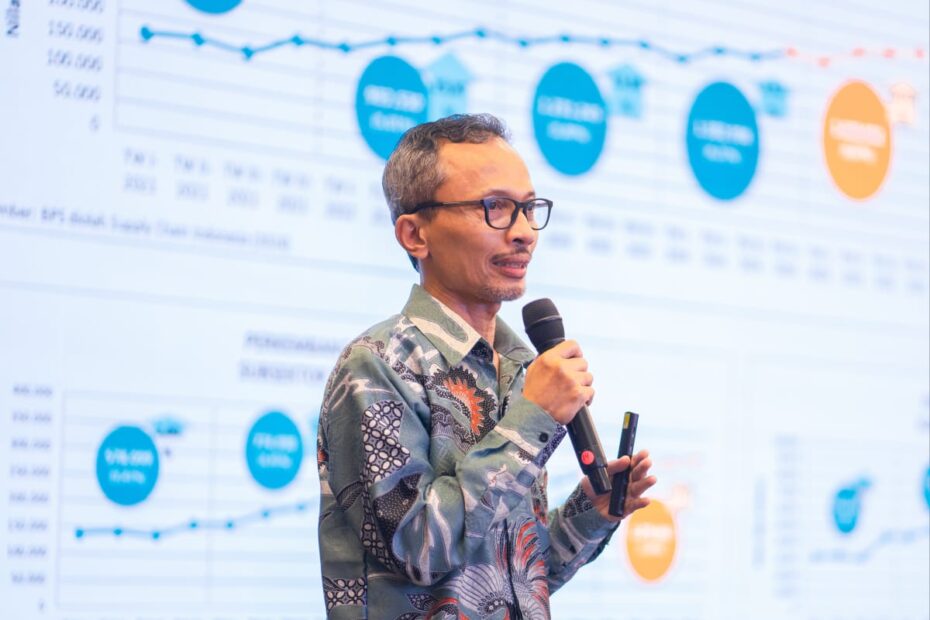
Supply Chain Indonesia (SCI) forecasts that Indonesia’s transportation and warehousing sector will contribute IDR 1,623.65 trillion to the nation’s Gross Domestic Product (GDP) in 2025, reflecting a growth rate of 12.53% year-on-year.
Data from Indonesia’s Central Statistics Agency (BPS) reveals that the transportation and warehousing sector has consistently outpaced the country’s overall economic growth.
In 2022, the sector grew by 19.87%, followed by 13.96% growth in 2023, with a projected 9.52% increase in 2024. In comparison, Indonesia’s overall GDP expanded by 5.31% in 2022 and 5.05% in 2023.
While the transportation subsector encompasses both passenger and goods transportation, the significant growth in this sector highlights the strong performance of the logistics industry, which has seen substantial and consistent growth from 2022 to 2024.
SCI further projects that by 2025, the transportation subsector will contribute IDR 1,276.66 trillion, growing by 11.09% year-on-year (c-to-c), while the warehousing subsector is expected to contribute IDR 346.99 trillion, with a higher growth rate of 18.26%.
SCI CEO Setijadi emphasized that the expansion of goods transportation and warehousing in 2025 will largely be driven by key industries such as manufacturing, trade, and agriculture, forestry, and fisheries.
“In the non-oil and gas manufacturing sector, logistics growth in 2025 will be led by the food and beverage industry, followed by chemicals and pharmaceuticals, metal and electronics goods, transportation equipment, basic metals, and textiles and apparel,” Setijadi explained on January 8, 2025.
He also pointed out that Indonesia’s logistics sector is influenced by global events, including the US-China trade conflict, as well as geopolitical tensions involving Russia, Ukraine, and the Middle East, all of which have contributed to global supply chain uncertainties.
Key Recommendations for National Logistics Development
SCI has provided several strategic recommendations to enhance Indonesia’s logistics system. First, finalization of regulatory reforms. The revision and issuance of a Presidential Regulation to update the 2012 National Logistics System Blueprint, alongside the formation of a logistics law and a permanent logistics institution;
Second, enhancing connectivity through improving end-to-end logistics connectivity, building on the extensive infrastructure development during the past two presidential terms.
Third, strengthening national supply chains through expanding the national supply chain by developing domestic commodities in various regions; Fourth, continued downstreaming through expanding downstream initiatives not just for mining, but also for agricultural, plantation, fisheries, and other industries; and Fifth, investment in human resources and technology through improving workforce capabilities, processes, technology, and fostering collaboration among logistics service providers.
“These initiatives will increase logistics efficiency, which is crucial for achieving national economic growth targets,” Setijadi said.