
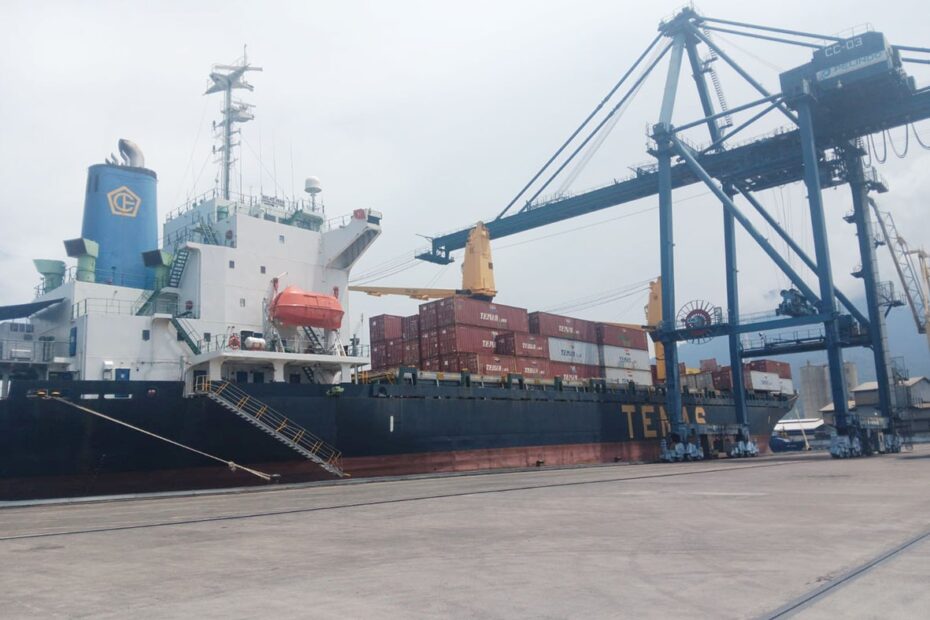
Container Terminal TPK Bitung posted a remarkable 21.21% growth in container throughput in Q1 2025. Even more striking, its oceangoing/import-export throughput have tripled in 2024, thanks to the industry growth, especially the Bitung Special Economy Zone – Bitung SEZ/KEK.
North Sulawesi, locally known as Sulut, recorded an annual economic growth of 5.39% in 2024, according to Burau of Statistic BPS. While slightly slower than the year before, the growth remained strong and steady.
Much of this resilience can be attributed to five core sectors that together form the backbone of the province’s economy: agriculture, trade, transportation, construction, and manufacturing. Agriculture alone contributes over 20% to the Gross Regional Domestic Product, underscoring the province’s deep roots in the land and sea.
But perhaps nothing captures Sulut’s economic transformation better than the Bitung SEZ. Since its inauguration on April 1, 2019, the zone has drawn investments of over IDR 32.9 trillion and provided jobs for more than 34,700 people. It’s not just an industrial complex, it’s a symbol of possibility.
Inside the SEZ a Chinese paper factory, PT Futai Sulawesi Utara, hums with renewed activity. The company began construction in 2019 with an investment of IDR 1.4 trillion, but the pandemic put plans on hold. By 2024, however, the factory roared to life.

Photo: Ivone Kondoy
“Since last year, we’ve been exporting about 100 containers of paper every month, most of them go to China,” said Ivone Kondoy, one of the company’s export-import officers.
The factory sources its raw materials from across the globe: used paper from Europe, tapioca from Thailand, and domestic chemicals. It’s a portrait of globalization playing out on local soil.
Beyond Bitung’s industrial zone, the province’s rich natural bounty continues to shine on the world stage. North Sulawesi’s agricultural and fishery exports are thriving, everything from canned tuna and frozen fish to coconut water concentrate and nutmeg finds its way to markets in the United States, China, Brazil, South Korea, the Netherlands, and beyond.
At a recent export send-off ceremony led by the Deputy Governor at the Bitung Terminal Petikemas (TPK), 213.75 tons of goods—valued at over IDR 13.36 billion—were shipped out to buyers across the globe. Canned tuna and coconut products headed for the U.S., Switzerland, Russia, and Italy. Nutmeg, long a prized spice of the region, was packed for delivery to India.
Imports, too, are crucial to keeping the wheels of industry turning. Machinery from China, spare parts from Thailand, canola oil from Malaysia, and tapioca from Vietnam flow into the port to support local production.
Bitung Customs Chief Feri Hadi noted that fishery products still dominate the province’s exports, while imported goods are largely industrial inputs and support materials. Zusane, who heads the Quarantine Service at Bitung Port, echoed this, pointing out the rising volume of processed coconut and seafood goods moving through customs.
Driving Port Throughput, Oceangoing Tripled
The expansion of industrial activities and the processing of agricultural and fishery products has significantly boosted productivity at the TPK Bitung container terminal. In fact, import-export volumes tripled over the past year, reflecting strong growth momentum.
In the first quarter of 2025, container throughput at TPK Bitung reached 74,928 twenty-foot equivalent units (TEUs)—a 21.21% increase compared to 61,816 TEUs recorded during the same period in 2024.
For the full year 2024, the terminal handled 280,699 TEUs, marking a 10.37% increase from 254,643 TEUs in 2023. This figure also surpassed the company’s 2024 target of 271,108 TEUs as outlined in its corporate work plan and budget (RKAP).
Ship calls also saw a notable uptick. In Q1 2025, TPK Bitung received 98 vessels, up 19.51% from 81 vessels in Q1 2024. Over the course of 2024, the terminal served 391 ships, an impressive 27.78% increase compared to 306 vessels in 2023.

Photo: Team of Pelindo Petikemas TPK Bitung explaining terminal performance at Plaining and Control Tower on May 7, 2025
According to Muhammad Habibi, Acting Terminal Head and Operations Management Manager of TPK Bitung, the terminal is targeting a throughput of 265,527 TEUs in 2025. He was accompanied by Finance Manager Torba during a statement given at TPK Bitung on Wednesday, May 7, 2025.
During Q1 2025, TPK Bitung facilitated 2,023 TEUs in import-export volume, consisting of 1,435 TEUs in exports and 588 TEUs in imports.
In 2024, total import-export activity reached 9,497 TEUs, comprising 5,026 TEUs of exports and 4,471 TEUs of imports. This marked a 166.32% year-on-year (YoY) increase from 3,566 TEUs in 2023 (2,714 TEUs of exports and 852 TEUs of imports).
Sustaining Top Performance
TPK Bitung continues to operate at full throttle, running 24 hours a day, seven days a week. The terminal has maintained impressive efficiency, with an average yard occupancy ratio (YoR) of 38.05% and a berth occupancy ratio (BOR) of just 15.85%, indicators of streamlined operations and excellent capacity management.
In terms of productivity, the terminal delivers competitive results. The Box Ship Hour (BSH), which measures how many containers are loaded or unloaded per hour to/from a vessel averages 28.88 for international and 30.70 for domestic shipments. These figures reflect solid operational performance, especially when supported by the terminal’s Box Crane per Hour (BCH) metrics, which further illustrate the speed and efficiency of crane operations.
The terminal’s infrastructure is a key contributor to its performance. TPK Bitung features two main pier areas: Piers 1 and 2 offer a total length of 355 meters and a width of 25 meters, with water depths ranging from -10 to -15m LWS. The newer Pier 3 (PMN) extends 327 meters in length and 35 meters in width, also supporting the same depth range, enabling it to accommodate larger vessels with ease.
To handle the growing demands of container traffic, TPK Bitung is well-equipped with a suite of modern loading and unloading machinery. These include two Reach Stackers, five Container Cranes (CC), 10 Rubber Tyred Gantry Cranes (RTGC), 26 chassis, 20 head trucks, three forklifts, and a side loader—providing a robust foundation for efficient terminal operations.
Still, maintaining top-tier service requires constant vigilance and investment. According to Dody Priambodo, Head of Shipping at PT SPIL’s Bitung branch, there’s always room for enhancement.

Photo: Dody Priambodo
“The performance of container loading and unloading equipment at TPK Bitung must be maximized, and if needed, new equipment should be added to meet rising demands,” he noted. As the market leader in container logistics at TPK Bitung, SPIL plays a significant role in pushing for operational excellence.
Currently, SPIL deploys 12 to 14 vessels in and out of Bitung, including feeder vessels with capacities of around 200 TEUs and larger vessels capable of carrying over 1,000 TEUs. Bitung also serves as a hub for transshipment routes connecting to Gorontalo, Luwuk, and Ternate, further emphasizing its strategic importance in eastern Indonesia’s maritime network.
Dody remains optimistic about the terminal’s future. He sees a bright outlook for 2025, citing the growing production of canned and fresh fish in Bitung as a reliable economic indicator for container traffic growth.
In addition to SPIL, other major national shipping lines such as Temas Line, Tanto Intim Line, and Meratus have also anchored their operations at TPK Bitung—cementing its position as a rising star in Indonesia’s maritime logistics sector.