
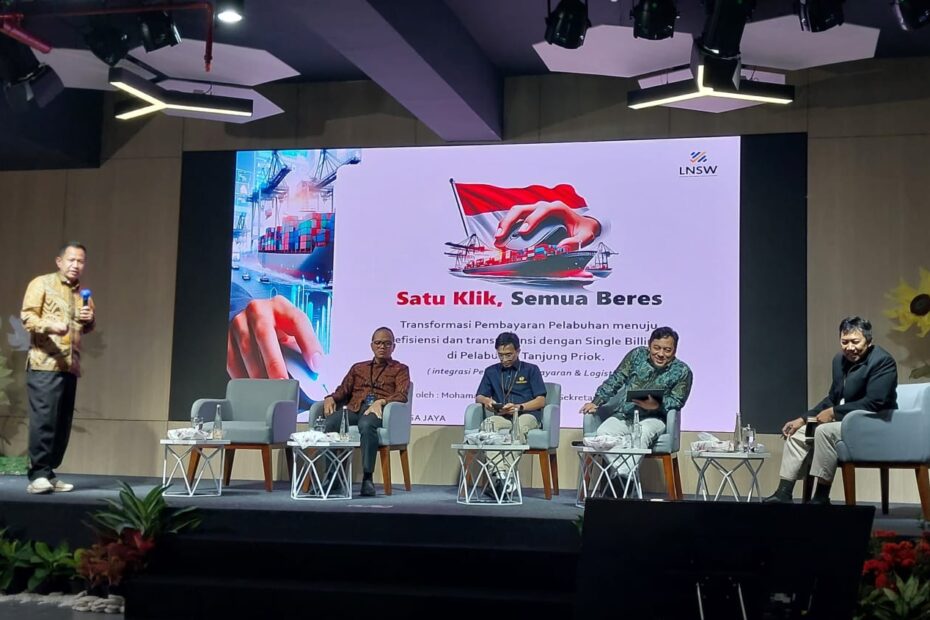
Indonesia’s port service sector is undergoing a significant digital transformation with the introduction of the Single Billing system, a streamlined, unified platform initiated by the National Single Window Institute (LNSW).
Designed to cut through layers of bureaucracy, the system promises to bring greater efficiency, transparency, and accountability to the nation’s maritime logistics.
This transformative initiative took center stage at the national seminar “Unifying Services, Increasing User Satisfaction,” held in Jakarta on Wednesday, May 28, 2025.
Opening the event was Galih Elham Setiawan, Director of Business Process Efficiency, while the closing remarks were delivered by Mira Puspita Dewi, Acting Head of LNSW.
The seminar brought together a diverse array of stakeholders, from shipping companies and port operators to government agencies and financial institutions.
Among the key voices at the forum was Mohamad Erwin, Secretary of Indonesia National Shipowners’ Association Jakarta (INSA Jaya), who emphasized that Single Billing is more than just a technical upgrade, it’s a crucial step toward modernizing Indonesia’s maritime logistics ecosystem.
“Single Billing brings together multiple payment systems under one digital roof. This effectively dismantles the complex, time-consuming bureaucratic maze that has long frustrated industry players,” Erwin said.
Before the introduction of Single Billing, port service users were required to process payments separately to various agencies such as the Port Authority (KSOP), Quarantine, and BLU Navigation, each operating with its own system. This not only slowed down operations but also opened the door to inefficiencies and administrative errors.
Erwin stressed, however, that the success of this system hinges on comprehensive integration and the establishment of a clearly defined Service Level Agreement (SLA) between all participating agencies.
“Without a transparent and enforceable SLA, users will continue to face service inconsistencies,” he warned.
“An SLA is more than a formality, it’s a moral and operational contract that ensures services are delivered on time, to standard, and with full accountability.”
In a cross-agency digital system, the SLA is the backbone of trust. For Single Billing to function seamlessly, platforms across all institutions, from KSOP to Quarantine and BLU Navigation, must operate in real time, with synchronized processes and automatic data entry.
According to LNSW, full implementation of the Single Billing system will commence following a complete outreach and education campaign to service users and stakeholders. Erwin expressed optimism about the progress of integration with BLU Navigation and called for continued collaboration and open communication to support a smooth transition.
The seminar also featured insights from leading experts including Erwin Hariadi (Head of LNSW’s Export Business Process Efficiency), Rusli Zulfian (Head of Sub-Directorate for Data Science Management and Treasury Information Systems at DJPB), and Catra Wardana (VP of Digital Solution at Bank Mandiri). The event was attended by representatives from STRANAS PK, Customs, BLU Navigation, private shipping companies, and other key maritime partners.
INSA Jaya reaffirmed its commitment to supporting digital transformation in Indonesia’s logistics sector. Under new chairman of Ir. H. Andi S. Patonangi, the organization aims to act not only as a system user but also as a proactive government partner advocating for sustainable and inclusive reforms.
“Single Billing marks the beginning of a more modern, efficient, and trustworthy maritime logistics era for Indonesia Digital transformation isn’t just about adopting new tools, it’s about reshaping governance,” Erwin said in conclusion.