

Tanjung Emas Port remains the primary gateway for both domestic and international logistics activities in Central Java. The volume of containers through the province’ leading container terminal – TPK Semarang – has consistently increased in last years.
This terminal operator – PT Pelindo Terminal Petikemas (SPTP), a sub-holding of state port operator PT Pelindo, reported that in 2024, TPK Semarang throughput grew up 15% year-on-year, to 895,904 TEUs, from 781,841 TEUs in 2023.
This includes 766,914 TEUs of oceangoing (export import) and 128,990 TEUs of domestic trade, respectively increasing 13% and 24% yoy.
Notably, export and import volumes were nearly balanced, with 385,224 TEUs in export and 381,689 TEUs in import.
The increase in container traffic can be attributed to several factors, including a notable rise in exports to key markets such as Taiwan (up 14%), the United States (up 26%), Germany (up 21%), and China (up 15%). Dominant export commodities include furniture and footwear.
Widyaswendra, Corporate Secretary of PT Pelindo Terminal Petikemas, explained that container throughput at TPK Semarang has been steadily rising. He pointed out that in 2020, the terminal handled 717,062 TEUs, prompting the company to enhance terminal operations to maximize capacity.
To accommodate continued growth, SPTP has outlined several plans. In 2025, a 150-meter ocean pier designed to support ship mooring activities at TPK Semarang will be in operation. This expansion will be complemented by the addition of two harbor mobile cranes to assist in loading and unloading, along with additional container stacking yards.
Looking further ahead, SPTP plans to introduce new quay container cranes (QCC) by the second quarter of 2026. Additionally, the pier and stacking yard will be upgraded. By 2029, container throughput of TPK Semarang is projected to reach 1.2 million TEUs.
“The growth of container throughput reflects the broader industrial growth in Central Java. We are committed to optimizing the terminal to ensure that it can continue to provide top-tier service while maintaining sufficient capacity,” Widyaswendra on Thursday, February 20, 2025.
In response to the growing volume, SPTP is taking measures to avoid congestion at both the seaport (mooring) and land side (container stacking). The company is ensuring all supporting infrastructure is well-aligned with principles of good governance to ensure smooth operations.
CY EXPANSION
Teguh Arif Handoko, Chairman of the Indonesian Logistics and Forwarders’ Association (ALFI/ILFA) for Central Java and Yogyakarta (DIY), expressed support for the capacity expansion, particularly the planned extension of the container yard (CY). He emphasized that cargo traffic from Central Java has grown significantly in recent years.
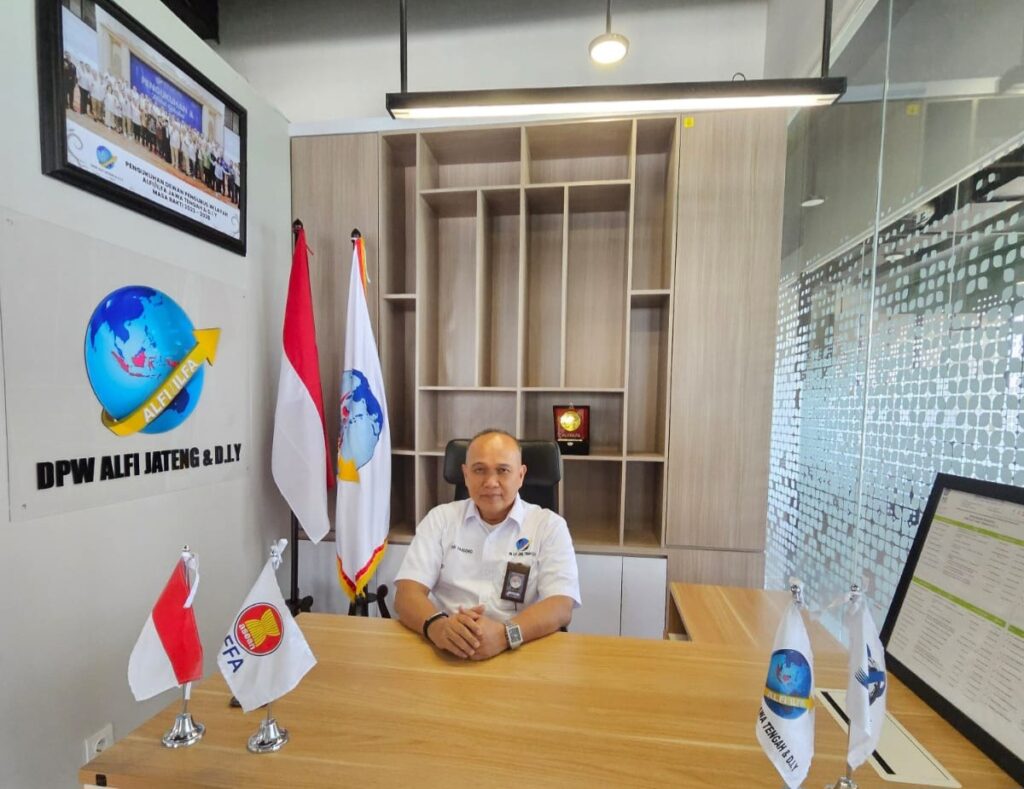
“We welcome the capacity increase program, especially the expansion of the CY, as container flow through TPK Semarang is expected to continue its upward trajectory,” said Teguh.
Teguh noted that the growth in container traffic reflects broader industrial development in Central Java, driven in part by the establishment of special economic zones like the Kendal Industrial Zone (KIK) and the Batang Integrated Industrial Zone (KITB). The rapid growth of these industrial zones has greatly impacted trade volumes, including both exports and imports of raw materials.
The logistics and forwarding sector in 2024 grew up by nearly 20%, contributing positively to port growth, particularly at container terminals like TPK Semarang.
Teguh forecasted continued growth in container traffic in the coming years, especially with the ongoing development of the KITB industrial area in Batang. He called on Pelindo to anticipate future surges in container volume to prevent congestion.
“We also hope that TPK Semarang will implement its plans to add new equipment for more efficient loading and unloading,” Teguh added.
He also urged cargo owners, especially importers, to remove their goods promptly to avoid delays and congestion at the terminal.