
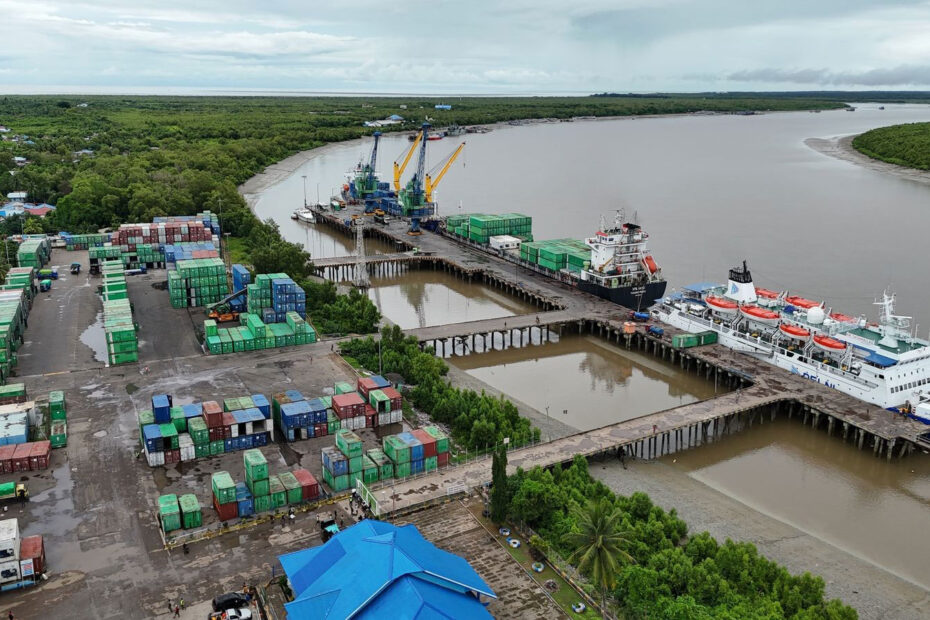
Surging cargo volumes linked to accelerating development in eastern Indonesia are straining operations at the Port of Merauke, prompting shipping lines, logistics firms and port authorities to call for container depots outside the main port area.
As the primary maritime gateway to South Papua province, Merauke has seen double-digit growth in container traffic over the past two years, increasing pressure on its limited storage yard and slowing vessel turnaround times.
Business groups say the solution lies in relocating container stripping and stuffing activities, currently carried out inside the port, to depots outside the port area located within a few kilometers of the quay.
“The increase in development in South Papua automatically drives higher logistics flows to Merauke,” said Abi Bakri Alhamid, Chairman of Merauke Chapter of Indonesian Logistics and Forwarders’ Association (ALFI/ILFA).
“In the long term, we need a container depot outside the port area to prevent congestion in the stacking yard.”
In the interim, he said, local authorities should allow containers to move directly from the port to distributors’ warehouses to ease pressure inside the terminal.
Operators say congestion has already begun to affect loading and unloading performance. “The storage yard inside the port is quite congested,” said Puji Hermoko, head of the Merauke branch of shipping line PT Salam Pacific Indonesia Lines (SPIL).
“Separating containers ready for loading and unloading from stripping and stuffing activities is essential. Otherwise, it increases vessel waiting times.”
Stripping refers to unloading cargo from containers, while stuffing involves packing goods into containers for shipment.
The Port of Merauke’s stacking yard covers around 1.5 hectares, though only 1 to 1.2 hectares can be used optimally, according to Julivan Ch. L. Salindeho, head of the Merauke Class IV Harbormaster and Port Authority (KSOP).
He said coordination is under way between KSOP, state port operator Pelindo, local government, shipping companies and transportation service providers to prepare an off-dock container depot that would shift stuffing and stripping outside the port perimeter.
“The goal is to optimize stacking yard capacity and speed up loading and unloading,” Julivan said following a recent meeting with the National Development Planning Agency (Bappenas).
Growth Outpaces Capacity
Container volumes at the terminal operated by PT Pelindo Terminal Petikemas have risen steadily.
Muhammad Rasul Irmadani, terminal head of TPK Merauke, said container throughput reached 52,715 twenty-foot equivalent units (TEUs) in 2025, up 14% from 46,429 TEUs in 2024. The 2024 figure itself represents a 14% increase from 40,671 TEUs in 2023.
The growth has pushed the yard occupancy ratio (YOR) to an average of 75%, partly because space is also used for stripping and stuffing. With an off-site depot in place, YOR could be reduced to around 40%, Rasul said.
To boost handling capacity, the operator has added equipment including a side loader for empty containers, a head truck and chassis. Additional units, including a reach stacker and two more head trucks with chassis, are in the delivery phase.
“We strongly support the presence of a depot outside the port,” Rasul said. “Annual container growth requires us to optimize the stacking yard for loading and unloading.”
Preparing for Future Demand
Industry players warn that logistics pressures could intensify once large-scale industrial projects in South Papua come online, including a planned sugarcane processing facility.
Suroso, director of PT Berkah Mutiara Laut, said the location of any new depot will be critical. Ideally, it should be within three kilometers of the pier to ensure efficient transport, given road limitations in Merauke that make some routes unsuitable for container trucks.
“Building a depot is not just about adding land,” he said. “It’s about securing the supply chain as development accelerates.”
With regional growth ambitions rising, stakeholders say infrastructure readiness will determine whether Merauke can keep pace as a logistics hub for Indonesia’s eastern frontier.