
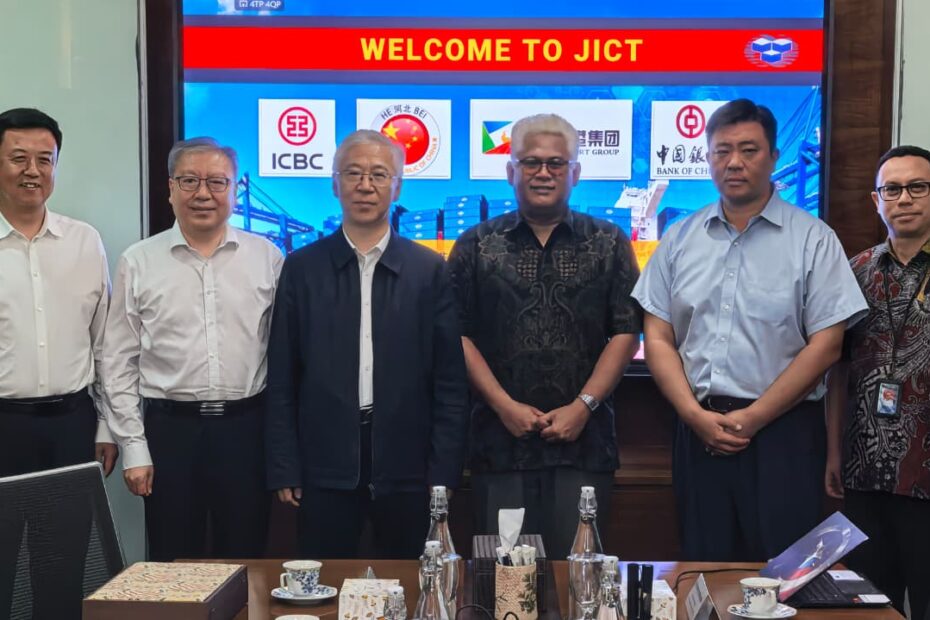
Jakarta International Container Terminal (JICT) hosted a delegation from China’s Hebei provincial government on Monday for discussions on trade connectivity, supply chain efficiency and logistics cooperation amid evolving global trade dynamics.
The delegation was led by Zhao Chenxin, executive vice governor of Hebei Province, accompanied by Lu Jian, executive deputy secretary-general of the Hebei provincial government, and Zhai Zengjun, deputy director of the Hebei Provincial Development and Reform Commission. Representatives from Chinese businesses, including COSCO Shipping, also attended the meeting.
The delegation was received by Hutchison Ports Indonesia CEO Seto Baskoro, JICT Operations and Engineering Director Doni Budiono, and the terminal’s management team at JICT.
The meeting focused on developments in international trade, shipping connectivity and logistics industry transformation, underscoring the growing role of container terminals in supporting cross-border economic activity.
During the visit, JICT presented its operational capabilities, container flow management systems, terminal service development and the use of technology to support domestic and international logistics operations.
Seto said modern ports now play a broader role in supporting trade and economic growth beyond cargo handling activities alone.
“We welcome the visit of the Hebei provincial government delegation to JICT as part of efforts to strengthen dialogue and shared understanding of challenges and opportunities in the global logistics ecosystem,” Seto said.
“Ports today are no longer viewed solely as loading and unloading infrastructure, but also as connectivity platforms linking trade, investment and international supply chains,” he added.
Seto said closer engagement between logistics operators, businesses and governments was becoming increasingly important to build trade systems that can adapt to market shifts and changes in global supply chains.
“Collaboration and connectivity among stakeholders are essential foundations for creating more efficient and sustainable trade flows,” he said.
Doni said the competitiveness of modern terminals depended not only on capacity but also on operational reliability and service consistency.
“JICT continues to strengthen operational excellence by improving reliability, engineering capability and the use of technology to ensure safe, efficient and responsive services in line with customer needs and developments in international trade,” Doni said.
The visit concluded with a discussion session on logistics industry developments and JICT’s role in supporting international trade connectivity.
JICT said dialogues with global stakeholders form part of its commitment to strengthening Indonesia’s position within international logistics and trade networks.
Hebei’s Global Trade
Hebei Province has strengthened its position as one of China’s key international trade hubs, with exports reaching $54.9 billion in 2025, making it the country’s 17th-largest exporter among 31 provinces. The province’s trade performance reflects its growing role in the global automotive, manufacturing, and industrial supply chains.
Cars were Hebei’s largest export commodity at $6.1 billion, followed by motor vehicle parts and accessories at $2.98 billion, according to China’s trade data. Other major exports included refined petroleum products worth $1.29 billion, delivery trucks at $1.04 billion, and iron structures valued at $1.01 billion.
The province’s export profile highlights Hebei’s expanding industrial base and its strategic role in supporting China’s overseas trade connectivity, particularly in the automotive and heavy manufacturing sectors.
On the import side, Hebei recorded imports worth $40.5 billion in 2025, ranking as the 14th-largest importer among China’s provinces. The province remains heavily reliant on raw materials and energy commodities to support its industrial activities.
Iron ore accounted for the largest share of imports at $11.1 billion, followed by crude petroleum worth $8.77 billion and petroleum gas at $4.74 billion. Hebei also imported soybeans valued at $3.16 billion and aluminium ore worth $1.41 billion.
The strong flow of imports and exports underlines Hebei’s importance in China’s international trade network and its role in linking global commodity suppliers with the country’s manufacturing sector.