
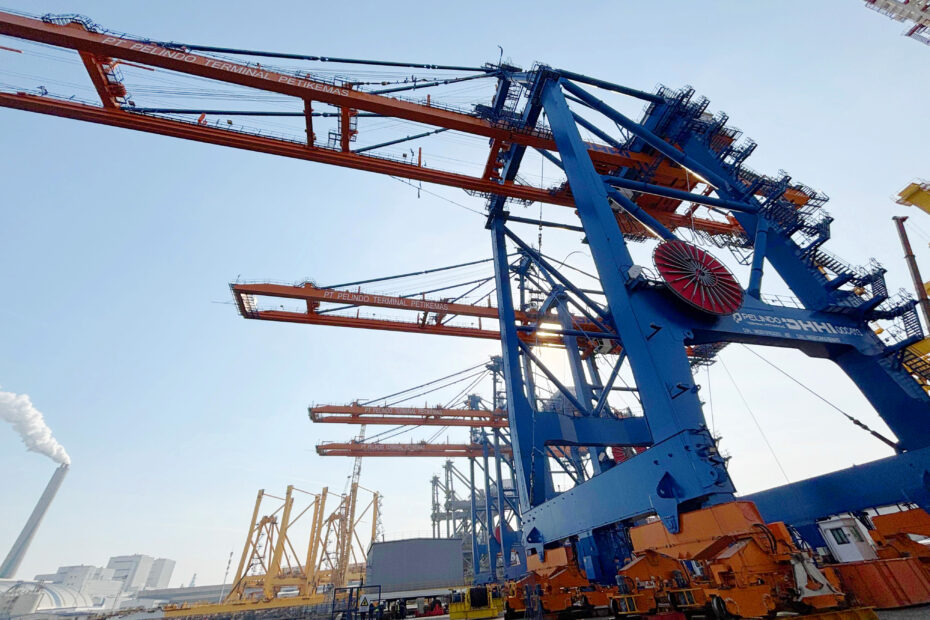
Indonesia’s largest container terminal operator is entering 2026 with ambition carefully tempered by realism. It targets steady gains through selective investment, regional industrial growth and efficiency upgrades, betting moderation as well. Hopefully these will sustain cargo volumes amid muted global trade
PT Pelindo Terminal Petikemas, a subholding of state-owned port operator Pelindo, is targeting container throughput of 13.77 million twenty-foot equivalent units (TEUs) this year (2026), a figure that reflects steady growth rather than a dramatic rebound. The target is about 5% higher than the company’s 2025 achievement and roughly 10% above the volumes handled in 2024.
Approved by shareholders as part of Pelindo Terminal Petikemas’ 2026 work plan and budget, the projection underscores what management describes as cautious optimism in a global trade environment that remains uncertain, fragmented and slower than historical norms.
“We are confident this target can be achieved, supported by industrial growth in several regions,” said Widyaswendra, corporate secretary of PT Pelindo Terminal Petikemas. “But we are not assuming extraordinary growth.”
The company’s outlook is anchored in expectations that Indonesia’s economy will expand by about 5.11% in 2025, providing a stable platform for trade, manufacturing and logistics activity heading into 2026. Rather than relying on a sharp recovery in global commerce, Pelindo is positioning itself to benefit from domestic demand, regional industrial development and incremental efficiency gains across its port network.
Uneven Growth Across Regions
Pelindo Terminal Petikemas operates container terminals across Indonesia’s vast archipelago, and management expects growth to be uneven, with gains concentrated in regions benefiting from government policy, industrial investment and natural-resource development.
Widyaswendra: “We are confident this target can be achieved, supported by industrial growth in several regions.”
In eastern Indonesia, Kendari Container Terminal is forecast to see rising volumes linked to the nickel industry. Indonesia has rapidly expanded nickel processing capacity as part of a broader push to move up the value chain and reduce exports of raw minerals. That policy shift has generated additional inbound and outbound container traffic tied to smelting, manufacturing and supporting industries.
Tarakan Container Terminal, meanwhile, is expected to benefit from increased activity related to liquefied natural gas, while Merauke Container Terminal is being positioned to support government-backed strategic projects, including food-security initiatives aimed at boosting agricultural output in eastern regions.
On Java, Pelindo is counting on rising traffic at the Semarang Container Terminal, driven by the expansion of manufacturing capacity in Central Java. Industrial estates such as the Batang Integrated Industrial Zone and the Kendal Industrial Zone have attracted domestic and foreign investors seeking alternatives to more congested and higher-cost industrial hubs in West Java.
“These industrial areas are already generating new cargo flows,” Widyaswendra said. “We expect that trend to continue as production ramps up.”
The shift reflects a broader rebalancing of industrial activity within Indonesia, as manufacturers spread operations across regions to manage costs, labor availability and infrastructure constraints. For port operators, that dispersion translates into more moderate, but geographically diversified, container growth.
Aligning with Shipping Expectations
Pelindo’s measured targets broadly align with forecasts from global shipping companies and domestic industry groups, which see container trade expanding at a restrained pace rather than rebounding sharply.
Maersk, the world’s largest container shipping line, has estimated global container demand growth of between 2% and 4%, reflecting steady but unspectacular trade conditions amid geopolitical tensions, supply-chain restructuring and slower growth in major economies.

Carmelita Hartoto (R) : “If the economy expands by around 5%, container volumes tend to move in the same range. Infrastructure, both physical and digital, must continue to be upgraded.”
Indonesia’s National Shipowners’ Association (INSA) expects national container volumes to follow a similar trajectory.
“Containerized trade generally grows in line with economic growth,” said Carmelita Hartoto, the association’s chairwoman. “If the economy expands by around 5%, container volumes tend to move in the same range.”
Household consumption remains a key driver of domestic cargo flows, she said, while manufacturing output and export-import performance will shape international volumes for an economy that relies heavily on seaborne trade.
Export and Logistics Outlook
Exporters are cautiously optimistic about prospects in 2026. Benny Soetrisno, chairman of the Indonesian Export Companies Association GPEI, estimates exports could grow by around 7%, supported in part by Indonesia’s expanding network of free trade agreements.
Benny Soetrisno: “Exports could grow by around 7%, supported in part by Indonesia’s expanding network of free trade agreements.”
“FTAs improve market access and reduce tariff barriers, making Indonesian products more competitive,” Benny Soetrisno said. Beyond boosting export volumes, he added, such agreements can strengthen Indonesia’s position in global supply chains by encouraging deeper integration with regional and international markets.
The logistics sector is expected to grow even faster than exports or the broader economy. Trismawan Sanjaya, secretary general of the Indonesian Logistics and Forwarders Association (ALFI/ILFA), forecasts growth of between 10% and 11.6% in transportation and warehousing, contributing as much as 1,700 trillion rupiah, or about $110 billion, to gross domestic product.
That expansion is being driven largely by digital trade and e-commerce, including transactions conducted via social-media platforms, as well as by industrial downstreaming projects and government programs.

Trismawan Sanjaya: Transportation and warehousing is expected to grow between 10% and 11.6%.”
“E-commerce growth, industrial downstreaming and public-sector initiatives are all increasing demand for logistics services,” Trismawan said. Food-security programs and other government-backed projects are also expected to support steady cargo flows, particularly to eastern Indonesia.
Structural Constraints Remain
Despite the upbeat projections, industry participants caution that structural constraints could limit how much growth ports and logistics providers are able to absorb.
Benny Soetrisno pointed to capacity limitations at some ports, which can disrupt the availability and repositioning of empty containers, an issue that can ripple through supply chains and raise costs. Inland transport remains another bottleneck, especially in regions where road and rail connectivity has not kept pace with port development.
Efficiency gains, analysts say, depend on coordination across the entire supply chain, from terminal operators and shipping lines to trucking companies, warehouses and customs authorities.
“Infrastructure, both physical and digital, must continue to be upgraded,” Carmelita said. “Without that, logistics costs will remain high and competitiveness will suffer,” she said further.
Trismawan cited regulatory uncertainty, uneven infrastructure development across regions and the lack of standardized services as persistent challenges. Technology-driven integration, he said, is essential if Indonesia is to compete with established logistics hubs in Southeast Asia.
For Setijadi, founder and chief executive of Supply Chain Indonesia, deeper inter-island connectivity and multimodal transport networks will be critical to sustaining long-term growth.

Setijadi: Deeper inter-island connectivity and multimodal transport networks will be critical to sustaining long-term growth.”
“With better infrastructure and integrated logistics systems, shipping and logistics will not only support trade,” he said, “but become a stronger engine of national economic growth.”
Investing in Efficiency
Against that backdrop, Pelindo Terminal Petikemas is focusing its capital spending on efficiency improvements rather than large-scale capacity expansion.
The company plans to deploy four quay container cranes and 14 rubber-tyred gantry cranes at the Surabaya Container Terminal, one of its busiest terminals. Semarang will receive four new quay cranes and an additional 135 meters of berth, enabling it to handle larger vessels and improve turnaround times.
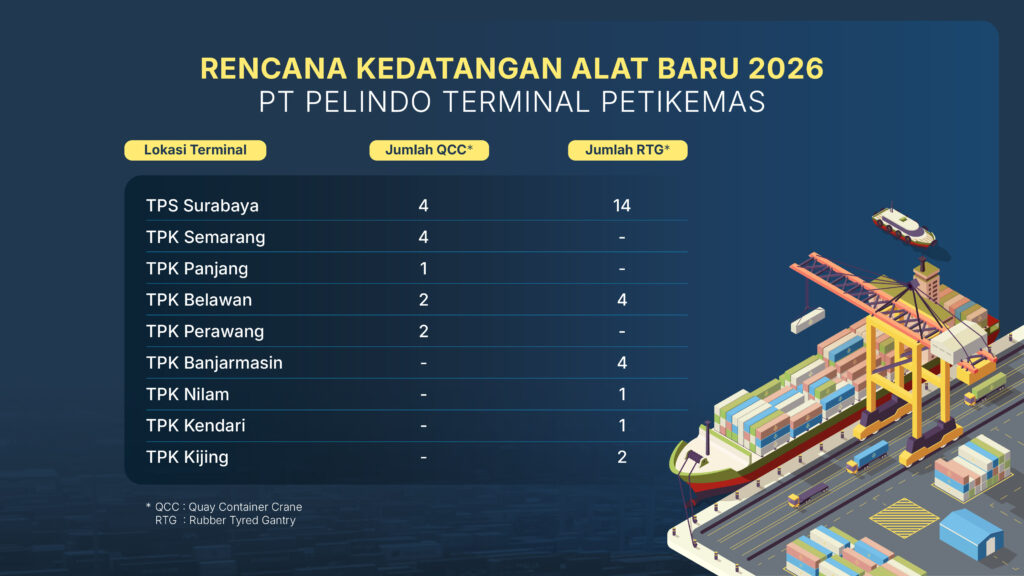
New equipment will also be distributed across several strategically important terminals, including Belawan in North Sumatra, Panjang in Lampung, Perawang in Riau and Banjarmasin in South Kalimantan. Eastern Indonesia will see upgrades at facilities such as Kendari Container Terminal and Kijing Terminal in West Kalimantan.
Alongside new procurement, Pelindo plans to optimize existing crane assets across its network, including quay container cranes and rubber-tyred gantry cranes. TPK Berlian in Surabaya is expected to receive two additional quay cranes as part of that effort.
The goal, Widyaswendra said, is to improve loading and unloading performance, reduce waiting times and ensure service reliability as freight volumes continue to rise gradually.
Industry groups say such investments are critical if Indonesia is to reduce logistics costs and improve competitiveness in regional and global supply chains. As cargo volumes grow, even modestly, pressure on port infrastructure will increase, making efficiency gains as important as capacity additions.
As Pelindo Terminal Petikemas prepares for another year of incremental expansion, its strategy reflects a broader reality facing the global shipping industry: growth is returning, but slowly. The challenge will be turning cautious forecasts into smoother cargo flows across one of the world’s most complex maritime economies, without betting on a surge that may prove elusive.