
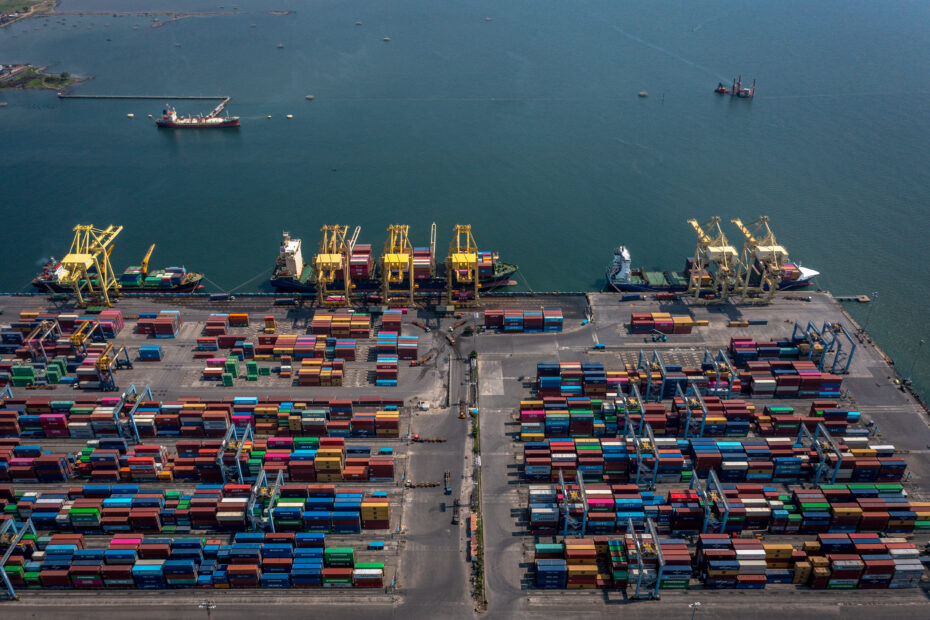
Rising exports and a sustained trade surplus are boosting logistics demand and container volumes at key ports, underscoring the need for greater capacity, efficiency and connectivity nationwide
Indonesia’s sustained trade surplus and rising exports are driving stronger demand for logistics services, lifting container traffic at key ports and reinforcing the need for continued investment in transport infrastructure and supply-chain efficiency.
The country’s trade balance posted a surplus of $5.64 billion in January-April 2026, supported by exports worth $92.15 billion, up 5.48% from a year earlier, according to Statistics Agency (BPS). Non-oil and gas products accounted for $87.74 billion of total exports.
The manufacturing sector remained the largest contributor to overseas shipments, generating exports valued at $75.57 billion during the four-month period, highlighting the sector’s central role in Indonesia’s trade performance.
China remained Indonesia’s largest export destination, absorbing goods worth $22.76 billion, followed by the United States at $10.17 billion and India at $6.14 billion. Exports to ASEAN countries totaled $17.70 billion, while shipments to the European Union reached about $6 billion.
The increase in trade activity has translated into stronger demand for logistics services, particularly at container terminals serving industrial and manufacturing centers across the country.
Central Java, one of Indonesia’s major manufacturing hubs, contributed around $4.5 billion in exports during January-April, shipping products including wood-based goods, knitted garments and palm sugar.
Despite improving trade performance, exporters continue to face challenges, including rising production costs and dependence on imported raw materials.
“Approximately 70% of our raw materials are still imported from China and several other East Asian countries,” said Ade Siti Muksodah, chairperson of the Central Java chapter of the Indonesian Export Companies Association (GPEI). “Prices for certain plastic-based raw materials have increased, which ultimately affects the competitiveness of our export products.”
Industry participants say rising logistics costs, reliance on imported inputs and regulatory uncertainty remain key concerns for exporters.
Ade said improvements in logistics services and additional capacity at Tanjung Emas Port would be crucial to supporting future export growth.
“The role of Tanjung Emas Port is very significant. Economic and logistics activities begin at the port. The most efficient and fundamental route for exports and imports remains maritime transportation,” she said.
Businesses are also closely monitoring policy developments, including regulations on export proceeds, taxation and geopolitical risks that could influence investment and long-term business planning.
Container Throughput Rises
The growth in trade activity has been reflected in rising container volumes at Semarang Container Terminal (TPK Semarang), one of Indonesia’s key gateways for international trade.
Widyaswendra, corporate secretary of PT Pelindo Terminal Petikemas, said international container throughput reached 382,093 twenty-foot equivalent units (TEUs) in January-May 2026, up 12.2% from 340,535 TEUs a year earlier.
Imports accounted for 192,829 TEUs, while export containers totaled 189,162 TEUs.
“Import container traffic grew by 10.7%, while export container traffic increased by 13.72% compared with the same period last year,” Widyaswendra said.
Container volumes at the terminal have risen steadily in recent years, increasing from 781,841 TEUs in 2023 to 895,904 TEUs in 2024 before surpassing one million TEUs in 2025.
To accommodate growing demand, PT Pelindo Terminal Petikemas is expanding berth capacity, enlarging container yards and preparing four new quay container cranes (QCCs) to improve loading and unloading operations.
“These four new QCCs are currently undergoing commissioning and testing to ensure operational readiness and safety compliance. We expect them to begin serving customers soon,” Widyaswendra said.
Major export commodities handled through the terminal include wood products, garments, footwear and processed seafood, while imports are dominated by industrial machinery, electrical equipment, vehicles and automotive components.
Logistics Key to Competitiveness
Industry players say efficient logistics infrastructure is becoming increasingly important as exporters compete in global markets where delivery speed and supply-chain reliability are critical.
Deddy Mulyadi, a garment manufacturer in Semarang, said Tanjung Emas Port plays an important role in serving export markets in the United States, Europe and Asia.
While acknowledging operational improvements, he said further investment would be needed to keep pace with industrial growth and rising cargo volumes.
“Tanjung Emas supports export activities, but cargo movement is still not as fast as at larger ports such as Jakarta or Surabaya. At times there are vessel queues that affect delivery schedules,” he said.
Improving connectivity between industrial zones and port facilities would help reduce logistics bottlenecks and strengthen export competitiveness, he added.
Bhimo Rizky Samudro, an economist at Sebelas Maret University (UNS), said Indonesia’s continued trade surplus demonstrated the competitiveness of its products despite global economic challenges.
“The trade surplus is a positive signal because it demonstrates that Indonesian products continue to compete successfully in international markets,” he said.
However, Bhimo noted that dependence on imported raw materials remains a structural challenge that limits the ability of domestic industries to generate greater added value.
At the same time, rising imports of raw materials and capital goods also indicate ongoing industrial activity and investment, he said.
Looking ahead, Bhimo said Indonesia’s ability to sustain export growth would depend not only on manufacturing performance but also on the efficiency of its logistics network.
“Container ports are strategic infrastructure for Indonesian trade. When ports operate efficiently, goods move faster and the competitiveness of national products improves,” he said.
As the world’s largest archipelagic nation, Indonesia relies heavily on maritime transport and efficient port operations to connect production centers with domestic and international markets.
Industry experts also say digital transformation will play a growing role in strengthening supply chains by improving cargo visibility, reducing costs and enhancing service reliability.
While Indonesia’s trade surplus provides a positive outlook for the economy, sustaining that momentum will require continued efforts to strengthen industrial competitiveness, expand logistics capacity and accelerate digital innovation across the supply chain.