
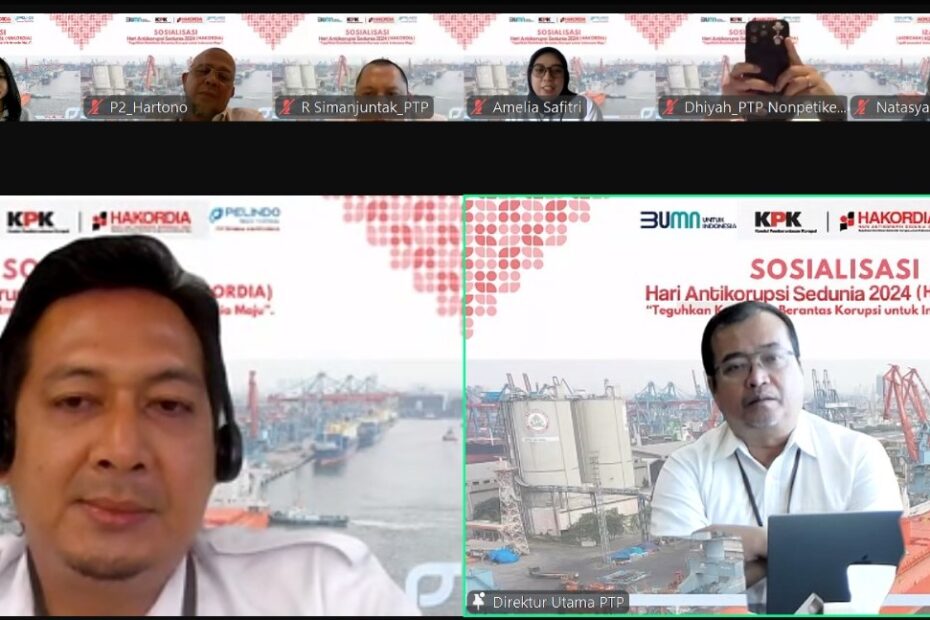
Non-container terminal operator PT PTP Nonpetikemas reaffirms its commitment to eradicating corruption through active campaigns, socialization, and the consistent application of Good Corporate Governance (GCG) principles.
On December 2, 2024, the company marked World Anti-Corruption Day (Hakordia) with a special event themed “Strengthening the Commitment to Eradicating Corruption for an Advanced Indonesia.” This occasion served as a testament to PTP Nonpetikemas’ ongoing efforts to foster a robust anti-corruption culture.
The event was inaugurated by Prakosa Hadi Takariyanto, the President Commissioner of PTP Nonpetikemas, who urged all employees to contribute to creating a transparent and accountable work environment. He emphasized the importance of reporting unethical practices, including the acceptance of gratuities, and encouraged active participation in the company’s anti-corruption initiatives.
In his address, President Director Indra Hidayat Sani stressed that integrity is fundamental to the company’s operations. “We remain committed to transparency and accountability in all our actions. Hakordia 2024 is an opportunity to further solidify our support for the Indonesian government and the Corruption Eradication Commission (KPK) in their efforts to combat corruption,” he stated. PTP Nonpetikemas continues to strengthen its stance against corruption through employee training, the implementation of reporting systems, and partnerships with the KPK.
December 9, which marks Hakordia, is an important global moment to reflect on and reaffirm the commitment to combating corruption. The event was attended by PTP Nonpetikemas’ management, including commissioners, directors, and employees, and featured a keynote address from Jeji Azizi, an Anti-Corruption Analyst for Business Entities at the KPK.
Azizi highlighted the Corruption Prevention Guidelines for Business Entities (PANCEK), a critical instrument designed to help companies meet their legal obligations regarding anti-corruption measures. With the enforcement of Supreme Court Regulation Number 13 of 2016 and Law Number 1 of 2023, PANCEK offers practical tools and checklists to assess and enhance a company’s corruption prevention systems.
The legal framework for tackling corruption in Indonesia is outlined in Law Number 31 of 1999, amended by Law Number 20 of 2001, which identifies 30 types of corruption crimes, categorized into seven main groups: state financial losses, embezzlement, fraudulent actions, extortion, gratification, conflict of interest in procurement, and bribery.
Anti-Bribery, Whistle-blower System for Transparency
In line with these regulations, PTP Nonpetikemas has implemented an Anti-Bribery Management System (SMAP) based on the international standard ISO 37001. To ensure the effective application of these standards, the company regularly conducts training sessions, awareness programs, and socialization initiatives. Internal regulations have been established to govern critical aspects of corruption prevention, such as controlling gratuities, preventing conflicts of interest, and managing the integrated one-stop reporting channel for violations.
Fiona Sari Utami, Senior Manager of Corporate Secretary at PTP Nonpetikemas, emphasized the importance of the Hakordia commemoration in strengthening awareness about integrity.
“We remain dedicated to supporting anti-corruption efforts through sustainable, collaborative programs. The Pelindo Group has provided a seamless, integrated one-stop reporting channel through the Whistleblower System (WBS), which is accessible at any time via the website pelindobersih.pelindo.co.id,” she explained.
The WBS allows employees and stakeholders to report various types of violations across nine categories: fraud, embezzlement, conflict of interest, bribery, policy violations, theft, corruption, extortion, and fraudulent actions. This system ensures that all reports are handled with transparency and integrity, contributing to a culture of accountability within the organization.
As PTP Nonpetikemas operates across 11 ports, it continues to innovate across all areas of its business, from technology to human resource management, ensuring that its services contribute to Indonesia’s economic growth, particularly in the logistics and port sectors. By strengthening its anti-corruption framework, the company aims to maintain a clean, transparent, and effective organization that drives positive change for both the industry and society.