
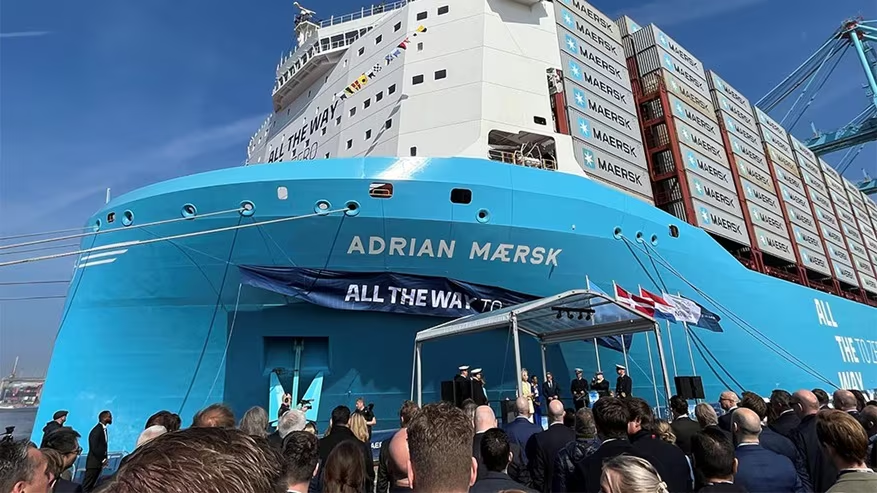
Maersk has officially named its new dual-fuel methanol-powered container vessel, Adrian Mærsk, during a ceremony at the APM Terminals Maasvlakte II in Rotterdam, late last month (March 27, 2025).
Stephanie Pullings Hart, Executive Vice President and Chief Operations Officer (COO) at Nestlé, served as the godmother for the ship.
Nestlé, a key customer of Maersk, ships all of its ocean cargo using Maersk’s ECO Delivery Ocean product, which utilizes alternative fuels to significantly reduce greenhouse gas (GHG) emissions.
By relying on these alternative fuels, Nestlé has reduced GHG emissions from its cargo by over 80% compared to traditional fossil fuels. Since 2023, the company has been fully committed to ECO Delivery Ocean as part of its broader sustainability goals.
Karsten Kildahl, Chief Commercial Officer (CCO) at Maersk, emphasized the importance of regulatory action to support this transition.
“The dual-fuel vessels represent the technology that is crucial for the shipping industry’s energy transition. What’s needed now is decisive action from the International Maritime Organization (IMO) member states during the upcoming meeting in London. We urgently need regulation to support the adoption of fuels that can significantly reduce GHG emissions. At the same time, partnerships with ambitious customers like Nestlé are essential for advancing the green transition in shipping and logistics,” said Kildahl.
Nestlé’s Stephanie Pullings Hart also underscored the company’s commitment to sustainability. “Climate change is one of the most pressing challenges of our time. As a global leader in the food and beverage industry, we are committed to taking bold actions to address this issue,” Hart said.
“By achieving a 20% reduction in greenhouse gas emissions ahead of our 2025 target, and striving for net-zero emissions by 2050, we’re demonstrating our dedication to sustainability. Our green logistics efforts, including our partnership with Maersk, reflect our commitment to reducing emissions and fostering a sustainable future,” she added.
The Adrian Mærsk has a capacity of over 16,000 TEUs (Twenty-Foot Equivalent Units) and will primarily serve the Asia-Mediterranean trade route following its maiden voyage from Rotterdam. As part of Maersk’s new East-West network, the vessel will contribute to Maersk’s goal of achieving schedule reliability above 90% once the network is fully operational. The company’s hub terminals, including APM Terminals Maasvlakte II in Rotterdam, play a critical role in this ambition.
Dual-fuel vessels are integral to Maersk’s decarbonization strategy. Bio- and e-methanol can reduce GHG emissions by 65% to 90%, depending on the feedstock and production process.
In addition to methanol, Maersk plans to deploy dual-fuel liquefied methane vessels, aiming to use bio- or e-methane as soon as feasible. Given the global demand for fuel, a combination of alternative low-emission technologies is essential to decarbonize the shipping industry effectively.