
As the tides of global economics grow increasingly turbulent, Indonesia’s maritime leaders are setting their sights on a bold destination: positioning the country as a powerhouse in the international shipping industry.
With the 1st Indonesia Maritime Week (IMW) 2025 just around the corner, stakeholders are rallying to strengthen national resilience and showcase Indonesia’s maritime potential to the world.
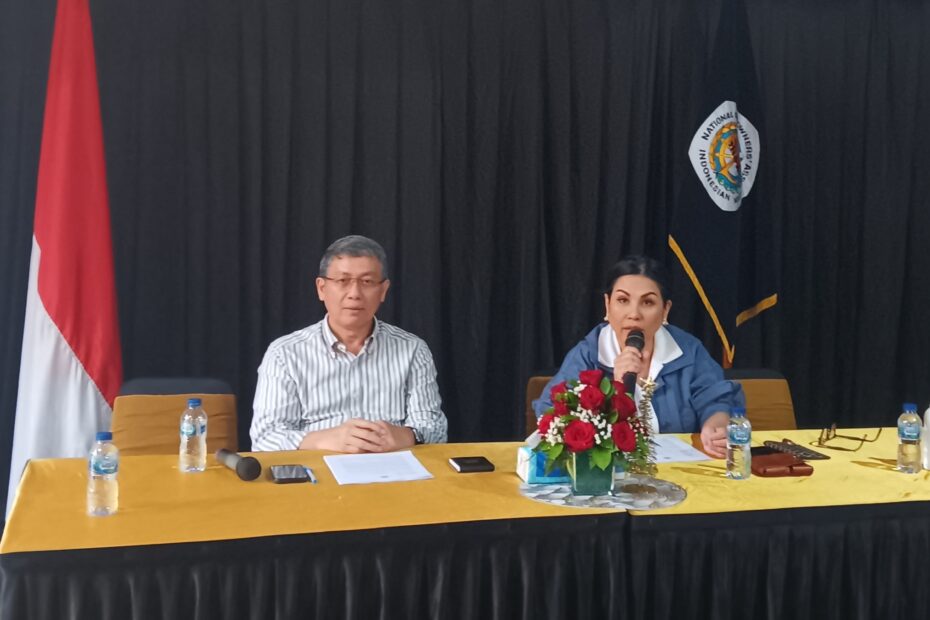
At a media gathering held in Jakarta ahead of the much-anticipated event, Chairwoman of Indonesia National Shipowner’s Association (INSA), Carmelita Hartoto, painted a sobering picture of the global shipping landscape. Trade tensions, shifting policies like the United States’ reciprocal tariffs, and the unstable Rupiah continue to test the durability of national shipping businesses.
“The global crisis shows no sign of slowing,” Carmelita said. “When the Rupiah fluctuates, it directly increases the cost of ship maintenance, most components are imported. And many of our players are burdened with debts in foreign currency, making the challenge even greater.”
Yet despite these headwinds, Carmelita’s message was clear: Indonesia must not drift but steer—decisively and ambitiously. And the upcoming IMW 2025 will be the compass.
Scheduled for May 26–28 in Jakarta, IMW 2025 promises to be the country’s largest and most prestigious maritime conference to date. Initiated by the Ministry of Transportation and organized with support from PT Pertamina International Shipping (PIS), PT Pelabuhan Indonesia (Pelindo), and INSA, the event will bring together key figures from across the global maritime sphere, industry leaders, policymakers, innovators, and major cargo stakeholders.
“It’s not just a conference, it’s a statement,” Carmelita emphasized. “Through IMW, we reaffirm our position in the global maritime arena. We want the world to see Indonesia not just as a participant, but as a strategic and competitive player.”
Central to this vision is Indonesia’s unwavering commitment to the cabotage principle, which mandates that domestic sea transport be carried out by Indonesian-flagged ships and crews. For Carmelita and many industry leaders, cabotage is more than just regulation, it is sovereignty in action.
“Cabotage keeps our shipping industry afloat and keeps our nation in control of its waters. Countries like the U.S. and Japan defend their cabotage principles because they understand what’s at stake. We must do the same,” she urged, calling on all ministries and institutions to stand guard over this vital policy.
While challenges remain – from overlapping exports within ASEAN to geopolitical uncertainty – Carmelita highlighted a key achievement: “Today, national shipping has become the host in its own country. We serve every corner of the archipelago, and that’s a success we must protect and build upon.”
Director General of Sea Transportation, Antoni Arif Priadi, added perspective from the regional stage, noting that ASEAN nations, while united under cooperative frameworks like the Maritime Transport Working Group (MTWG), often find themselves competing rather than collaborating due to the similarity in export commodities.
“In ASEAN, many countries export similar products, like crude palm oil. So intra-regional trade can be limited by that overlap,” Antoni said. “Still, collaboration platforms like MTWG help us share insights and strengthen our collective maritime strategies.”
Looking ahead to IMW 2025, organizers plan to invite not just local stakeholders but also international financiers—including banks—to explore opportunities in the Indonesian maritime sector, making it clear that this event is not just a showcase, but a call to action.
As the currents of global trade continue to shift, Indonesia is anchoring its hopes on a united, resilient, and forward-looking maritime industry. IMW 2025 may just be the launchpad the nation needs to sail confidently into the future.