
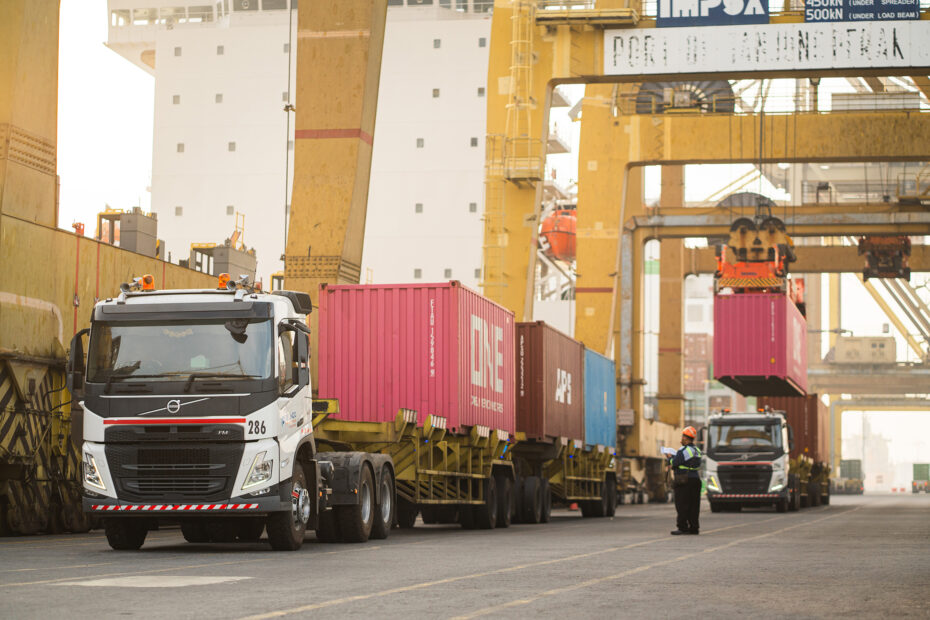
At a time when global trade remains volatile, PT Pelindo Terminal Petikemas (SPTP), a subholding of state port operator PT Pelindo, has defied expectations with a double-digit surge in international container traffic in the first half of 2025, a sign that Southeast Asia is benefiting from global supply chain realignments.
The company, which operates and manages container terminals across the archipelago, reported handling 2.1 million twenty-foot equivalent units (TEUs) of export and import containers between January and June, up 13.64% from the 1.8 million TEUs logged in the same period last year.
The growth comes amid rising trade activity between Indonesia and key partners such as China, as more manufacturers and logistics firms shift operations to the region in response to geopolitical tensions and trade policy changes, including U.S. tariffs under President Donald Trump’s administration.
“This growth actually exceeded our internal forecasts,” said Widyaswendra, Corporate Secretary of Pelindo Terminal Petikemas. “Even with ongoing global uncertainty, both exports and imports have continued to show resilience, particularly through key terminals serving international routes.”
International container volumes were nearly evenly split, with exports totaling 1.01 million TEUs and imports at 998,000 TEUs in the first half. Domestic throughput also edged up, reaching 4.2 million TEUs, a 4.86% increase from the same period in 2024.
Ports Surge as China Routes Gain Momentum
Among the busiest terminals, TPK Semarang posted a 17.7% year-on-year rise in traffic to 415,000 TEUs, while IPC TPK saw a dramatic 43.26% jump to 440,000 TEUs. Both ports serve as key international gateways, linking Indonesian exporters to global buyers.
The expansion in container volumes coincides with new shipping services launched along fast-growing Asia-Pacific routes. One such example is the North China Indonesia (NCI) service introduced earlier this month by Singapore’s Pacific International Lines (PIL), connecting Chinese ports directly with Indonesia’s Tanjung Priok in Jakarta (TPK Koja) and Tanjung Perak (TPS) in Surabaya, bypassing the need for transshipment hubs in third countries.
“The trade volume between Indonesia and China is currently very encouraging,” said Sujeeva Salwatura, President Director of PIL Indonesia. “That’s the main reason we’re reopening this direct service. We believe the current market conditions are ideal.”
PIL had previously suspended services to Indonesia for five years, but renewed demand, especially from Southeast Asia’s growing consumer base, prompted the company’s return.
Japanese carrier Ocean Network Express (ONE) has also seen similar trends. “In the first half of this year, our growth in Indonesia ranged from 3 to 5 percent,” said Keishin Watanabe, President Director of ONE Indonesia.
“We expect the strongest growth on the Indonesia–China route, particularly as manufacturers diversify their supply chains into Southeast Asia.”
Logistics and Domestic Distribution Riding the Wave
The container boom is also lifting the domestic logistics sector. Gateway Container Line (GCL), Indonesia’s largest LCL (Less than Container Load) consolidator, reported notable increases in shipments, especially for goods coming from China.
“LCL imports grew nearly 9% in the first half, with China as the biggest contributor,” said GCL President Director Hesty Rosmawati. “Meanwhile, FCL (Full Container Load) imports rose more than 5%, and exports to destinations like Vietnam and the UAE surged.”
LCL exports climbed 9.2%, led by shipments to Jebel Ali, while FCL exports jumped 23.4%, a signal of growing demand from both ASEAN markets and the Middle East.
At the macro level, Indonesia’s logistics and warehousing sector expanded 9.01% year-on-year in the first half, contributing 6.08% to the country’s gross domestic product (GDP), according to data from the Indonesian Logistics and Forwarders Association (ALFI) and Supply Chain Indonesia (SCI).
SCI projects full-year growth of 8.56% in the logistics sector, with total output valued at IDR 1,517 trillion (US$93 billion), roughly 6.5% of Indonesia’s GDP.
“The acceleration in logistics is closely linked to the growth of agriculture, food manufacturing, and retail trade,” said SCI Chairman Setijadi. “This signals a healthy recovery in both domestic consumption and international trade.”
As global supply chains continue to shift in response to geopolitical risks and new trade policies, Indonesia’s ports and logistics hubs appear well positioned to absorb more of the world’s redirected cargo.
For Pelindo and its network of terminals, the challenge now is to maintain momentum while upgrading capacity and infrastructure, a task that could determine Indonesia’s future role in the regional supply chain.