
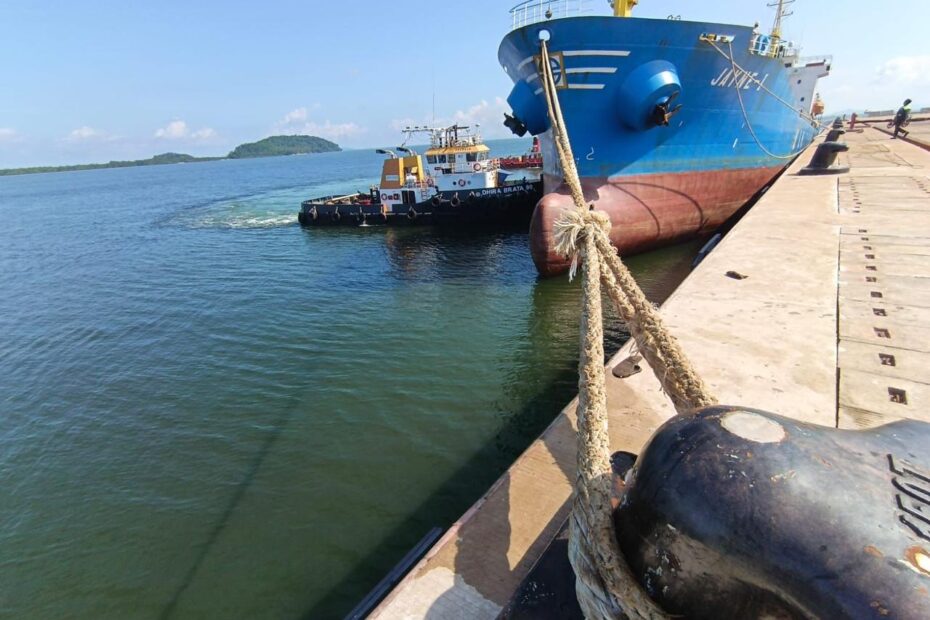
Kijing Terminal in West Kalimantan has rapidly become a critical logistics gateway since its operations were handed over to PT Pelabuhan Tanjung Priok (PTP Nonpetikemas) in August 2022.
Positioned on the edge of the Strait of Malacca, one of the world’s busiest maritime trade routes, the terminal is playing a pivotal role in boosting regional exports, particularly of palm oil, and anchoring West Kalimantan’s economic development.
The terminal, located in Mempawah Regency, now serves as the main export channel for crude palm oil (CPO) and its derivatives from the province, one of Indonesia’s largest CPO producers. The region is home to 84 plantations, 132 palm oil processing companies and 42 dedicated terminals.
“Kijing Terminal is the economic lifeblood of West Kalimantan,” said Indra Hidayat Sani, President Director of PTP Nonpetikemas, during a press briefing in Pontianak on Monday. “Its development supports not only regional industry but also strengthens national logistics and supply chains.”
Strategic Position, Modern Infrastructure
Built to handle international-scale cargo flows, Kijing Terminal is equipped to serve up to 15 vessels simultaneously, including ships up to 100,000 deadweight tons (DWT), thanks to a channel depth of 15 metres and a 1,900-metre pier.
Modern loading and unloading equipment—such as harbor mobile cranes, mobile conveyors, flexible hoses and portable filling stations—enable efficient handling of a broad range of commodities. Beyond palm oil, the terminal also processes coal, fertilizer, palm kernel, bauxite, wood products and heavy cargo.
“Kijing is not just a port, it is a strategic node for exports, imports and downstreaming industrial programs that will accelerate economic growth,” Indra added.
Cargo Volumes Surge
Kijing Terminal’s cargo throughput has seen consistent growth. Total cargo handled rose from 2.27 million tons in 2023 to 3.09 million tons in 2024. The port operator is targeting 3.3 million tons by the end of 2025.
As of June 2025, throughput stood at 2 million tons, led by dry bulk cargo (965,000 tons), followed by liquid bulk (759,000 tons), and general cargo (328,000 tons). The terminal recorded a 225% year-on-year increase in dry bulk volume in the first half of 2025.
Average throughput reached 2,716 tons per ship per day (T/S/D), a sharp rise from 836 T/S/D during the same period last year, reflecting gains in efficiency and operational performance.
“These figures signal growing confidence among our customers,” said Dwi Rahmad Toto S., PTP’s Director of Commercial and Business Development, who is also serving as Acting Director of Operations. “We are optimizing vessel turnaround times and cargo handling to meet rising demand.”
Integrated Network
The Pontianak branch of PTP Nonpetikemas oversees four terminal areas, Dwikora Port, Perintis Sintete Port, Ketapang, and Kijing Terminal. These facilities handle various non-containerized commodities including rubber, palm kernel meal, and plywood.
Kijing Terminal’s cargo mix mirrors the economic profile of West Kalimantan, with strong hinterland production driving cargo volumes. Officials say the reallocation of underutilized assets across Pelindo’s terminal network has improved synergy and boosted operational capacity.
“This reallocation is a strategic effort to maximise asset productivity and strengthen collaboration across units,” Dwi said.
With its growing throughput, expanding infrastructure, and strategic location, Kijing Terminal is expected to play an increasingly central role in Indonesia’s maritime trade network, and in the government’s broader ambition to enhance downstream industries and national logistics resilience.