
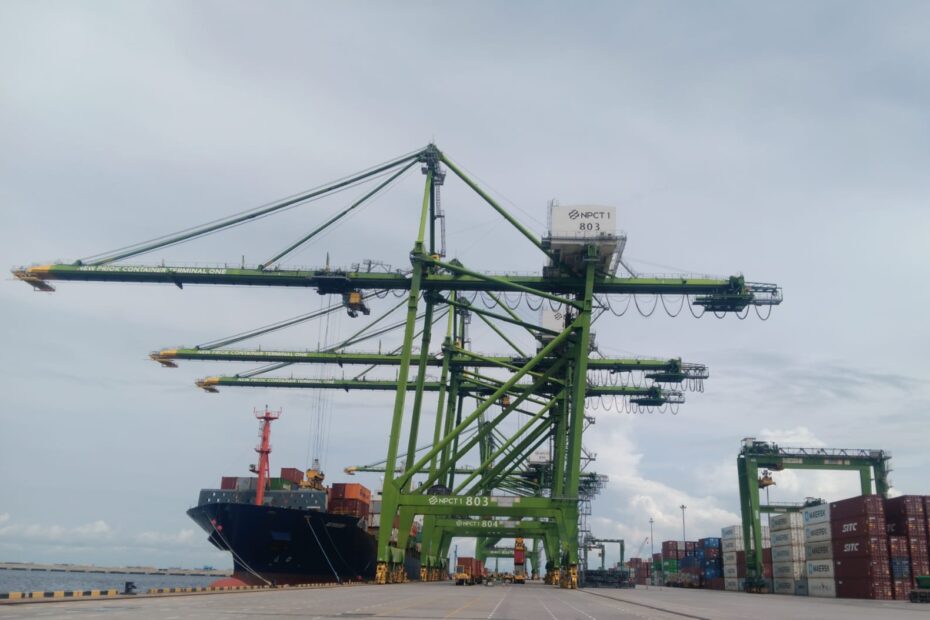
New Priok Container Terminal One (NPCT1) expects to operate at full capacity of 1.5 million twenty-foot equivalent units (TEUs) in 2025, prompting management to prioritise scheduled (window) vessel calls and scale back ad hoc services to prevent congestion at the country’s busiest port.
On a late December afternoon, the container ship AS Penelope, operated by German carrier Hapag-Lloyd, berthed smoothly at one of NPCT1’s piers in North Jakarta.
Four quay cranes worked in tandem, loading and unloading containers bound for Singapore and Malaysia’s Tanjung Pelapas – a snapshot of what has become routine at the fast-growing terminal.
The vessel, capable of carrying more than 5,000 TEUs, was scheduled to complete cargo operations within 26 hours, handling 1,677 containers, or 2,926 TEUs. Productivity averaged 64 container moves per hour, underscoring the terminal’s operational efficiency.
That performance, NPCT1 management says, reflects a facility now operating at the upper limits of its installed capacity.
“Operationally, we are capable of reaching 1.5 million TEUs this year,” NPCT1 Director Kiki Mohammad Hikmat told reporters during a media visit on Dec. 30.
“The key challenge is ensuring that service quality is maintained and congestion does not occur.”

Throughput Nears Full Capacity
Between January and November 2025, NPCT1 handled around 1.39 million TEUs, putting it on track to reach full annual capacity by year-end. The figure marks another step in a steady growth trajectory since the terminal began operations in 2016.
In August, NPCT1 surpassed a cumulative throughput of 10 million TEUs, with annual volume growth averaging between 10% and 17% over nearly a decade.
“This milestone reflects the trust of our customers,” Kiki said, adding that performance gains were driven by consistent focus on safety, innovation and operational discipline.
As volumes rise, NPCT1 is entering what management describes as a “critical phase”. With capacity fully utilised, the terminal plans to focus on window calls, scheduled berthing slots, while gradually reducing ad hoc vessel calls.
“This is essential to keep berth and yard utilisation under control,” Kiki said. “Scheduled services provide certainty for shipping lines and significantly reduce congestion risk.”
Globally Connected, Operational Excellence
NPCT1 currently handles about 16 weekly shipping services and works with major global carriers including Maersk, MSC, Evergreen, HMM, Hapag-Lloyd, Yang Ming and Wan Hai Lines. The terminal serves as a key logistics hub for Indonesian exporters and importers across manufacturing, automotive, consumer goods and agriculture.
The terminal’s 850-metre quay allows it to handle up to three vessels simultaneously, while a 16-metre-deep basin enables it to accommodate large container ships.
By November 2025, NPCT1 had recorded 801 vessel calls. Yard occupancy stood at 51% as of Dec. 30, a level considered safe for a high-throughput terminal. Daily receiving and delivery capacity reached roughly 2,800 containers.
Operational performance this year has been supported by three key initiatives. First, NPCT1 expanded and renewed its equipment fleet, adding one quay crane, five rubber-tyred gantry (RTG) cranes and seven prime movers. The terminal now operates nine quay cranes, 29 RTGs and 51 prime movers, with seven more vehicles set to enter service.
Second, the terminal introduced a Terminal Booking System (TBS) in August, allowing trucking companies to schedule gate access and reducing queues at terminal entrances.
Third, NPCT1 optimised yard operations by refining container clustering, adjusting bay priorities and closely monitoring export-import flows. These measures have helped keep yard occupancy near the optimal 60% level, even as volumes grew by up to 17% from 2024.
Digitalisation and Safety
Beyond infrastructure, NPCT1 has placed emphasis on workforce development and safety. Routine inspections, health monitoring and environmental controls are conducted to ensure compliance with occupational safety standards.
Digitalisation has also played a central role. The terminal has migrated billing and customer transactions to the ECON platform, integrated its terminal operating system with trucking companies, and strengthened cybersecurity protections.

“Digital systems allow us to operate continuously, 24/7, including during peak holiday periods,” Kiki said.
Sustainability Push
As capacity tightens, NPCT1 is also advancing its environmental agenda. The terminal aims to cut its carbon footprint by 50% by 2030.
NPCT1 has installed solar panels – becoming the first container terminal in Indonesia to do so, currently supplying about half of the main building’s electricity needs. RTGs now operate on electric or hybrid systems, while all prime movers have transitioned from B20 to B40 fuel. A cold ironing facility allows berthed vessels to draw shore power and shut down onboard engines.
The terminal holds ISO 14001:2015 certification for environmental management and plans further investments, including additional solar capacity and seven electric prime movers.
Spanning 32 hectares, with daily handling capacity of up to 6,000 TEUs and nearly 1,000 reefer outlets, NPCT1 is positioning itself as a global-standard terminal at the heart of Indonesia’s maritime supply chain.
“Our focus is to ensure growth goes hand in hand with service quality,” Kiki said. “Indonesia’s logistics sector has strong potential, and NPCT1 is ready to support that growth sustainably.”