
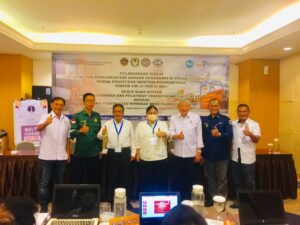
The Indonesia Stevedoring Companies’ Association (APBMI) proves its strong commitment to apply the IMO’s regulation of IMDG (International Maritime Dangerous Goods) Code and to implement the Regulation of Minister of Transportation (PM) Number 16/2021 Concerning Procedures for Handling and Transporting Dangerous Goods at Ports (IMDG Code).
This commitment is realized by carrying out IMDG Code training for human resources of its members of stevedoring companies’ association (PBM). In cooperation with BP2TL Jakarta (Sea Transportation Education and Training Centre) of Ministry of Transportation, APBMI, today, Tuesday, 29 November 2022, hosted the Training Batch I in Jakarta.
The IMDG Code Training was officially opened by Dr. Eko Nugroho Wijatmoko, the Head of PPSDM Training Division at Directorate General of Sea Transportation.
On his remark speech for the training, Eko Nugroho explained that this training is mandatory for everyone who is directly or indirectly involved in handling and transporting dangerous goods at ports as mandated in the PM 16/2021.
APBMI Chairman Juswandi Kristanto, who participated in the opening session, explained that this training remained APBMI’s commitment to fully support the implementation of the regulation (PM 16/2021). In addition, he said, this also a strong commitment of stevedoring companies to support smooth flow of goods and shipping activities at the port.
“So, we (PBM) are committed to preparing competent human resources in handling dangerous goods as mandated in PM 16/2021,” said Juswandi.
He added, the PM 16/2021 is a derivative of a regulation issued by the IMO (International Maritime Organization). “As a country member of IMO, we have an obligation to carry out what is stipulated by IMO. This also reflects our ports in the global community” he said.
As reported earlier, The IMDG Code was developed as an international code for the maritime transport of dangerous goods in packaged form, in order to enhance and harmonize the safe carriage of dangerous goods and to prevent pollution to the environment.
According to IMO (International Maritime Organization), the Code sets out in detail the requirements applicable to each individual substance, material or article, covering matters such as packing, container traffic and stowage, with particular reference to the segregation of incompatible substances.
The Code, was initially adopted in 1965 as a recommendatory instrument. It was in 2002 that the general Assembly at its seventeenth session adopted by resolution A.716(17) the IMDG Code, and decides to give it a mandatory status under the umbrella of SOLAS Convention, from 1 January 2004. However, some parts of the Code remain recommendatory.
The opening of the IMDG Code Training was also witnessed by some key government representatives and institutions including Head of Tanjung Priok Authority Capt. Wisnu Handoko, representative from Tanjung Priok Harbour Master Rudi H, Head of BP2TL Functional Training Organizer Darwis M.Mar.E, Head of LSP BP2TL Capt. Aliot, and a number of representatives from related associations, such as INSA, ISAA, GPEI and others
Commending this training Head of Tanjung Priok Authority Capt. Wisnu Handoko said: “We appreciate very much for this training, in order to implement the PM 16/2021 to ensure security and safety in handling dangerous goods at the port, as well as an effort to prevent incidents from occurring that could hinder port performance due to handling problems. dangerous goods.”
As many as 60 participants from several PBMs, both from Jakarta and other regions, joint this training.