
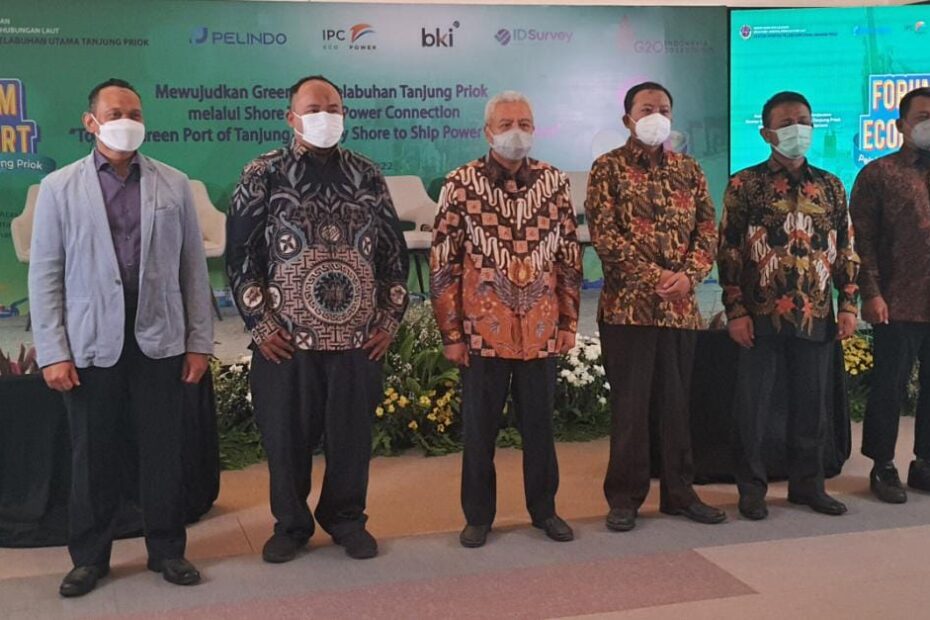
The adoption of shore to ship (STS) power connection in Indonesia’s ports should be optimized as the system will significantly decrease emission while on the other hand it will cut cost of shipping industry, a recent discussion entitled Mewujudkan Green Port Pelabuhan Tanjung Priok melalui Shore to Ship Power Connection (Realizing Priok Greenport through Shore to Ship Connection) conducted by Forum Ecoport Tanjung Priok, makes a conclusion.
Even, in view of its urgency and in line with the international guidelines (MARPOL Annex 6), the discussion also recommends for a more expansive adoption of this STS over the ports nationwide and gradually make it as mandatory.
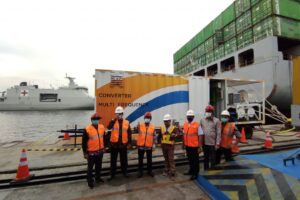
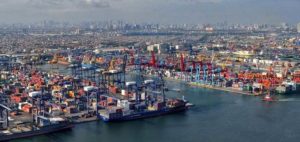
As the leading Indonesia’s port, Tanjung Priok is recommended to be a role model in adoption of the STS. Moreover, Priok has actually adopted the system run by Pelindo subsidiary PT EPI (Eco Power).
Quoting data from International Maritime Organization (IMO), Indra Ranu Kusuma, lecturer from ITS, who is one of the speakers for the discussion, says that in the last decade, maritime transportation has correspondingly produced 3%-5% of the total global Green House Gas (GHG) emission. If no actions being taken, this portion may increase to 18% by 2050 in correspondence since the drastic oversea trading increments.
Also, emission factors for auxiliary engine generation was calculated based on 0.1 % sulphur fuel. Ships can shut down their engines while berthed and plug into an onshore power source.
So, shore side electricity is also known as Shore Connection, Shore-to-ship Power, Cold ironing, Onshore power supply, Alternative Maritime Power, is an alternative for solution.
“This technology has shown great effects on gas emission reductions and been gradually utilized in many ports around the world, like Port of Los Angeles,” he said.
Juergen Lorenz, M.Sc. MBA, Technology & Business Development Specialist for the IMO’s IKI-IMI-PEMSEA project says that STS is one of the strategies recommended by the several organizations to reduce the environmental impact of seagoing vessels in ports.
Ports nowadays are not normally equipped to supply vessels with electricity from the dockside, nor are vessels usually equipped to receive power in this way.
Around the world, though, many activities in this direction are now underway and interest in the technology is rapidly growing, spurred on by tougher environmental legislation, greater focus on emissions in ports from shipping, and, more recently, rising fuel prices.
However, Juergen said that there are many ports worldwide that have been adopting the STS Power connection, including Port of Rotterdam, Port of Long Beach, Port of Loss Angeles, etc.
Juergen suggests the ports in Indonesia to adopt it. Though it needs investment, both at the port side and onboard (vessels), but the system is totally helping to cut emission and create cost efficiency to vessel operation. On behalf of IMO, Juergen is joining the team to help the ASEAN ports to adopt the system.
Mandatory to Start from Terminal 3
Wisnu Handoko Head of Tanjung Priok Authority confirmed that after two years in operation, the STS in Tanjung Priok has been running well. He called for more expansive adoption in line with the international guidelines to run this and expect any stakeholders, including PT EPI, BKI (Indonesia Classification Bureau in any ports), and also shipping lines.
Wisnu affirmed that in line with the MARPOL Annex 6, this STS will be mandatory. “We will gradually expand this from now until next three to five years. We will start it (mandatory STS) from terminal 3 Tanjung Priok as in the last two years this system has been running well in this terminal and some national shipping lines, including Meratus, have connected their vessels with this STS,” he said.
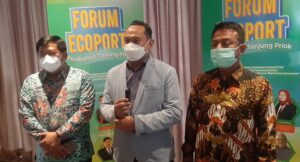
EPI, as the operator of the system at Tanjung Priok, has set up road map for expanding the adoption of the system. In line with the government (Port Authority) plan adopt Mandatory STS from Terminal 3, EPI’s roadmap will start from STS connection with domestic container vessels, and then followed by international container vessels and multipurpose vessels.
“We actually have come to the roadmap. Now, we have handled some domestic container vessels,” Imannudin EPI President Director said.
EPI has actually been running the STS system in supplying electricity to vessels at the port (Tanjung Priok) since 2020. The first supply was done in October 15, 2020. Imannudin noted there are some indicators, including noise reduction, to say that this STS has significantly minimized the environment pollution, thus supporting the port program to go green (green port).
In addition, this STS has created efficiency in shipping fuel consumption as the STS will help a vessel engine not to work during berthing at the port, thus minimizing fuel (marine fuel) consumption.
“This service remains our (EPI’s) commitment to support the program of green port while on the other hand this was expected to cut marine fuel consumption.”
“This is our commitment to support the green port. This STS will minimize the air pollution from engine’s fuel burning during a vessel berthing at the port. This minimizes noises from vessel engine,” said Imanuddin.
In addition, according to Imanuddin, this will create cost efficiency of shipping company. “We expect this will cut the shipping companies fuel cost by 15-30%. In addition, this will give time for vessel engine to do maintenance,” he said.
Priok Needs 20 Convertors, EPI Ready to Invest
EPI had procured two mobile convertors, meaning that EPI can provide this service for two vessels simultaneously. EPI plans to procure more convertors in line with the plan to expand the service and the response of users (shipping lines) to connect with this system.
Shipping lines appreciate with this STS power connection service as in addition to cut emission, will also cut the vessel bunker cost. “We appreciate this STS as it will help us in cutting cost (bunker cost),” said Capt Witono Deputy for INSA (Indonesia National Shipowners’ Association) Chairwoman.
Capt Witono calls for more facilities (convertors) in Tanjung Priok and more ports to adopt this system thus creating more cost efficiency to shipping lines. “Our vessels actually have been familiar with the system as they are always connected with it during docking. What we expect is that provision of more facilities and more ports to adopt it, thus giving more cost efficiency to shipping,” Cpt Witono said.
“We will procure more convertors if needed,” said Imanuddin. According to Imannudin, Priok with so many berths (terminals) need at least 19-20 convertors. “We (EPI) are ready to invest more. But, we are still discussing it with our holding (PT Pelindo) on this future investment.”
“Options are open. It can be run under direct investment from holding or partnership with other subsidiaries. But, what is clear is that we, EPI and Pelindo Group, are ready to do investment in procuring more facilities (convertors).”
Imannudin underlined that this investment is not just purely business oriented, but further to support the programs of reducing emission.
According to the studies, as presented by Juergen Lorenz, each berth needs around $ 300,000 to 4 million for the STS installation, depending on port location, power demand, voltage, frequency, and vessel type.
A feasibility study for the Port of Rotterdam, Juergen said, reached €4 million per berth, while at the Port of Gothenburg the figure was only a fraction of this (€ 255,000 for 2 berths), because of the already available high-voltage power supply, the lack of a need for a frequency converter and the limited power requirements of RoRo vessels.
At the Port of Long Beach estimated costs per berth vary significantly, depending on power requirements and berth location, ranging from US $ 1 to 4 million.
Studies by the Port of Amsterdam and by the European Commission indicate that investments for cruise ships are likely to be around € 6 million per berth.