

PT Pelindo Multi Terminal (SPMT), a subholding of PT Pelindo with core business in operating non-container (multipurpose) terminals – is dedicated to enhancing the operational performance of all the terminals it operates. SPMT is undergoing a comprehensive transformation to strengthen the country’s logistics infrastructure.
One of the key initiatives in this transformation is the implementation of a robust port transformation process. This process is based on six core principles: business processes, human resources (HR), technology, equipment, infrastructure, and health, safety, security, and environment (HSSE).
“The port transformation process, which began at the end of 2022, will continue sustainably, with the goal of boosting port productivity and reducing ship transit times (port stay),” said Arif Rusman Yulianto, Operations Director of Pelindo Multi Terminal.
A significant achievement of this transformation is the increase in productivity at the Jamrud Nilam Mirah Surabaya Branch. The dry bulk loading and unloading productivity surged by 51%, from 1,499 Tons/Ship/Day (T/S/D) to 2,266 T/S/D. This productivity boost is accompanied by a reduction in port stay time, which has decreased by 8 hours, from 58 hours to just 50 hours.
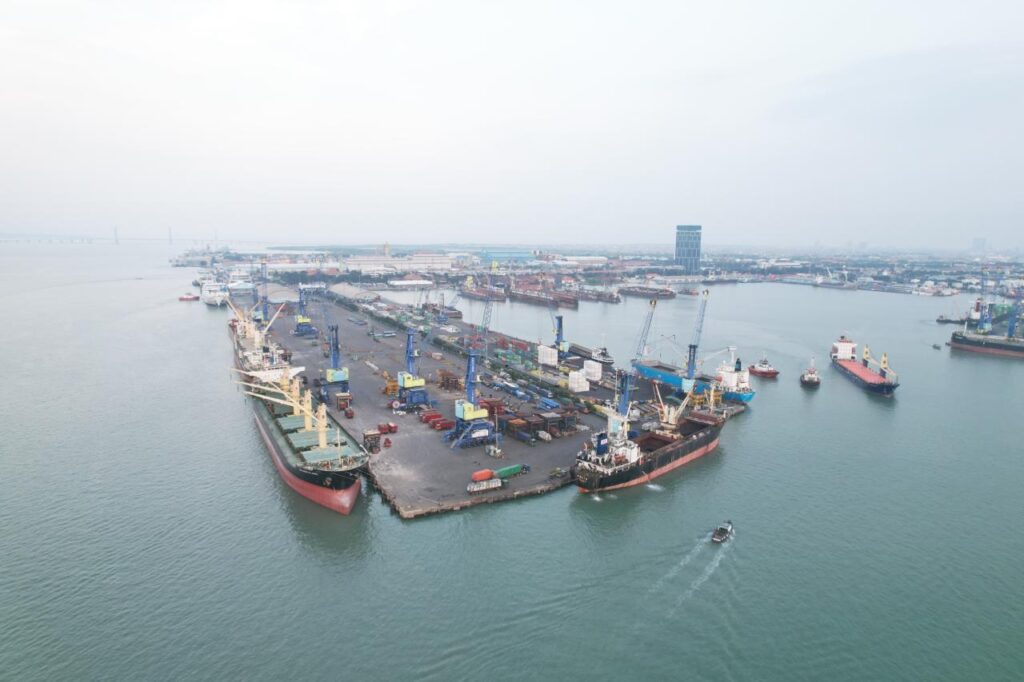
Additionally, the standardization and systematization of port operations—key components of Pelindo Multi Terminal’s transformation—have contributed to impressive growth in loading and unloading flows. In 2024, the total volume of general and bag cargo commodities reached 30.25 million Tons/M3, reflecting a 19.55% year-on-year (YoY) increase. The flow of dry bulk cargo, such as coal, iron ore, sugar, soybeans, and more, saw a 7.15% YoY growth, reaching 59.08 million tons.
The flow of vehicles also grew significantly, rising by 21.63% to 1.84 million units in 2024 compared to 2023. Meanwhile, gas commodity throughput reached 13.97 MMBTU (Metric Million British Thermal Units), a 5.86% YoY increase.
This steady growth in cargo volumes highlights the effectiveness of centralized and standardized operational management at each terminal, which is further supported by technological advancements, such as the implementation of PTOS-M (Pelindo Terminal
Operating System Multipurpose). This system enables efficient planning and control of terminal operations.
“Pelindo Multi Terminal is committed to enhancing the quality of port services, aiming to create a more efficient logistics chain. Currently, we are focused on modernizing terminal facilities, strengthening partnerships, and adopting advanced technologies that will shape the future of the company,” said Arif.
Arif also emphasized that Pelindo Multi Terminal is open to collaborations with various stakeholders to further modernize port operations. These partnerships will accelerate port transformation, ultimately benefiting Indonesia’s national economy by improving logistics efficiency and competitiveness.
Currently, Pelindo Multi Terminal operates 20 branches across Sumatra, Java, Kalimantan, Sulawesi, Bali, and Nusa Tenggara, in addition to 3 subsidiaries: PT Pelabuhan Tanjung Priok (PTP), which manages 11 branches; PT Indonesia Kendaraan Terminal Tbk (IKT/IPCC), which operates 6 terminals; and PT Terminal Curah Utama.