
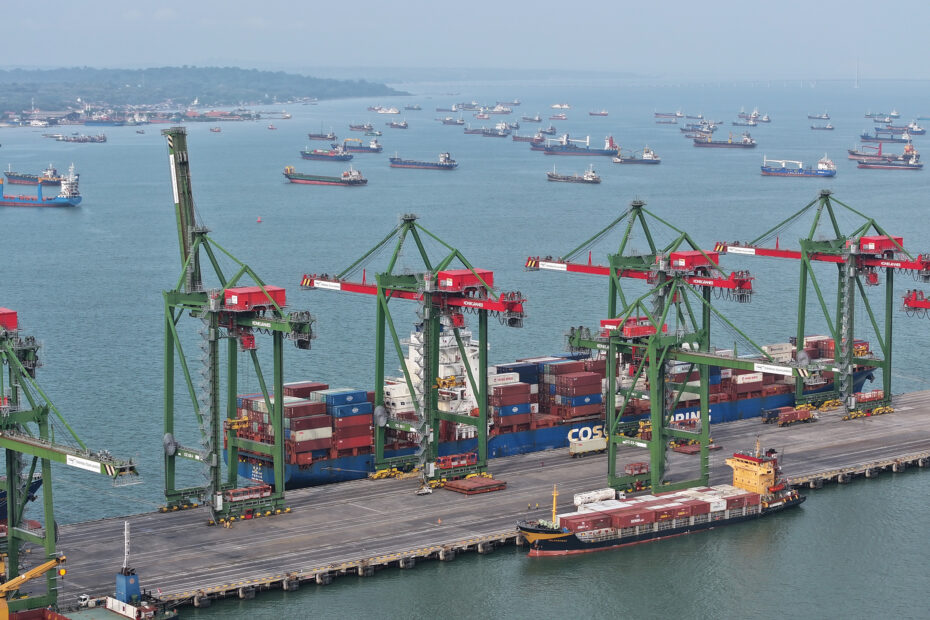
Indonesia’s container throughput rose 5.5% in the first half of 2026, buoyed by new shipping services, additional vessel calls and stronger domestic and international trade, signalling resilient logistics activity despite continued global economic uncertainty
State-owned container terminal operator PT Pelindo Terminal Petikemas handled 6.63 million twenty-foot equivalent units (TEUs) between January and June, up 5.51% from a year earlier, driven by the launch of new shipping routes, higher vessel traffic and growing cargo demand across its terminals.
International container throughput climbed 9.13% to 2.27 million TEUs, while domestic volumes increased 3.72% to 4.36 million TEUs, the company said.
Import containers rose 11.67% to 1.11 million TEUs during the six-month period, while export containers increased 6.70% to 1.13 million TEUs, indicating continued expansion in Indonesia’s trade flows.
“The growth has been supported by increased shipping activity, the opening of new services, additional vessel calls, direct international services in eastern Indonesia, and rising logistics demand generated by National Strategic Projects,” Corporate Secretary Widyaswendra said on Monday (July 27).
He said investments in terminal infrastructure, improved inter-port connectivity and service enhancements had also helped maintain efficient cargo flows and strengthen the competitiveness of Indonesia’s logistics network.
Widyaswendra added that ongoing modernization of container terminals would further improve operational efficiency and support supply chain reliability as cargo volumes continue to expand.
Industry participants said the rise in container throughput reflected the resilience of Indonesia’s economy, particularly its manufacturing sector, despite a volatile global environment.
Harry Sutanto, Deputy Chairman for Maritime and Port Affairs at the Indonesian Logistics and Forwarders’ Association (ALFI), said import growth outpacing exports should not be viewed negatively because most imports consist of production inputs.
“About 78% of Indonesia’s imports are raw materials and capital goods. Rising imports indicate that manufacturing activity remains strong and businesses are preparing for higher production,” Harry said in an interview on July 23.
Growing trade volumes have encouraged shipping lines to introduce new services and increase vessel calls at Indonesian ports, he added.
Panjang Port in Lampung was among the strongest performers, recording a 17.4% increase in container throughput during the first half of the year.
“Almost all ports posted positive growth, although at different rates. Pelindo-operated ports account for around 90% of Indonesia’s trade activity,” Harry said.
He said shipping companies remain cautious about opening new routes, conducting detailed assessments of cargo demand before committing vessels to ensure new services are commercially viable.
“Shipping companies need confidence that cargo volumes will be sufficient to sustain regular operations before launching new routes,” he said.
The global shipping industry, however, continues to face headwinds from geopolitical tensions that have disrupted trade routes and increased transportation costs.
Freight rates on the Asia-Europe route have risen between 30% and 70% as carriers adjust sailing schedules and reroute vessels in response to geopolitical developments, Harry said.
A weaker rupiah against the U.S. dollar has also raised import costs for Indonesian businesses, adding pressure to supply chains despite continued growth in cargo volumes.
Even so, Indonesia’s logistics sector remains supported by resilient domestic demand, expanding industrial activity and continued investment in port infrastructure, Harry said.
Positive Outlook Tempered by Structural Challenges
Industry executives and logistics experts said the increase in container throughput reflects resilient domestic economic activity, although sustaining growth will depend on improving port efficiency, logistics infrastructure and shipping connectivity.
Carmelita Hartoto, Chairperson of the Indonesian National Shipowners’ Association (INSA), said the first-half increase in container volumes was an encouraging sign for Indonesia’s economy despite continued global headwinds.
“The growth in national container traffic in the first half of 2026 is a positive signal for Indonesia’s economy. It shows that economic activity and the movement of goods through ports remain stable despite global economic pressures,” Carmelita said on Thursday.
She said maintaining the momentum would require continued efforts to improve the national logistics ecosystem, including more efficient ports, stronger inter-island connectivity and smoother shipping operations.
“We hope this trend can be sustained by maintaining a supportive business climate, improving port efficiency, strengthening national connectivity and ensuring reliable shipping services,” she said.
Raja Oloan Saut Gurning, a maritime logistics expert at the Sepuluh Nopember Institute of Technology (ITS) in Surabaya, said rising container volumes were a natural outcome of expanding economic and trade activity.
“Economic growth leads to higher trade volumes. As trade expands, seaborne transportation and logistics activity also increase, creating greater demand for container terminal services,” he said.
Saut said the shipping industry often describes this relationship as “ships follow the trade,” meaning vessel deployment and port activity tend to expand alongside trade growth.
He added that studies have shown higher container throughput can generate broader economic benefits, although the impact depends on the efficiency of the country’s logistics system.
Constraints such as inadequate infrastructure, limited intermodal connectivity, distribution bottlenecks and customs, immigration and quarantine (CIQ) procedures continue to weigh on logistics performance, he said.
Improving Service Quality
Experts said improving container terminal performance will be critical to strengthening Indonesia’s trade competitiveness by reducing logistics costs and improving supply chain efficiency.
Public policy analyst Agus Pambagio said container shipping remains the backbone of Indonesia’s domestic distribution network as well as its export and import trade.
He said the sector still faces structural challenges, including imbalanced container flows between regions, limited port capacity and sedimentation in shipping channels that can restrict vessel operations.
“If shipping channels become shallow, vessels cannot operate at full capacity. They must reduce their cargo loads to sail safely, lowering transport efficiency and increasing logistics costs,” Agus said.
He said regular dredging, expanded port capacity, modernization of terminal facilities and investment in cargo-handling equipment would be needed to improve productivity.
Agus also called for faster development of international transshipment hubs to reduce Indonesia’s reliance on foreign ports for international container movements.
“Some international cargo still has to be transshipped through neighboring countries before reaching its final destination. Developing competitive transshipment ports in Indonesia would improve logistics efficiency and keep more of the economic value within the country,” he said.
The comments underscore that while Indonesia’s container traffic has continued to grow alongside expanding trade and industrial activity, sustaining that growth will depend on addressing long-standing infrastructure and logistics bottlenecks.