
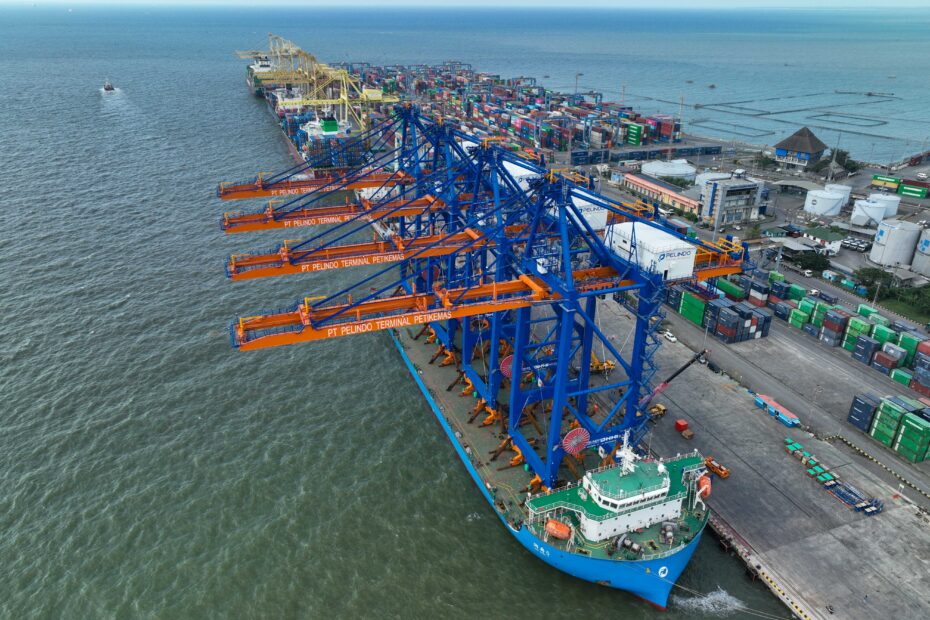
PT Pelindo Terminal Petikemas contributed IDR 1.73 trillion ($106 million) to state revenue throughout 2025, reflecting the company’s growing role in supporting Indonesia’s fiscal strength, improving logistics connectivity, and driving sustainable national economic growth.
The contribution consisted of 1.45 trillion rupiah in taxes, 55.59 billion rupiah in non-tax state revenue and 224.5 billion rupiah in concession payments, according to the company.
Value-added tax accounted for the largest portion at 485.45 billion rupiah, followed by corporate income tax payments and employee income tax contributions.
The figures come as Indonesia accelerates efforts to modernize its maritime infrastructure and improve connectivity across its sprawling archipelago of more than 17,000 islands, where logistics costs have long remained among the highest in the region.
“This support is a concrete manifestation of the company’s commitment as part of the Pelindo Group in supporting national development through the state budget,” Corporate Secretary Widyaswendra said Tuesday.
Indonesia’s transportation and warehousing sector expanded 8.98% year-over-year in the fourth quarter of 2025, according to data from Statistics Indonesia (BPS), reflecting growing trade activity and rising demand for logistics services.
Analysts and academics say the country’s port sector remains critical to sustaining economic growth, particularly as Indonesia seeks to strengthen domestic supply chains and position itself more deeply within global manufacturing and commodity trade networks.
Anton Agus Setyawan, a management science professor at Muhammadiyah University of Surakarta, said logistics activity in Indonesia has steadily expanded since the early 2000s alongside the growth of industrial production and inter-island commerce.
“As an archipelagic nation, Indonesia depends heavily on efficient logistics distribution,” Anton said. “Infrastructure development has improved conditions, particularly through toll-road construction, but port modernization and maritime connectivity still need to be optimized.”
He added that more efficient ports could help narrow price disparities between western and eastern Indonesia by lowering distribution costs for essential goods.
Expanding Port Capacity, Modernization
Pelindo Terminal Petikemas has continued to expand and modernize its container-terminal operations through the procurement and relocation of cargo-handling equipment at several strategic container terminals (TPK).
The company recently added four Quay Container Cranes (QCC) at TPK Semarang and another QCC at TPK Panjang. Surabaya Container Terminal (TPS) also received 14 Rubber Tyred Gantries and four QCCs to strengthen loading and unloading capacity.
Additional equipment has been deployed to regional terminals, including TPK Kendari, TPK Banjarmasin and TPK Nilam, as the company seeks to improve cargo flows beyond Indonesia’s main commercial hubs.
Several new units are also under production, including cranes and RTGs for Belawan, Perawang and Kijing terminals. Pelindo has also redistributed equipment between terminals to improve operational efficiency, including the transfer of two QCC units from TPS to TPK Berlian.
Raja Oloan Saut Gurning, a maritime expert at Sepuluh Nopember Institute of Technology, said the increase in loading equipment reflected rising ship traffic and growing cargo volumes.
“An increase in containerized ship arrivals fundamentally signals economic growth,” Raja said. “The downstream impact is stronger trade and broader economic interaction through maritime transport.”
Still, he noted that terminal efficiency depends not only on the number of cranes and cargo-handling units but also on supporting infrastructure such as docks, storage yards, warehouses and gate systems.
One of the industry’s key performance indicators, he said, is reducing vessel turnaround time to maximize available service slots and improve shipping reliability.
Pelindo has also continued retrofitting older equipment to extend operational life and improve productivity, while capacity expansion at regional terminals has become increasingly important as industrial activity spreads outside Java.
At Kijing Terminal, vessel calls rose 15% in 2025 to 741 calls, driven largely by cargo from downstream palm-oil and alumina industries.
“Kijing Terminal is seeing significant increases in non-containerized cargo, including dry bulk and liquid bulk shipments,” Raja said.
Meanwhile, Banjarmasin Terminal remains one of Kalimantan’s key logistics gateways, supported by domestic trade flows tied to mining and regional consumption demand.
In eastern Indonesia, Kendari New Port has also seen growing demand after operations were relocated to Bungkutoko, increasing terminal capacity to around 116,000 twenty-foot equivalent units, or TEUs.
Logistics as Economic Strategy
Transportation observer Tory Damantoro, who serves on the advisory board of the Indonesian Transportation Society (MTI), said Pelindo’s contribution to state revenue highlights the company’s broader role in Indonesia’s economic strategy.
“As a national commercial port operator, Pelindo functions as a macroeconomic enabler in achieving the government’s target of lowering logistics costs to 8% of GDP,” Tory said.
Indonesia’s logistics costs remain high compared with neighboring economies, a challenge policymakers view as a barrier to industrial competitiveness and export growth.
Tory said Pelindo now faces pressure not only to improve operational efficiency at ports but also to strengthen inter-island connectivity and support a more integrated national distribution system.
“Pelindo must play a larger role not just in operational efficiency, but also in ensuring balanced and affordable logistics connectivity across the archipelago,” he said.
He added that efficient and standardized container terminals would become increasingly important as Indonesia seeks to expand manufacturing, downstream commodity processing and export-oriented industries.
According to Tory, Indonesia’s ports must evolve beyond their traditional role as cargo gateways and become part of an integrated national supply chain capable of supporting the country’s ambitions to move further into the global value chain.