
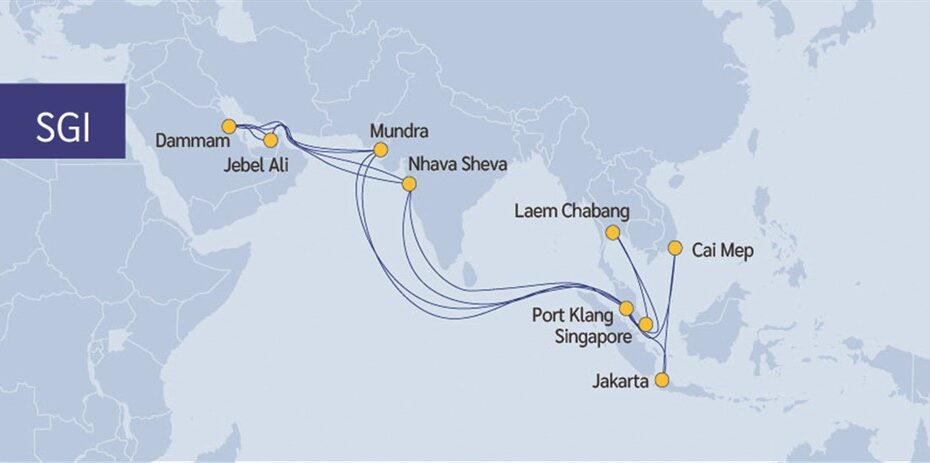
The ESL (Emirates Shipping Line) new service – Southeast Asia Gulf India (SGI) service – will start to enter the Indonesia market, following the first call of the service scheduled to berth at New Priok Container Terminal One (NPCT1) on May 30, 2024.
As ESL has announced, this leading liner shipping company headquartered in the United Arab Emirates has just launched the Southeast Asia Gulf India (SGI) service, revamped from the previous VGI service.
The SGI is a butterfly service with of the loops covering Jakarta Jakarta – Port Klang – Mundra – Jebel Ali – Dammam – Mundra – Port Klang – Laem Chabang. Its other loop covers Laem Chabang – Singapore – Port Klang – Nhava Sheva – Jebel Ali – Dammam – Nhava Sheva – Port Klang – Cai Mep – Jakarta.
This provides This provides a direct service from Jakarta to Mundra, India, and from Nhava Sheva, India, into Jakarta. Using the transshipment hubs of Port Klang and Jebel Ali, customers can access key ports in the Indian Subcontinent, Middle East, Red Sea, and East Africa.
The country presents immense potential, with a positive macroeconomic outlook, and a strong domestic market. As part of the company’s commitment to creating innovative network solutions for its customers, ESL is actively looking to grow its footprint in Indonesia and enhance connectivity to and from the country.
The maiden voyages departed from Laem Chabang on 16th May and from Cai Mep on 19th
May. Coverage within Southeast Asia and India has increased with the addition of Singapore, Jakarta and Mundra to the service rotation.
ESL is a leading liner shipping company headquartered in the United Arab Emirates. With a
network of over 70 offices across 28 countries, ESL connects communities and businesses across the dynamic regions of Asia, the Indian Subcontinent, the Middle East and Red Sea, and Africa, operating an annual capacity of around 700,000 TEU.