

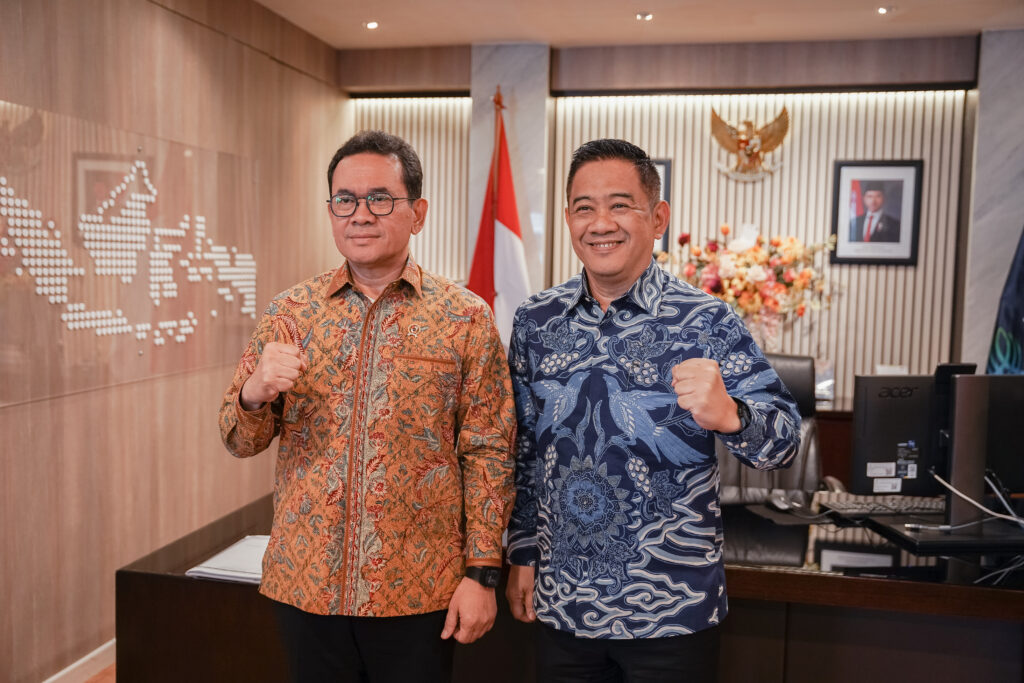
Photo : Akbar Djohan (R) discussing with Indonesia Minister of Trade Budi Santoso on how local contents can support the national industry
The Indonesian Logistics and Forwarders Association (ALFI) is calling for an increased focus on local content in Indonesia’s industrial sector to strengthen its competitiveness and bolster the domestic economy.
ALFI Chairman Akbar Djohan emphasized that promoting the use of domestic raw materials, supporting the local materials industry, and enhancing export value are all vital to the country’s economic growth.
Akbar specifically pointed to the steel industry as one area requiring urgent attention. Despite Indonesia’s substantial and capable steel industry, many local manufacturers continue to rely on importing raw steel materials, particularly from China.
This reliance highlights a disconnect between Indonesia’s industrial potential and its actual demand. The domestic steel industry is more than capable of meeting national needs, yet imports remain a significant part of the equation.
ALFI is particularly concerned about the long-standing dependency on imported materials and believes that boosting local content will help reduce the trade balance deficit while promoting domestic industrial development. Utilizing more locally sourced materials will create jobs, improve production quality, and stimulate the national economy.
For instance, Indonesia’s steel industry has ample capacity to meet domestic demand. However, factors such as price and efficiency often drive businesses to import steel, especially from China. If local industries increasingly use domestic steel, it could foster greater economic equity within the sector, while also providing resilience against global market fluctuations.
BENEFITS TO THE COUNTRY
Akbar, who is also President Director of state-owned steel maker PT Krakatau Steel, outlines several key benefits of increasing the local content, or Tingkat Komponen Dalam Negeri (TKDN) levels, in Indonesia’s industrial sector.
Frist, it will drive the domestic economic growth. Increasing TKDN plays a vital role in strengthening the domestic economy. “By using more local products and raw materials, demand for domestic goods rises, which in turn stimulates industrial growth, creates jobs, and attracts investment across various sectors, including manufacturing and services,” he said.
Second, reducing import dependency. One of Indonesia’s biggest challenges is its heavy reliance on imported products and raw materials. “By increasing TKDN, the country can significantly reduce its dependency on foreign goods, mitigating trade balance deficits and lessening vulnerability to global price volatility or foreign policy shifts that can destabilize the economy,” he said.
Third, improving product quality and global competitiveness. Increased focus on TKDN encourages domestic industries to innovate, improve product quality, and adopt cutting-edge technologies. With more local components in use, businesses will be pushed to enhance production efficiency and invest in research and development (R&D), resulting in products that are more competitive on the global market.
Fourth, boosting local job opportunities. “By increasing TKDN, domestic industries will create more job opportunities across manufacturing, R&D, logistics, and marketing sectors. This growth in local employment will help reduce unemployment rates and improve the overall welfare of the population,” Akbar Explained.
Fifth, enhancing national industrial independence. According to Akbar, by utilizing more domestic products and components, Indonesia can reduce its reliance on foreign countries for technology, raw materials, and other critical inputs. This independence is essential to strengthening Indonesia’s ability to withstand global crises or disruptions in international supply chains.
Sixth, attracting more investment. Akbar explains that industries that meet high TKDN requirements are more attractive to both local and foreign investors. Investments focused on expanding domestic production capacities will have a positive impact on the national economy.
Additionally, policies that promote the use of domestic components in strategic sectors like energy, infrastructure, and transportation will further stimulate growth in these critical areas.
Seventh, supporting infrastructure and strategic sectors. Increasing TKDN also supports the development of vital infrastructure and strategic sectors such as energy, telecommunications, and transportation. In large-scale projects like toll road construction, bridges, or power plants, using more domestic products will reduce reliance on foreign imports and promote growth in these critical sectors.
ALIGNING WITH GOVERNMENT POLICY
Akbar acknowledges that the Indonesian government has introduced various regulations and incentives to raise TKDN, including policies mandating the use of domestic goods and services in government procurement. However, ALFI calls for even stronger policies to incentivize the increased use of local raw materials. Fiscal measures, such as tax breaks for products with higher local content, and stricter regulations on raw material imports, could help create a more self-sufficient industrial ecosystem capable of competing globally.
Moreover, efforts to improve the quality of local raw materials must be supported. Strengthening these industries will not only benefit the domestic market but will also enhance Indonesia’s global competitiveness. Over time, reducing dependency on imports and ramping up local production could also lower logistics costs and accelerate production cycles.
The push for increased local content is a strategic initiative aimed at advancing Indonesia’s industrial capabilities. With collaboration between industry associations, the government, and business stakeholders, Indonesia has the potential to develop a more independent, competitive, and globally influential industrial ecosystem.