
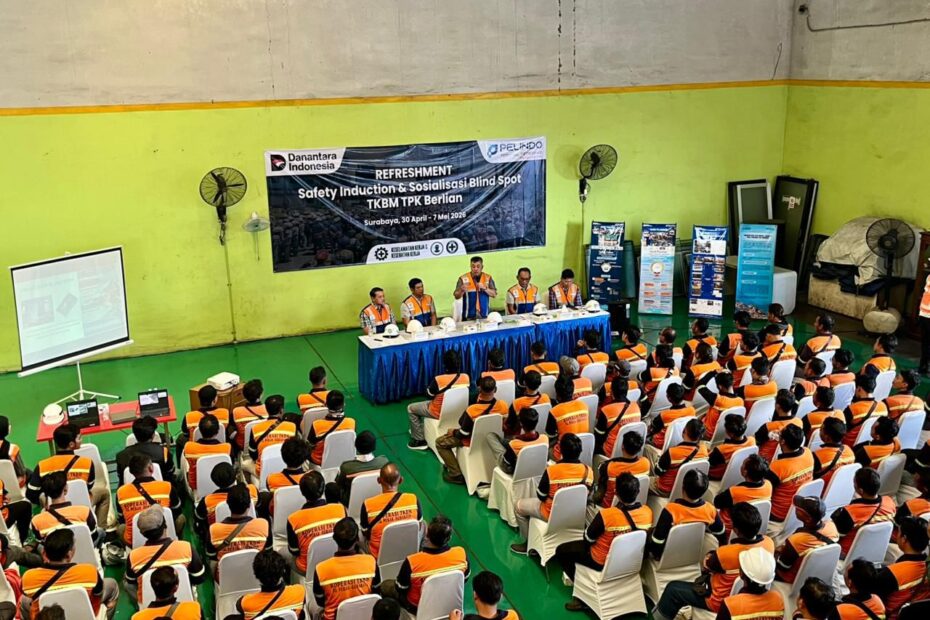
Container terminal operator TPK Berlian has conducted occupational safety and health (OHS) refresher training for 835 dockers/stevedoring workers (TKBM) at Tanjung Perak Port as part of efforts to strengthen safety standards in container loading and unloading operations.
The training program, held in six batches from April 30 to May 7, focused on improving workers’ understanding of safety procedures in high-risk operational areas at the port.
TPK Berlian Terminal Head Burhanudin said workplace safety must become part of daily work culture rather than merely fulfilling administrative requirements.
“In a terminal environment filled with heavy equipment and dynamic container flows, there is no room for compromise on safety procedures,” Burhanudin said during the training session.
He said consistency in following safety procedures and maintaining awareness of coworkers’ conditions were essential to creating a safe working environment.
“Our hope is that every worker comes to work enthusiastically and returns home healthy and safe,” he added.
The training was also attended by PT Pelabuhan Indonesia (Persero) President Director Achmad Muchtasyar, who emphasized the importance of protecting workers in port operations.
“The primary objective of this OHS refresher training is to ensure the safety of all workers in the port area for the sake of their families waiting at home,” Achmad said.
“For Pelindo, consistent implementation of OHS is a non-negotiable culture,” he added.
The program covered nine key points in the company’s Corporate Life Saving Rules (CLSR), including procedures for working in restricted areas, water safety requirements, handling dangerous goods, and the use of protective equipment for working at heights and in confined spaces.
Participants were also trained on Lock-Out-Tag-Out (LOTO) procedures used during equipment maintenance to prevent accidental activation of machinery.
The training further highlighted risks related to blind spots around heavy equipment such as reach stackers, rubber-tyred gantries (RTGs), and container trucks.
Through visual simulations, workers were instructed to follow pedestrian pathways, maintain safe distances from operating equipment, and avoid distractions such as mobile phones and earphones that could reduce awareness of alarms and field instructions.
Eko Iswahyuono, chairman of the Tanjung Perak Stevedoring Workers Cooperative, welcomed the program and said safety awareness among both equipment operators and field workers was critical to maintaining operational performance.
“We appreciate this safety induction and blind spot refresher program because shared understanding between operators and field workers is essential for collective safety,” Eko said.
TPK Berlian said the training was aimed not only at improving technical knowledge but also at strengthening a workplace culture focused on safety awareness and accident prevention.
The company said it remained committed to maintaining its “Zero Accident” target to support safe and reliable logistics operations at the port.