
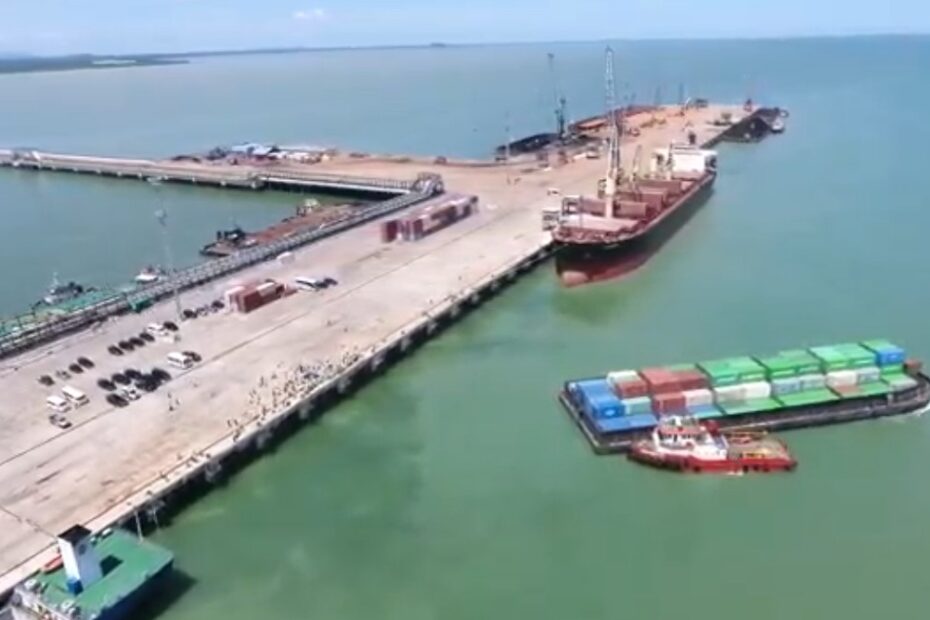
Pelindo inaugurated Terminal Kijing’s first container export service, improving West Kalimantan’s logistics connectivity, lowering transport costs, expanding market access, and supporting regional economic growth through international trade
PT Pelabuhan Indonesia (Pelindo) on Monday launched the first container export service from Terminal Kijing in West Kalimantan, marking a milestone in efforts to strengthen regional logistics connectivity and expand direct access to international markets.
The maiden voyage, operated by PT Pulau Laut Line, departed from Terminal Kijing in Mempawah Regency carrying export cargo bound for regional and international destinations. The service is expected to improve supply chain efficiency, reduce logistics costs and enhance the competitiveness of West Kalimantan’s export commodities.
The inaugural shipment comprised 180 twenty-foot equivalent unit (TEU) containers carrying alumina, coconut products and refined oil from exporters in the Kijing and Tayan industrial areas.
From Kijing, PT Borneo Alumina Indonesia exported 12 containers of alumina hydroxide to Pasir Gudang, Malaysia, while PT Unicoco Industries Indonesia shipped two containers of processed coconuts to the same destination. PT Ferrindo exported 10 containers of whole coconuts to Yangpu, China. From Tayan, PT Indonesia Chemical Alumina shipped 150 containers to South Korea, Japan and Taiwan.
The launch ceremony was attended by West Kalimantan Governor Ria Norsan, Mempawah Regent Erlina, Pelindo Commercial Director Farid Padang, Pelindo Regional 2 Executive Director Budi Prasetio, Pelindo Regional 2 Pontianak General Manager Yanto, government agencies and representatives from shipping companies and exporters.
Farid Padang said the launch represented an important step in expanding Pelindo’s logistics network and supporting economic growth in West Kalimantan.
“Today we are conducting our first export from Kijing Port, shipping 180 containers of alumina, coconut products and refined oil. We will continue expanding port capacity by deploying larger vessels, adding cranes and extending the berth,” Farid said.
West Kalimantan Governor Ria Norsan welcomed the launch, saying the provincial government would continue supporting the terminal’s development through investment facilitation, infrastructure improvements and streamlined licensing.
“We will continue improving road access to Terminal Kijing to support smoother logistics activities and strengthen West Kalimantan’s export competitiveness,” she said.
Budi Prasetio said the first export reflected collaboration among Pelindo, government agencies, shipping lines, exporters and other stakeholders to optimize the terminal’s operations.
Pelindo has also expanded operational readiness by providing container handling equipment and supporting facilities to improve service efficiency and reliability.
Yanto, General Manager of Pelindo Regional 2 Pontianak, said the direct export service allows exporters to ship goods without relying on ports outside West Kalimantan, reducing inland transportation costs and shortening delivery times.
The terminal currently offers direct services to Pasir Gudang, while cargo destined for China can be transshipped more efficiently through Malaysia, he said.
Growing Throughput
Terminal Kijing has recorded steady cargo growth since operations were managed by PTP Nonpetikemas. Throughput increased from 1.95 million tonnes in 2023 to 2.75 million tonnes in 2024 before reaching 4 million tonnes in 2025.
During the first quarter of 2026, the terminal handled approximately 1.5 million tonnes of cargo, consisting mainly of 845,000 tonnes of dry bulk and 662,000 tonnes of liquid bulk.
Dry bulk handling reached 223% of its performance target during the period, while liquid bulk achieved 168% and bag cargo reached 93%, reflecting increasing cargo activity and customer demand.
PTP Nonpetikemas President Director Indra Hidayat Sani said the company remained committed to providing safe, reliable and productive terminal operations.
“We continue to prioritize operational safety, service quality, modern equipment and workforce readiness to support efficient domestic and international logistics flows through Terminal Kijing,” Indra said.
Terminal Kijing is equipped with a 750-metre container berth capable of accommodating vessels of up to 100,000 deadweight tonnes (DWT), alongside dedicated multipurpose, liquid bulk and dry bulk berths.
Its facilities include container yards, an empty container depot, a container freight station, reefer facilities, integrated inspection areas and supporting infrastructure. Operations are supported by harbour mobile cranes, quay container cranes, reach stackers, forklifts, head trucks and other cargo-handling equipment.
Pelindo said the terminal is expected to play a larger role as a logistics gateway for West Kalimantan by supporting export growth, improving cargo distribution and strengthening Indonesia’s downstream industrial development.