
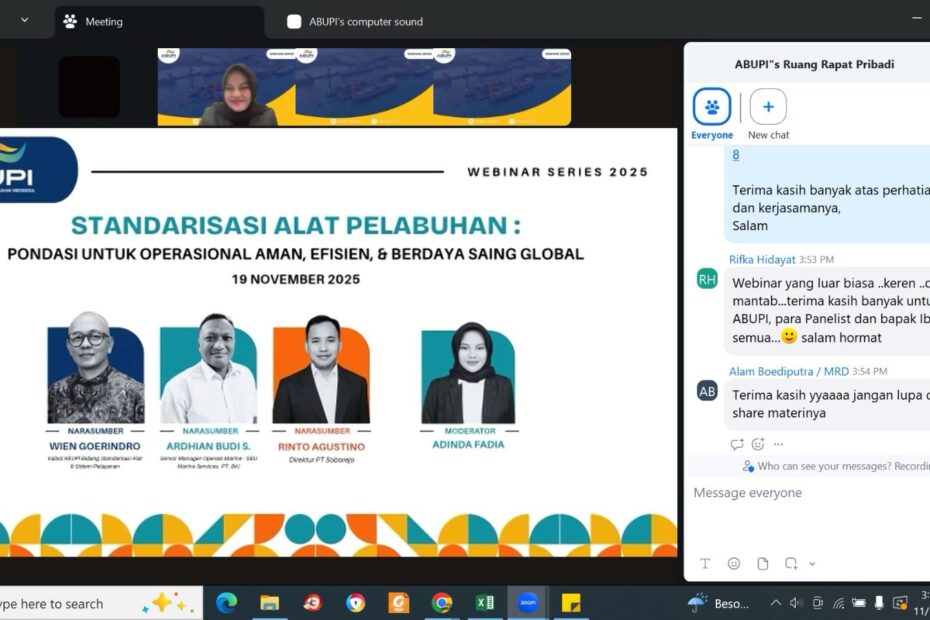
Indonesia’s port industry is once again turning its attention to safety, efficiency and competitiveness, with the Indonesian Port Business Association (ABUPI) placing equipment and infrastructure standardization at the centre of its strategic agenda.
In a webinar titled “Port Equipment Standardization: The Foundation for Safe, Efficient, and Competitive Operations,” ABUPI Deputy Chairman I, Ari Purboyo, said the country’s push to modernize port operations still faces persistent challenges. Variations in inspection standards, inconsistent equipment specifications and limited data integration among ports, he said, continue to create inefficiencies and raise accident risks.
“Without uniform standards, these disparities are no longer sustainable,” Ari told participants, who included ABUPI members and maritime industry stakeholders.
The discussion brought together three speakers representing technical, operational and industrial perspectives: Wien Goerindro, Head of ABUPI’s Shipping Equipment & Systems Standardization Division; Ardhian Budi Sulistyo, Senior Manager for Marine Operations at PT Biro Klasifikasi Indonesia (BKI); and Rinto Agustino, CEO of PT Soborejo.
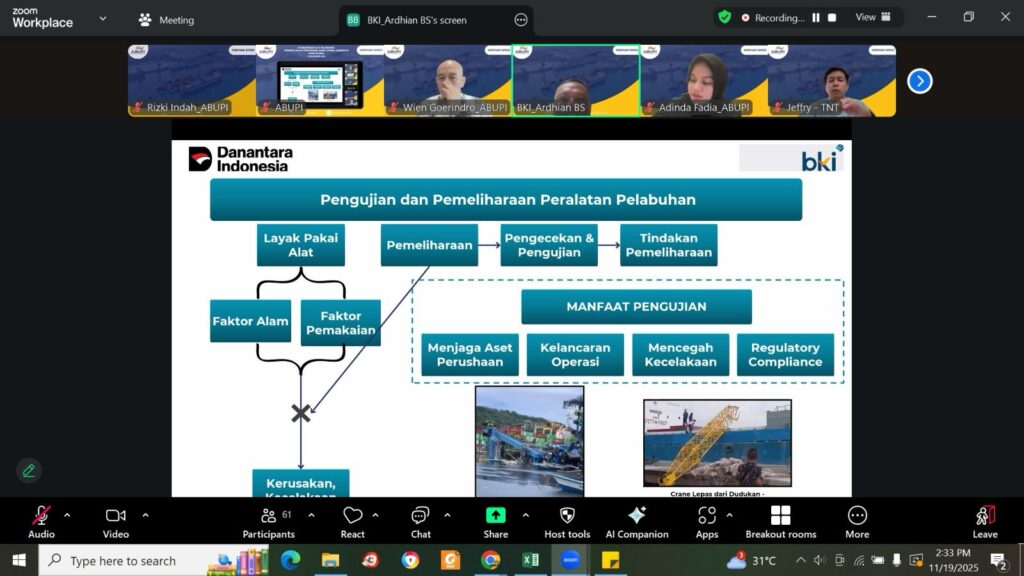
Wien said many Indonesian ports still rely on loading and unloading equipment with differing specifications, resulting in inconsistent service quality and potential operational disruptions. Dock infrastructure and standard operating procedures, he added, also require updates to meet international benchmarks. “Equipment and operational standards form the foundation of safe and efficient port services,” he said.
BKI’s Ardhian outlined the agency’s role in ensuring equipment and facility compliance. He said BKI uses visual inspections, load tests and non-destructive testing to assess structural integrity, with certification designed not only to meet regulatory requirements but also to strengthen operational safety. “The right testing instruments can reduce equipment failure and improve reliability,” he said.

Turning to infrastructure maintenance, Rinto stressed that dock deterioration is often caused not by ageing structures but by maintenance that fails to follow technical standards. Regular and planned maintenance, he said, is essential for infrastructure longevity and service reliability. “The issue is often not the construction itself, but how the infrastructure is maintained,” he said.
Speakers agreed that standardization should be seen not merely as a technical exercise but as a foundation for a safer and more competitive port ecosystem. Unified standards, they said, would reduce downtime, improve worker safety and offer greater operational certainty for both domestic and international users.
ABUPI said it will accelerate the development and adoption of equipment and service standards across Port Business Entities. The association expects the initiative to support Indonesia’s logistics competitiveness and strengthen the role of national ports in global supply chains.
The webinar underscored ABUPI’s commitment to improving operational quality as Indonesia works to modernize its port sector. With coordinated efforts among industry players, port operators and classification bodies, ABUPI aims to help drive the shift toward safer, more efficient and globally competitive port operations.