
The Indonesian National Shipowners’ Association (INSA) has expressed its support for the economic development initiatives under President Prabowo Subianto’s administration, particularly its vision for Golden Indonesia 2045. However, INSA also urges the government to introduce incentives that will accelerate growth within the shipping sector and create more opportunities for national companies (national shipping companies) to invest, particularly in transportation infrastructure, including ports.
As part of its efforts to realize the Golden Indonesia 2045 vision, the government has launched a series of key initiatives: eight missions (Asta Cita), 17 priority programs, and eight quick-win strategies. These programs aim to achieve national economic growth of 8% over the next five years, and include initiatives like providing free nutritious meals for children and pregnant women, promoting self-sufficiency in food, water, and energy, advancing the industrialization of natural resources, and building three million housing units.
Carmelita Hartoto, INSA Chairperson, emphasized the strategic importance of the maritime sector in achieving these national goals. “The shipping industry is integral to the government’s vision, particularly since one of its core missions focuses on maritime development,” she said.
Despite facing global economic instability, geopolitical uncertainties, and the ongoing climate crisis, Carmelita acknowledged the difficulties the government faces in meeting its ambitious targets. She stressed that the realization of these goals will require the collective effort of all sectors, including national shipping businesses represented by INSA.
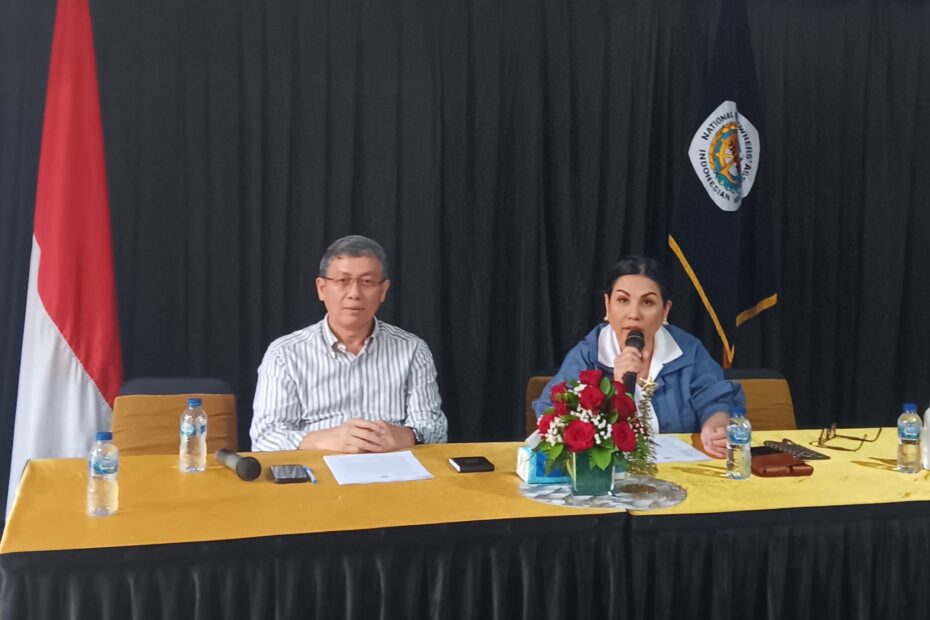
“Our members are committed to collaborating with the government to support the implementation of its strategic programs and the eight missions outlined in Asta Cita,” Carmelita stated in a press discussion on Wednesday, December 18.
Carmelita, who also serves as the Chair of the Federation of ASEAN Shipowners’ Associations (FASA) and President of the Asian Shipowners’ Association (ASA), highlighted that national shipping is a cornerstone of Indonesia’s logistics. The sector plays a vital role in improving regional connectivity, ensuring the efficient distribution of goods, and fostering economic equality through development in rural areas. Additionally, national shipping supports the continuation of downstreaming and industrialization by providing shipping services for raw materials to smelters in Indonesia.
“INSA is always ready to engage with the government to ensure that its strategic programs are effectively implemented,” Carmelita stated.
Addressing Challenges in the Shipping Sector
Despite its support, Carmelita pointed out several challenges facing the national shipping industry. One major issue is the taxation system, which diverges from international maritime standards and places an undue burden on national shipping companies. A particularly concerning example is the Motor Vehicle Fuel Tax (PBBKB), which imposes a 10% tax on fuel purchased for sea transportation, even though the fuel is already subject to an 11% Value-Added Tax (VAT).
“The double taxation is extremely burdensome for national shipping companies. We urge the government to abolish the PBBKB for sea transportation,” Carmelita said.
While sea transportation has significant potential to optimize existing infrastructure and align with government policies on improving connectivity and economic equality, the limited capacity of domestic shipyards remains a key constraint. This limitation in terms of ship types, technologies, and sizes hampers their global competitiveness. Carmelita called on the government to provide tax incentives and favorable bank interest rates to help domestic shipyards become more competitive.
Incentives for Shipyard Development
Carmelita further emphasized the need for targeted incentives to support the growth of Indonesia’s shipyards. She pointed to China’s model, where the government supports ship construction with an 80% down payment scheme, with the remaining 20% covered by the shipowner.
“If subsidies like those in China are not feasible, alternative support could include tax exemptions for ship components,” she suggested.
Currently, shipyards in Indonesia face significant challenges, including high import taxes on ship components, which makes domestic shipbuilding less competitive. As a result, ships built in Indonesia can cost up to 30% more than those produced abroad.
“We appreciate the government’s efforts to build a national shipyard, but as long as ship components and engines are not produced locally and tax incentives remain unavailable, it will be difficult to encourage shipyards to construct large and competitive vessels,” Carmelita stated.
Broader Opportunities in Port Investment
Carmelita also expressed concerns over unhealthy competition in the national shipping market, particularly the involvement of State-Owned Enterprises (BUMNs) in shipping activities outside their core business areas. She noted that BUMNs have been sourcing cargo from other BUMNs, which could distort the market balance.
“We want the national shipping industry to maintain a healthy and conducive business climate,” Carmelita emphasized. “Collaboration between national private shipping companies and BUMNs should be prioritized, with BUMNs transporting up to 70% of their cargo through national private companies. This will allow the private sector to thrive, driving economic growth and enabling further investment.”
Additionally, Carmelita called for greater involvement of national companies, including shipping firms, in port development. She emphasized the importance of ensuring that potential ports are not solely managed by BUMNs or foreign companies. While she welcomed foreign participation, she stressed that national companies must also be engaged.
“We cannot allow all potential ports to be managed exclusively by BUMNs or foreign entities. While foreign participation can encourage Main Liner Operators (MLOs) to provide services to Indonesia, it is crucial that our national companies are involved,” Carmelita explained.
She highlighted several emerging ports where national shipping lines could invest, such as NPCT2 and NPCT3 (New Priok Container Terminals 2 and 3), Kijing Port, Bitung Port, Kuala Tanjung, and other developing port facilities. “From a business perspective, these ports and terminals present significant opportunities. We hope national companies, including shipping lines, will be actively involved,” she recalled.