
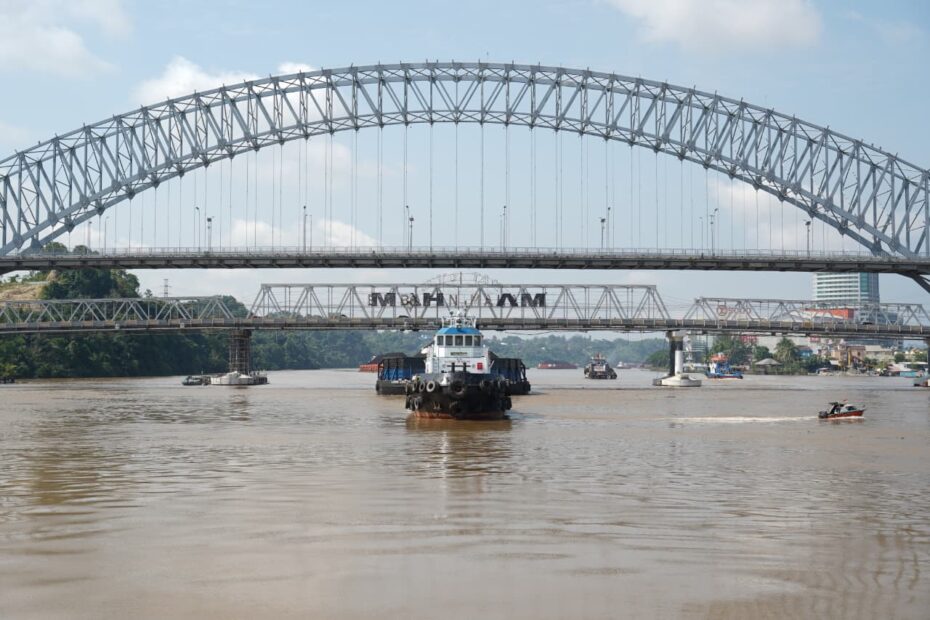
On the busy waters of East Kalimantan’s Mahakam River, where coal barges and cargo vessels thread their way beneath a series of low bridges, pilotage and towage service operator PT Pelindo Jasa Maritim is racing to keep traffic moving safely around the clock.
PT Pelindo Jasa Maritim (SPJM) Group, a subholding of PT Pelabuhan Indonesia (Persero), says it has stepped up operational readiness to support a new 24-hour navigation policy under bridges along the Mahakam, a key artery for industry in the region.
The policy, coordinated by the Samarinda Class I Harbormaster and Port Authority Office (KSOP) together with other government and shipping stakeholders, aims to ease congestion and strengthen safety oversight in one of Indonesia’s busiest inland waterways.
Previously, under-bridge navigation windows were limited to morning hours, creating bottlenecks as vessel traffic increased.
“As part of the Pelindo Group, which handles pilotage and towing activities in the Mahakam River, we welcome the government’s initiative to implement 24-hour navigation under the bridge as an alternative solution to ensure smooth operations and anticipate undesirable events,” said SPJM Director of Operations and Engineering Edward Napitupulu.
The Mahakam River is lined with vital infrastructure, including bridges connecting growing urban and industrial centers. Navigating large vessels through its narrower passages requires precise coordination between pilots, tugboats and traffic controllers.
To meet the expanded schedule, SPJM has restructured its operations. Under the previous arrangement, vessels passed beneath bridges between 6 a.m. and 10 a.m. local time. The new system doubles the movement slots, allowing two upstream and two downstream transits in each cycle.
Senior Manager for Region 4 Al Abrar said the company would reinforce manpower and equipment to support the change.
“In addition to refreshing existing personnel, we are adding 10 more pilots, bringing the total to 42, all equipped with the required skills, experience and certifications in line with regulations,” Abrar said. The company will also evaluate the performance of its tugboat fleet and deploy an additional escort tug to strengthen services in the Mahulu area, supplementing three existing assisted tugboats.
Beyond manpower and vessels, SPJM is investing in technology. The company has prepared an integrated Planning and Control (PnC) room and expanded Automatic Identification System (AIS) capacity to enable real-time monitoring of ship movements. It is also standardizing services, integrating occupational safety and health (HSSE) data, and enhancing transparency for service users.
The measures, Napitupulu said, are designed not only to reduce waiting times but to improve overall navigational safety in a river where tides, currents and bridge clearances leave little margin for error.
“These efforts must be carried out sustainably,” he said. “Considering that pilotage and towing activities prioritize the active participation of all parties in upholding navigational safety, support from all stakeholders is needed to ensure smooth vessel operations in the Mahakam River, so services become faster, safer, more efficient and more reliable.”
For a river that serves as a lifeline for East Kalimantan’s economy, the shift to 24-hour navigation marks a significant operational step, one that operators hope will keep trade flowing without compromising safety.