
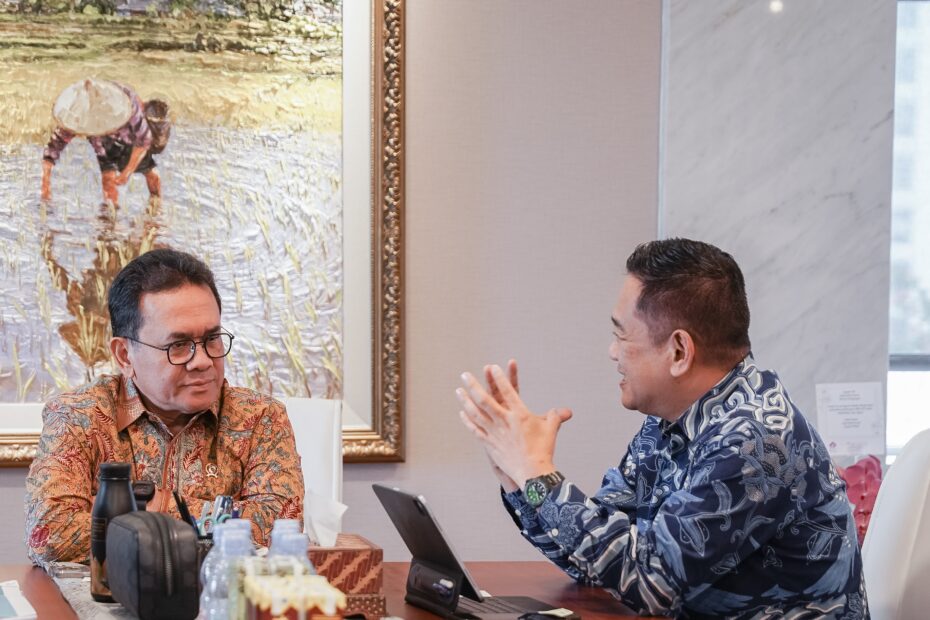
Photo: Akbar Johan (R) discussing with Trade Minister Budi Santoso
The Indonesian Logistics and Forwarders Association (ALFI) has responded positively to the government’s recent policy shift that eliminates import quotas and relaxes Domestic Component Level (TKDN) requirements.
According to ALFI Chairperson M. Akbar Djohan, this policy could stimulate growth in the national logistics sector, while also presenting certain challenges that must be addressed proactively.
“With the liberalization of imports, we expect a significant increase in the volume of goods entering Indonesia. This will directly boost activity in logistics services such as loading and unloading, transportation, and warehousing,” Akbar said during a press conference in Jakarta on Thursday (April 10, 2025).
He emphasized that the relaxation of TKDN regulations could ease the importation of components that are currently difficult to source domestically.
“Industries like automotive and electronics rely heavily on specialized parts that aren’t yet produced locally. This policy could help reduce logistics costs, as companies won’t have to resort to more expensive alternatives,” he explained.
Logistics Infrastructure Improvement
However, Akbar also cautioned that the anticipated surge in imports could strain existing logistics infrastructure.
“Our ports and airports already face congestion. Without strategic efforts to expand capacity, we risk container backlogs and shipping delays,” he warned.
He also voiced concern for smaller logistics players. “Local forwarders and logistics companies may struggle to compete with larger, foreign operators unless there’s sufficient policy protection and support,” he said.
To address these concerns, ALFI is urging the government to take a series of strategic steps. These include expanding port, airport, and land distribution infrastructure, providing incentives to local logistics operators, and fostering stronger integration with the manufacturing sector.
“There should be mentoring programs and accessible financing schemes for domestic logistics companies to enhance their competitiveness,” Akbar added.
Incentives for National Logistics Providers
Despite the challenges, Akbar remains optimistic. He believes that with the right balance of policy and support, the logistics sector can benefit significantly from this new direction.
“ALFI is committed to working closely with the government and key stakeholders to ensure a smooth transition. If managed properly, this policy could mark a turning point in enhancing Indonesia’s logistics performance on the global stage,” he said.
Akbar also highlighted the importance of financial support for Micro, Small, and Medium Enterprises (MSMEs) operating in logistics, particularly in light of global economic pressures such as the United States’ reciprocal tariff policy.
“MSMEs are currently burdened by rising operational costs. They need easier access to financing and more competitive interest rates to survive and grow,” he said.
He called on national banks, particularly members of the State Bank Association (Himbara), to proactively offer tailored financial solutions. These should include short-term working capital funding and long-term investment financing for technology and infrastructure.
“Programs like KUR (People’s Business Credit) with low-interest rates must be made more accessible. With solid banking support, logistics MSMEs can not only stay afloat but also thrive in global markets,” Akbar concluded.
The government’s move to eliminate import quotas is part of a broader economic strategy introduced by President Prabowo Subianto.
During the “Economic Discussion with the President of the Republic of Indonesia” event at Menara Mandiri in Jakarta on Tuesday (April 8, 2025), Prabowo argued that import quotas have often led to inequality and limited access for many business players within the national supply chain.